Gao Mengge, Zhao Xiaosu
Peking University People's Hospital, Peking University Institute of Hematology, National Clinical Research Center for Hematologic Disease, Beijing Key Laboratory of Hematopoietic Stem Cell Transplantation, Beijing, China.
Research Unit of Key Technique for Diagnosis and Treatments of Hematologic Malignancies, Chinese Academy of Medical Sciences, Beijing, China.
Front Immunol. 2024 Jul 16;15:1432651. doi: 10.3389/fimmu.2024.1432651. eCollection 2024.
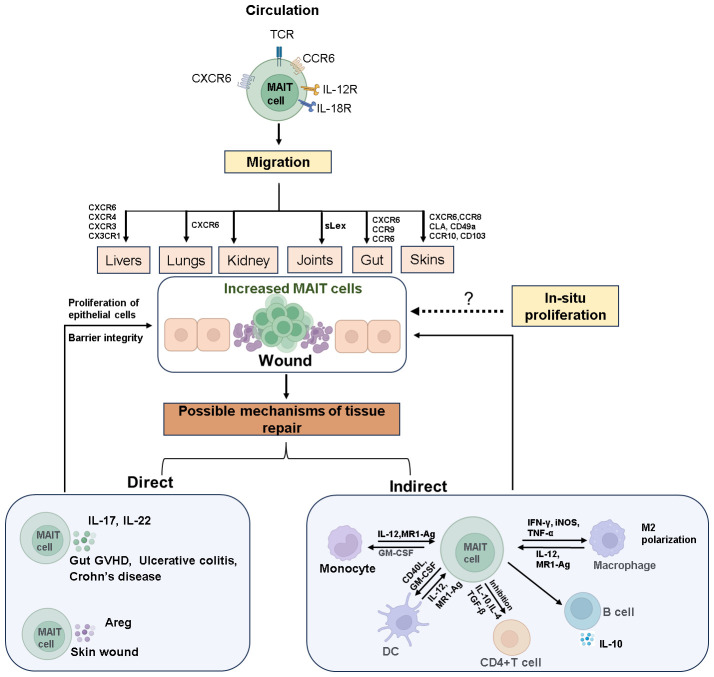
Mucosa-associated invariant T (MAIT) cells are a subset of innate-like non-conventional T cells characterized by multifunctionality. In addition to their well-recognized antimicrobial activity, increasing attention is being drawn towards their roles in tissue homeostasis and repair. However, the precise mechanisms underlying these functions remain incompletely understood and are still subject to ongoing exploration. Currently, it appears that the tissue localization of MAIT cells and the nature of the diseases or stimuli, whether acute or chronic, may induce a dynamic interplay between their pro-inflammatory and anti-inflammatory, or pathogenic and reparative functions. Therefore, elucidating the conditions and mechanisms of MAIT cells' reparative functions is crucial for fully maximizing their protective effects and advancing future MAIT-related therapies. In this review, we will comprehensively discuss the establishment and potential mechanisms of their tissue repair functions as well as the translational application prospects and current challenges in this field.
黏膜相关恒定T(MAIT)细胞是一类具有多功能特性的固有样非常规T细胞亚群。除了其广为人知的抗菌活性外,它们在组织稳态和修复中的作用也越来越受到关注。然而,这些功能背后的确切机制仍未完全明了,仍在不断探索中。目前看来,MAIT细胞的组织定位以及疾病或刺激的性质,无论是急性还是慢性,都可能诱导其促炎与抗炎或致病与修复功能之间的动态相互作用。因此,阐明MAIT细胞修复功能的条件和机制对于充分发挥其保护作用以及推进未来与MAIT相关的治疗至关重要。在这篇综述中,我们将全面讨论其组织修复功能的建立及潜在机制,以及该领域的转化应用前景和当前挑战。