
阿托品联合瑞芬太尼用于小儿急性阑尾炎手术的临床效果评价
Evaluation of the clinical effects of atropine in combination with remifentanil in children undergoing surgery for acute appendicitis.
作者信息
Li Yu-Juan, Chen Yong-Yan, Lin Xia-Lan, Zhang Wei-Zhi
机构信息
Department of Anesthesiology, Shanxi Provincial Children's Hospital, Taiyuan 030013, Shanxi Province, China.
出版信息
World J Gastrointest Surg. 2024 Jul 27;16(7):2065-2072. doi: 10.4240/wjgs.v16.i7.2065.
BACKGROUND
Acute appendicitis (AA) is the most common cause of acute abdomen in children. Anesthesia significantly influences the surgical treatment of AA in children, making the scientific and effective selection of anesthetics crucial.
AIM
To assess the clinical effect of atropine (ATR) in combination with remifentanil (REMI) in children undergoing surgery for AA.
METHODS
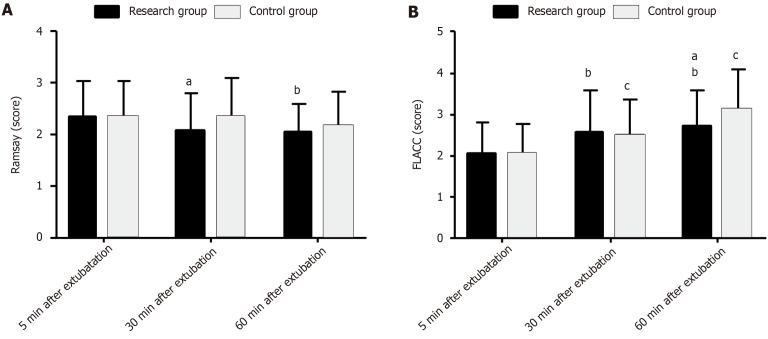
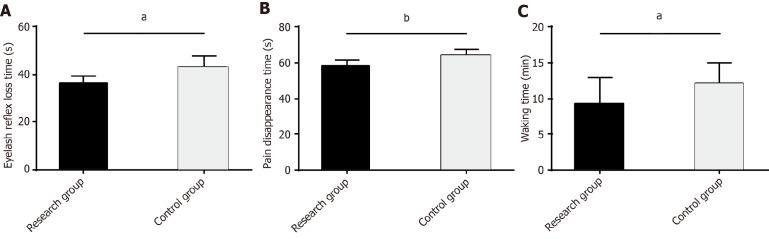
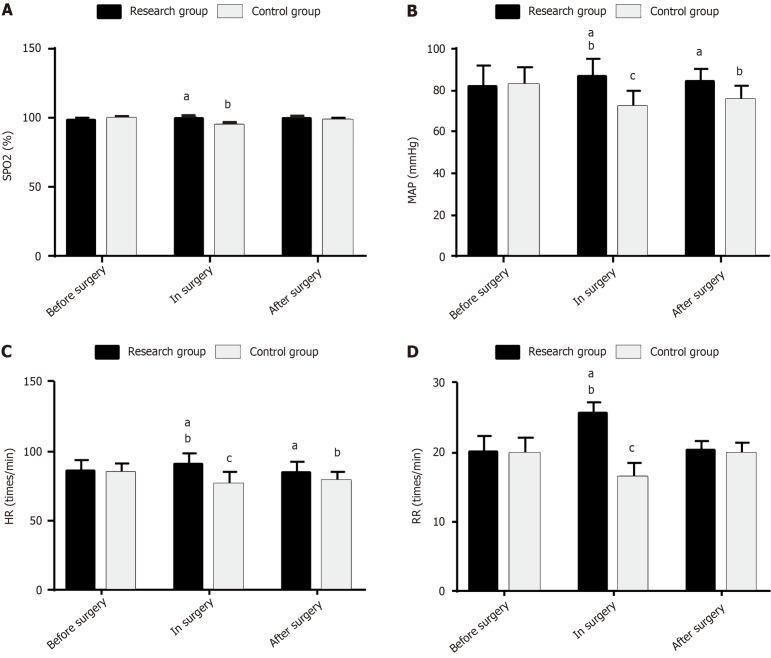
In total, 108 cases of pediatric AA treated between May 2020 and May 2023 were selected, 58 of which received ATR + REMI [research group (RG)] and 50 who received REMI [control group (CG)]. Comparative analyses were conducted on the time to loss of eyelash reflex, pain resolution time, recovery time from anesthesia, incidence of adverse events (AEs; respiratory depression, hypoxemia, bradycardia, nausea and vomiting, and hypotension), intraoperative responses (head shaking, limb activity, orientation recovery, safe departure time from the operating room), hemodynamic parameters [oxygen saturation (SPO), mean arterial pressure, heart rate, and respiratory rate], postoperative sedation score (Ramsay score), and pain level [the Face, Legs, Activity, Cry, Consolability (FLACC) Behavioral Scale].
RESULTS
Compared with the CG, the RG showed significantly shorter time to loss of eyelash reflex, pain resolution, recovery from anesthesia, and safe departure from the operating room. Furthermore, the incidence rates of overall AEs (head shaking, limb activity, ) were lower, and influences on intraoperative hemodynamic parameters and stress response indexes were fewer. The Ramsay score at 30 min after extubation and the FLACC score at 60 min after extubation were significantly lower in the RG than in the CG.
CONCLUSION
ATR + REMI is superior to REMI alone in children undergoing AA surgery, with a lower incidence of AEs, fewer influences on hemodynamics and stress responses, and better post-anesthesia recovery.
背景
急性阑尾炎(AA)是儿童急腹症最常见的病因。麻醉对儿童AA的外科治疗有显著影响,因此科学有效地选择麻醉剂至关重要。
目的
评估阿托品(ATR)联合瑞芬太尼(REMI)在儿童AA手术中的临床效果。
方法
选取2020年5月至2023年5月间接受治疗的108例小儿AA患者,其中58例接受ATR+REMI[研究组(RG)],50例接受REMI[对照组(CG)]。对睫毛反射消失时间、疼痛缓解时间、麻醉恢复时间、不良事件(AEs;呼吸抑制、低氧血症、心动过缓、恶心呕吐和低血压)发生率、术中反应(摇头、肢体活动、定向恢复、离开手术室的安全时间)、血流动力学参数[血氧饱和度(SPO)、平均动脉压、心率和呼吸频率]、术后镇静评分(Ramsay评分)和疼痛程度[面部、腿部、活动、哭闹、安慰(FLACC)行为量表]进行比较分析。
结果
与CG相比,RG的睫毛反射消失时间、疼痛缓解时间、麻醉恢复时间和离开手术室的安全时间明显更短。此外,总体AEs(摇头、肢体活动等)的发生率更低,对术中血流动力学参数和应激反应指标的影响更小。RG拔管后30分钟的Ramsay评分和拔管后60分钟的FLACC评分明显低于CG。
结论
在接受AA手术的儿童中,ATR+REMI优于单独使用REMI,不良事件发生率更低,对血流动力学和应激反应的影响更小,麻醉后恢复更好。
 Zotero 插件