Ha Albert S, Scott Michael, Zhang Chiyuan Amy, Li Shufeng, Langroudi Ashkan P, Glover Frank, Basran Satvir, Del Giudice Francesco, Shaw Gary M, Eisenberg Michael L
Department of Urology, School of Medicine, Stanford University, Stanford, California.
Gangarosa Department of Environmental Health, Rollins School of Public Health, Emory University, Atlanta, Georgia.
JAMA Netw Open. 2024 Aug 1;7(8):e2425269. doi: 10.1001/jamanetworkopen.2024.25269.
The age of fathers at childbirth is rising, with an increasing number of births attributed to older fathers. While the impact of advanced paternal age has been documented, sociodemographic data about fathers aged 50 years and older remain scarce.
To explore sociodemographic and temporal trends among the oldest US fathers (age ≥50 years) and their associations with perinatal outcomes.
DESIGN, SETTING, AND PARTICIPANTS: This retrospective cross-sectional study included data from all US births from 2011 to 2022 using the National Vital Statistics System. Data were analyzed from August 2023 and May 2024.
Reported paternal age at childbirth.
Outcomes of interest were sociodemographic factors, temporal trends in older fatherhood, and perinatal outcomes, including preterm birth, low birth weight, gestational diabetes, gestational hypertension, assisted reproductive technology (ART), rates of maternal primiparity, and the infant sex ratio.
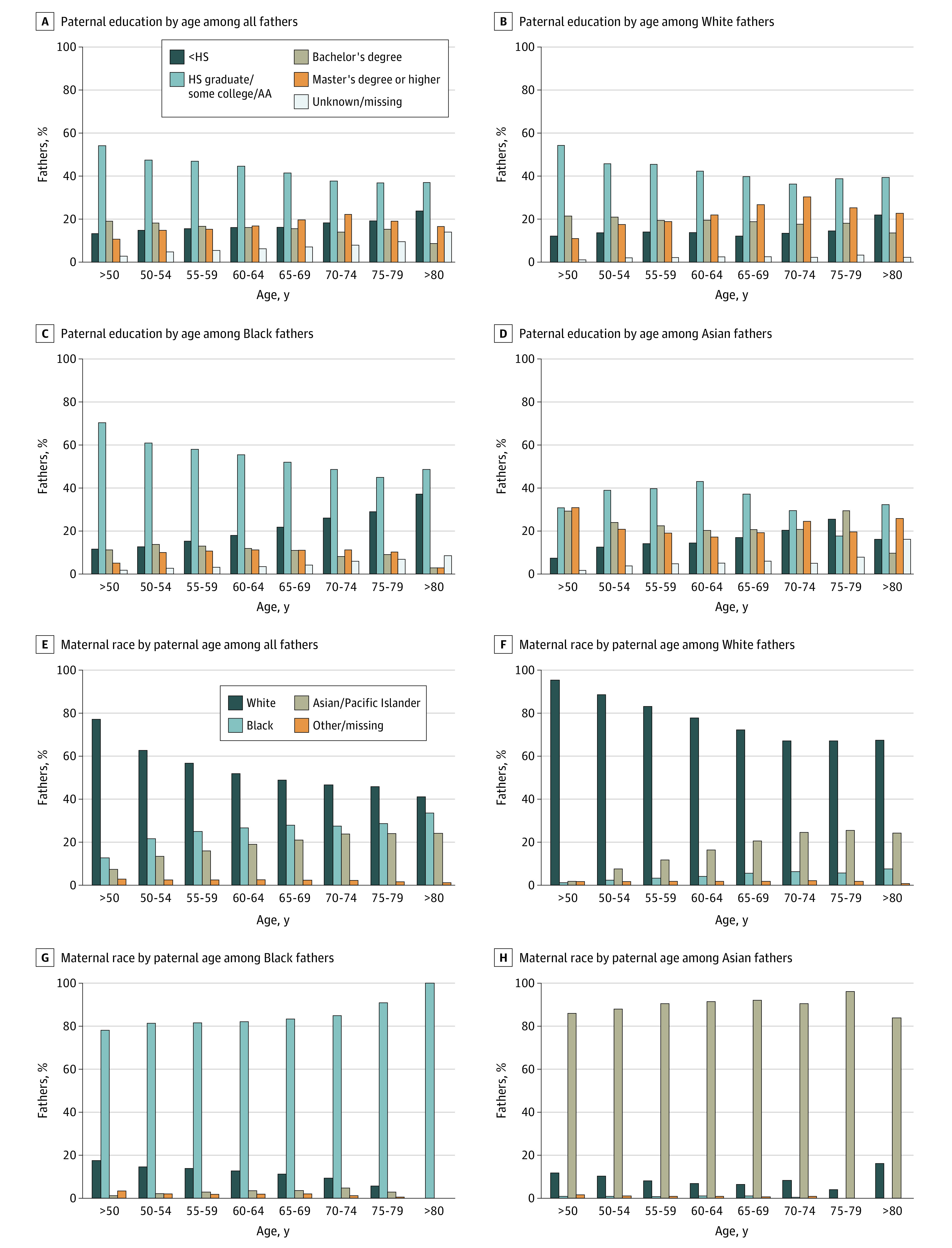
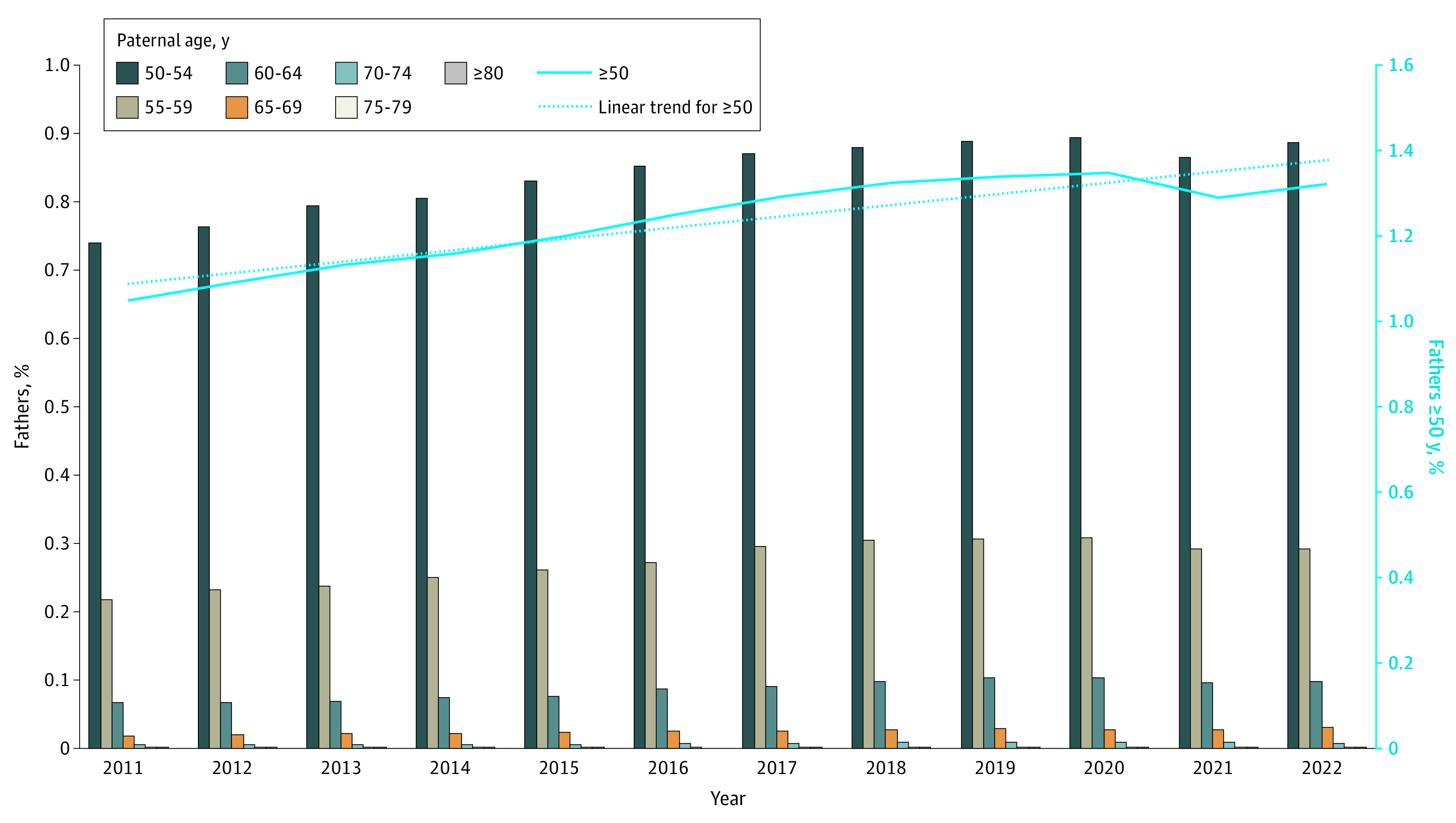
From 2011 to 2022, the US recorded 46 195 453 births, with an overall mean (SD) paternal age of 31.5 (6.8) years and 484 507 (1.1%) involving fathers aged 50 years or older, 47 785 (0.1%) aged 60 years or older, and 3777 (0.008%) aged 70 years or older. Births to fathers aged 50 years or older increased from 1.1% in 2011 to 1.3% in 2022 (P for trend < .001). Fathers aged 50 years or older were more diverse, with variations in educational achievement and race and ethnicity. Marital status and maternal racial and ethnic and educational backgrounds also varied by paternal age and race. Despite controlling for maternal age and other sociodemographic and perinatal factors, every 10-year increase in paternal age was consistently associated with greater use of ART (eg, age 50-59 years: adjusted odds ratio [aOR], 2.23; 95% CI, 2.19-2.27), higher likelihood of first maternal birth (eg, age 50-59 years: aOR, 1.16; 95% CI, 1.15-1.17), and increased risks of preterm birth (eg, age 50-59 years: aOR, 1.16; 95% CI, 1.15-1.18) and low birth weight (eg, age 50-59 years: aOR, 1.14; 95% CI, 1.13-1.15) compared with fathers aged 30 to 39 years. No significant changes in the infant sex ratio were observed, except among fathers aged 70 years or older (aOR, 0.92; 95% CI, 0.86-0.99) and 75 years or older (aOR, 0.84; 95% CI, 0.73-0.97), who showed a decreased likelihood of having male offspring.
In this cross-sectional study of all US births from 2011 to 2022, the percentage attributed to older fathers, while small, increased. Notable variations in paternal and maternal race and education were identified. Older fatherhood was associated with increased ART use, first-time maternal births, adverse perinatal outcomes, and altered sex ratio. Further research of this population is crucial for improving patient counseling and family planning.
分娩时父亲的年龄在上升,归因于年长父亲的出生数量越来越多。虽然高龄父亲的影响已有记录,但关于50岁及以上父亲的社会人口统计学数据仍然稀缺。
探讨美国年龄最大的父亲(年龄≥50岁)的社会人口统计学和时间趋势及其与围产期结局的关联。
设计、设置和参与者:这项回顾性横断面研究使用国家生命统计系统纳入了2011年至2022年美国所有出生的数据。数据于2023年8月至2024年5月进行分析。
报告的分娩时父亲年龄。
感兴趣的结局是社会人口统计学因素、年长父亲身份的时间趋势以及围产期结局,包括早产、低出生体重、妊娠期糖尿病、妊娠期高血压、辅助生殖技术(ART)、初产妇比例以及婴儿性别比。
2011年至2022年,美国记录了46195453例出生,父亲的总体平均(标准差)年龄为31.5(6.8)岁,其中484507例(1.1%)父亲年龄在50岁及以上,47785例(0.1%)年龄在60岁及以上,3777例(0.008%)年龄在70岁及以上。50岁及以上父亲的分娩数量从2011年的1.1%增加到2022年的1.3%(趋势P<0.001)。50岁及以上的父亲更加多样化,在教育程度、种族和族裔方面存在差异。婚姻状况以及母亲的种族、族裔和教育背景也因父亲年龄和种族而异。尽管对母亲年龄以及其他社会人口统计学和围产期因素进行了控制,但父亲年龄每增加10岁,始终与更多地使用ART相关(例如,50 - 59岁:调整后的优势比[aOR],2.23;95%置信区间[CI],2.19 - 2.27),母亲首次生育的可能性更高(例如,50 - 59岁:aOR,1.16;95% CI,1.15 - 1.17),并且与30至39岁的父亲相比,早产(例如,50 - 59岁:aOR,1.16;95% CI,1.15 - 1.18)和低出生体重(例如,50 - 59岁:aOR,1.14;95% CI,1.13 - 1.15)的风险增加。除了70岁及以上(aOR,0.92;95% CI,0.86 - 0.99)和75岁及以上(aOR,0.84;95% CI,0.73 - 0.97)的父亲,其生育男性后代的可能性降低外,未观察到婴儿性别比有显著变化。
在这项对2011年至2022年美国所有出生的横断面研究中,归因于年长父亲的百分比虽小但有所增加。确定了父亲和母亲在种族和教育方面的显著差异。年长父亲身份与ART使用增加、母亲首次生育、不良围产期结局以及性别比改变相关。对这一人群的进一步研究对于改善患者咨询和计划生育至关重要。