Illibauer Jennifer, Clodi-Seitz Tamara, Zoufaly Alexander, Aberle Judith H, Weninger Wolfgang J, Foedinger Manuela, Elsayad Kareem
Division of Anatomy, Center for Anatomy & Cell Biology, Medical University of Vienna, Vienna A-1090, Austria.
Medical Imaging Cluster, Medical University of Vienna, Vienna A-1090, Austria.
Proc Natl Acad Sci U S A. 2024 Aug 13;121(33):e2323016121. doi: 10.1073/pnas.2323016121. Epub 2024 Aug 1.
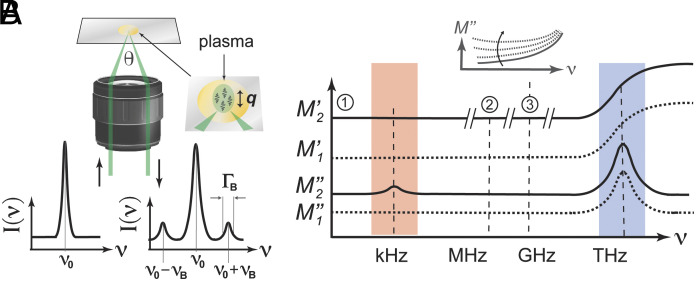
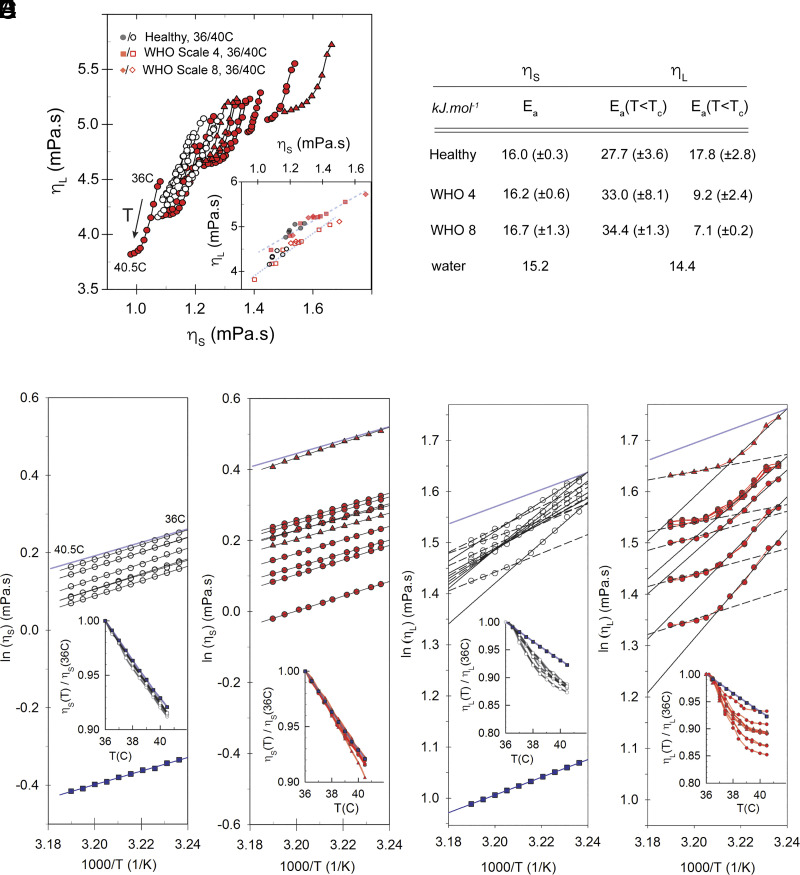
Blood plasma viscosity (PV) is an established biomarker for numerous diseases. Measurement of the shear PV using conventional rheological techniques is, however, time consuming and requires significant plasma volumes. Here, we show that Brillouin light scattering (BLS) and angle-resolved spectroscopy measurements of the longitudinal PV from microliter-sized plasma volumes can serve as a proxy for the shear PV measured using conventional viscometers. This is not trivial given the distinct frequency regime probed and the longitudinal viscosity, a combination of the shear and bulk viscosity, representing a unique material property on account of the latter. We demonstrate this for plasma from healthy persons and patients suffering from different severities of COVID-19 (CoV), which has been associated with an increased shear PV. We further show that the additional information contained in the BLS-measured effective longitudinal PV and its temperature scaling can provide unique insight into the chemical constituents and physical properties of plasma that can be of diagnostic value. In particular, we find that changes in the effective longitudinal viscosity are consistent with an increased suspension concentration in CoV patient samples at elevated temperatures that is correlated with disease severity and progression. This is supported by results from rapid BLS spatial-mapping, angle-resolved BLS measurements, changes in the elastic scattering, and anomalies in the temperature scaling of the shear viscosity. Finally, we introduce a compact BLS probe to rapidly perform measurements in plastic transport tubes. Our results open a broad avenue for PV diagnostics based on the high-frequency effective longitudinal PV and show that BLS can provide a means for its implementation.
血浆粘度(PV)是多种疾病公认的生物标志物。然而,使用传统流变技术测量剪切PV耗时且需要大量血浆。在此,我们表明,利用布里渊光散射(BLS)和对微升大小血浆体积的纵向PV进行角分辨光谱测量,可以替代使用传统粘度计测量的剪切PV。鉴于所探测的不同频率范围以及纵向粘度(剪切粘度和体粘度的组合),这并非易事,因为后者赋予了纵向粘度独特的材料特性。我们针对健康人和患有不同严重程度新冠病毒病(CoV)的患者的血浆进行了验证,新冠病毒病与剪切PV升高有关。我们进一步表明,BLS测量的有效纵向PV中包含的额外信息及其温度标度,可以为血浆的化学成分和物理性质提供独特见解,具有诊断价值。特别是,我们发现有效纵向粘度的变化与高温下CoV患者样本中悬浮液浓度增加一致,且与疾病严重程度和进展相关。快速BLS空间映射、角分辨BLS测量、弹性散射变化以及剪切粘度温度标度异常的结果支持了这一点。最后,我们引入了一种紧凑型BLS探头,以便在塑料传输管中快速进行测量。我们的结果为基于高频有效纵向PV的PV诊断开辟了一条广阔的道路,并表明BLS可以提供实现这一目标的手段。