Jaume Guillaume, de Brot Simone, Song Andrew H, Williamson Drew F K, Oldenburg Lukas, Zhang Andrew, Chen Richard J, Asin Javier, Blatter Sohvi, Dettwiler Martina, Goepfert Christine, Grau-Roma Llorenç, Soto Sara, Keller Stefan M, Rottenberg Sven, Del-Pozo Jorge, Pettit Rowland, Le Long Phi, Mahmood Faisal
Department of Pathology, Brigham and Women's Hospital, Harvard Medical School, Boston, MA.
Department of Pathology, Massachusetts General Hospital, Harvard Medical School, Boston, MA.
bioRxiv. 2024 Jul 23:2024.07.20.604430. doi: 10.1101/2024.07.20.604430.
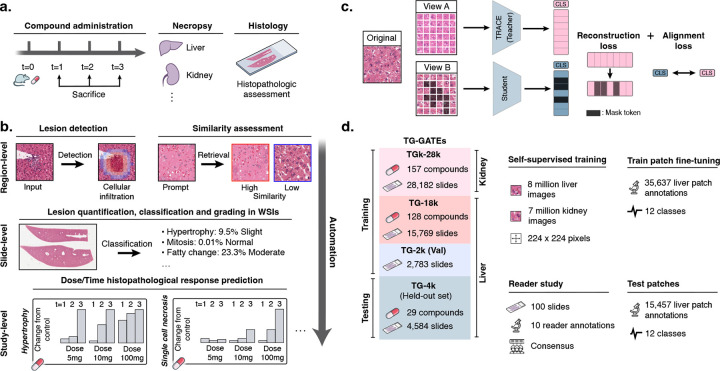
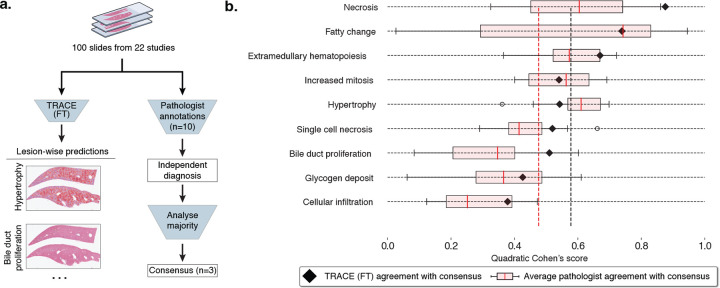
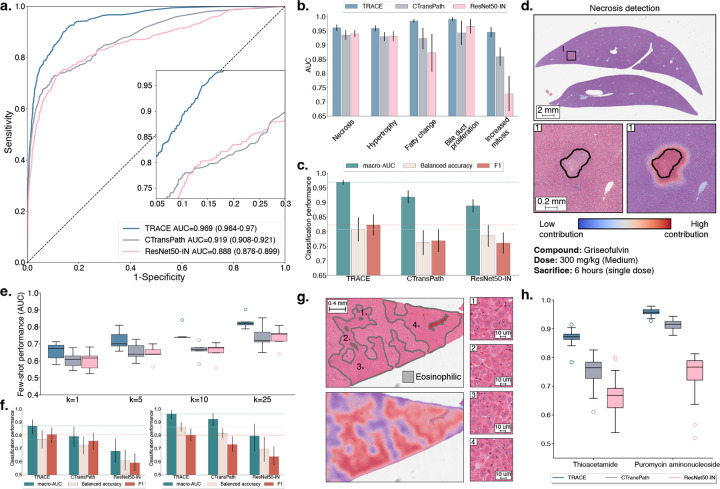
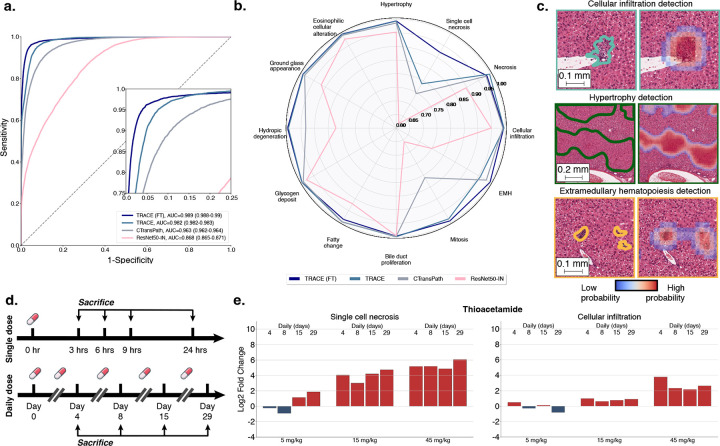
In drug development, assessing the toxicity of candidate compounds is crucial for successfully transitioning from preclinical research to early-stage clinical trials. Drug safety is typically assessed using animal models with a manual histopathological examination of tissue sections to characterize the dose-response relationship of the compound - a time-intensive process prone to inter-observer variability and predominantly involving tedious review of cases without abnormalities. Artificial intelligence (AI) methods in pathology hold promise to accelerate this assessment and enhance reproducibility and objectivity. Here, we introduce TRACE, a model designed for toxicologic liver histopathology assessment capable of tackling a range of diagnostic tasks across multiple scales, including situations where labeled data is limited. TRACE was trained on 15 million histopathology images extracted from 46,734 digitized tissue sections from 157 preclinical studies conducted on . We show that TRACE can perform various downstream toxicology tasks spanning histopathological response assessment, lesion severity scoring, morphological retrieval, and automatic dose-response characterization. In an independent reader study, TRACE was evaluated alongside ten board-certified veterinary pathologists and achieved higher concordance with the consensus opinion than the average of the pathologists. Our study represents a substantial leap over existing computational models in toxicology by offering the first framework for accelerating and automating toxicological pathology assessment, promoting significant progress with faster, more consistent, and reliable diagnostic processes.
在药物研发中,评估候选化合物的毒性对于从临床前研究成功过渡到早期临床试验至关重要。药物安全性通常通过动物模型进行评估,并对组织切片进行手动组织病理学检查,以确定化合物的剂量反应关系——这是一个耗时的过程,容易出现观察者间的差异,并且主要涉及对无异常病例的繁琐审查。病理学中的人工智能(AI)方法有望加速这一评估,并提高可重复性和客观性。在这里,我们介绍TRACE,这是一种为毒理学肝脏组织病理学评估设计的模型,能够处理跨多个尺度的一系列诊断任务,包括标记数据有限的情况。TRACE在从157项临床前研究的46,734个数字化组织切片中提取的1500万张组织病理学图像上进行了训练。我们表明,TRACE可以执行各种下游毒理学任务,包括组织病理学反应评估、病变严重程度评分、形态学检索和自动剂量反应表征。在一项独立的读者研究中,TRACE与十位获得董事会认证的兽医病理学家一起进行了评估,与共识意见的一致性高于病理学家的平均水平。我们的研究代表了毒理学现有计算模型的重大飞跃,提供了第一个加速和自动化毒理学病理学评估的框架,通过更快、更一致和可靠的诊断过程推动了重大进展。