Keahi Danielle L, Sanders Mathijs A, Paul Matthew R, Webster Andrew L H, Fang Yin, Wiley Tom F, Shalaby Samer, Carroll Thomas S, Chandrasekharappa Settara C, Sandoval-Garcia Carolina, MacMillan Margaret L, Wagner John E, Hatten Mary E, Smogorzewska Agata
Laboratory of Genome Maintenance, The Rockefeller University, New York, NY, USA.
Cancer, Ageing and Somatic Mutation (CASM), Wellcome Sanger Institute, Hinxton, UK.
bioRxiv. 2024 Jul 22:2024.07.20.604431. doi: 10.1101/2024.07.20.604431.
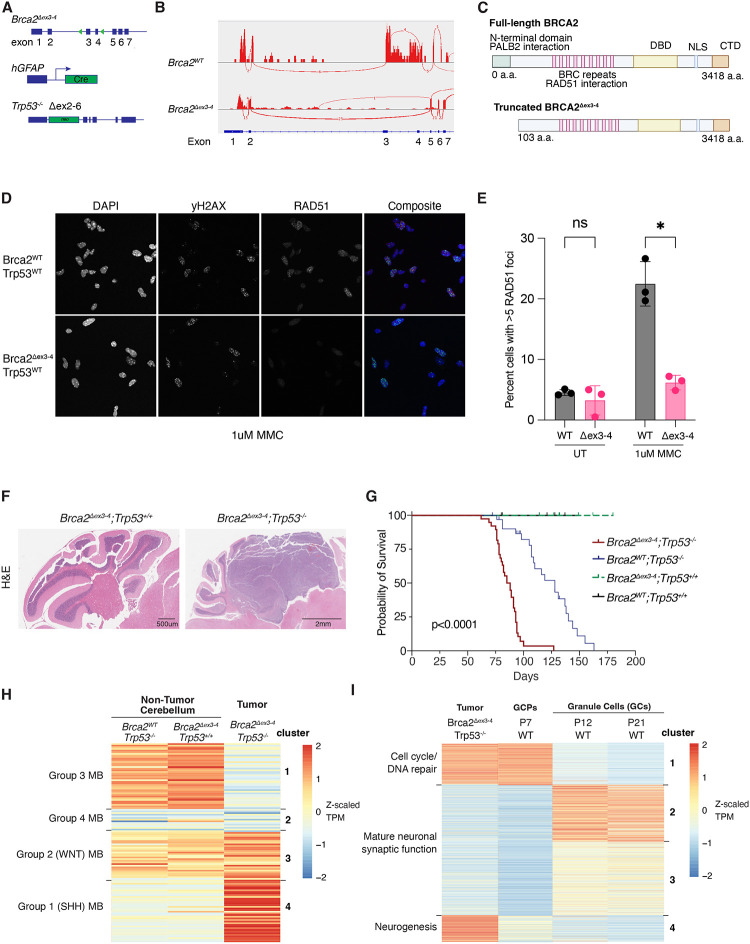
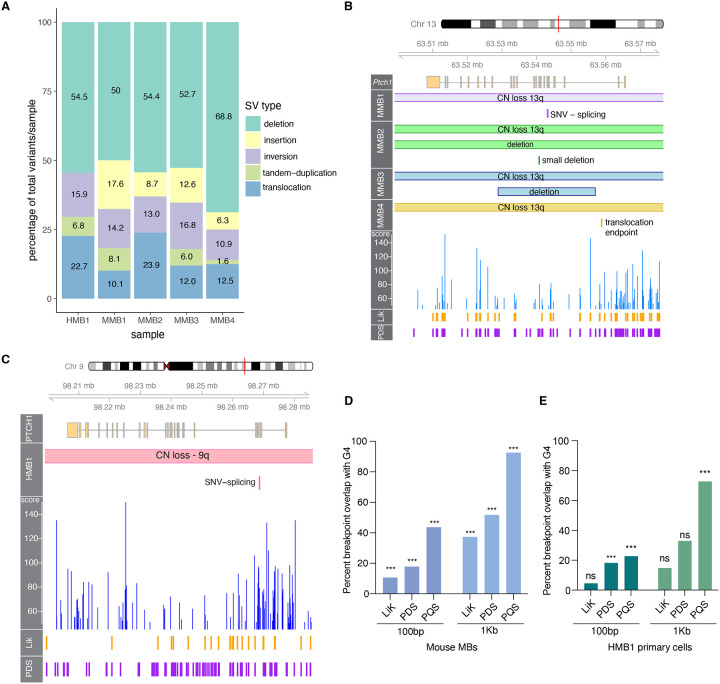
Biallelic pathogenic variants in the essential DNA repair gene causes Fanconi anemia, complementation group FA-D1. Patients in this group are highly prone to develop embryonal tumors, most commonly medulloblastoma arising from the cerebellar granule cell progenitors (GCPs). GCPs undergo high proliferation in the postnatal cerebellum under SHH activation, but the type of DNA lesions that require the function of the BRCA2 to prevent tumorigenesis remains unknown. To identify such lesions, we assessed both GCP neurodevelopment and tumor formation using a mouse model with deletion of exons three and four of in the central nervous system, coupled with global loss. animals developed SHH subgroup medulloblastomas with complete penetrance. Whole-genome sequencing of the tumors identified structural variants with breakpoints enriched in areas overlapping G-quadruplexes (G4s). -deficient GCPs exhibited decreased replication speed in the presence of the G4-stabilizer pyridostatin. helicase, which resolves G4s during replication, was highly upregulated in tumors, and knockout in primary MB tumor cells resulted in increased genome instability upon pyridostatin treatment. These data suggest that G4s may represent sites prone to replication stalling in highly proliferative GCPs and without BRCA2, G4s become a source of genome instability. Tumor cells upregulate G4-resolving helicases to facilitate rapid proliferation through G4s highlighting PIF1 helicase as a potential therapeutic target for treatment of -deficient medulloblastomas.
必需DNA修复基因中的双等位基因致病变异导致范可尼贫血,互补组FA - D1。该组患者极易发生胚胎性肿瘤,最常见的是起源于小脑颗粒细胞祖细胞(GCPs)的髓母细胞瘤。在SHH激活下,GCPs在出生后的小脑中经历高度增殖,但需要BRCA2功能来预防肿瘤发生的DNA损伤类型仍然未知。为了识别此类损伤,我们使用在中枢神经系统中缺失外显子3和4且伴有全基因组缺失的小鼠模型,评估了GCP的神经发育和肿瘤形成。动物发生了完全显性的SHH亚组髓母细胞瘤。对肿瘤进行全基因组测序发现,结构变异的断点在与G - 四链体(G4s)重叠的区域富集。在存在G4稳定剂吡啶抑制素的情况下,缺乏BRCA2的GCPs复制速度降低。在复制过程中解析G4s的解旋酶在肿瘤中高度上调,并且在原发性髓母细胞瘤细胞中敲除该解旋酶会导致在吡啶抑制素处理后基因组不稳定性增加。这些数据表明,G4s可能代表在高度增殖的GCPs中易于发生复制停滞的位点,并且在没有BRCA2的情况下,G4s成为基因组不稳定性的一个来源。肿瘤细胞上调G4解旋酶以促进通过G4s的快速增殖,突出了PIF1解旋酶作为治疗缺乏BRCA2的髓母细胞瘤的潜在治疗靶点。