Weinreich Marcel, McDonough Harry, Yacovzada Nancy, Magen Iddo, Cohen Yahel, Harvey Calum, Gornall Sarah, Boddy Sarah, Alix James, Mohseni Nima, Kurz Julian M, Kenna Kevin P, Zhang Sai, Iacoangeli Alfredo, Al-Khleifat Ahmad, Snyder Michael P, Hobson Esther, Al-Chalabi Ammar, Hornstein Eran, Elhaik Eran, Shaw Pamela J, McDermott Christopher, Cooper-Knock Johnathan
Sheffield Institute for Translational Neuroscience (SITraN), University of Sheffield, UK.
Department of Clinical Neurobiology at the German Cancer Research Center (DKFZ) and the Medical Faculty of the Heidelberg University, Heidelberg, Germany.
bioRxiv. 2024 Jul 23:2024.07.20.604416. doi: 10.1101/2024.07.20.604416.
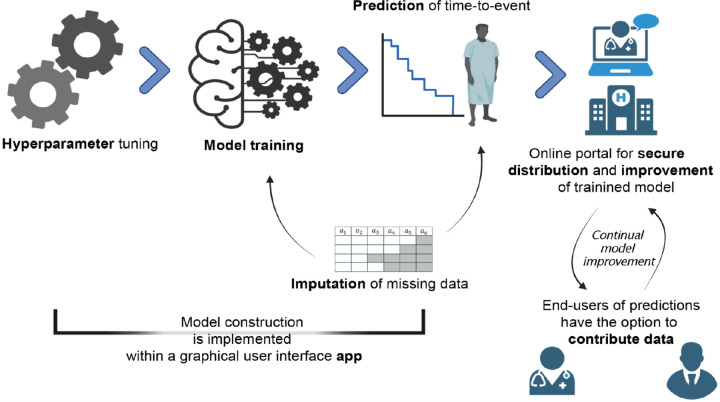
Time-to-event prediction is a key task for biological discovery, experimental medicine, and clinical care. This is particularly true for neurological diseases where development of reliable biomarkers is often limited by difficulty visualising and sampling relevant cell and molecular pathobiology. To date, much work has relied on Cox regression because of ease-of-use, despite evidence that this model includes incorrect assumptions. We have implemented a set of deep learning and spline models for time-to-event modelling within a fully customizable 'app' and accompanying online portal, both of which can be used for any time-to-event analysis in any disease by a non-expert user. Our online portal includes capacity for end-users including patients, Neurology clinicians, and researchers, to access and perform predictions using a trained model, and to contribute new data for model improvement, all within a data-secure environment. We demonstrate a pipeline for use of our app with three use-cases including imputation of missing data, hyperparameter tuning, model training and independent validation. We show that predictions are optimal for use in downstream applications such as genetic discovery, biomarker interpretation, and personalised choice of medication. We demonstrate the efficiency of an ensemble configuration, including focused training of a deep learning model. We have optimised a pipeline for imputation of missing data in combination with time-to-event prediction models. Overall, we provide a powerful and accessible tool to develop, access and share time-to-event prediction models; all software and tutorials are available at www.predictte.org.
事件发生时间预测是生物学发现、实验医学和临床护理中的一项关键任务。对于神经疾病而言尤其如此,在神经疾病中,可靠生物标志物的开发常常受到难以可视化和采样相关细胞及分子病理生物学的限制。迄今为止,尽管有证据表明Cox回归模型包含不正确的假设,但由于其易用性,许多工作仍依赖于该模型。我们在一个完全可定制的“应用程序”及配套的在线门户网站中实现了一组用于事件发生时间建模的深度学习和样条模型,非专业用户可将其用于任何疾病的任何事件发生时间分析。我们的在线门户网站使包括患者、神经科临床医生和研究人员在内的终端用户能够在数据安全的环境中,使用经过训练的模型进行访问和预测,并为模型改进贡献新数据。我们展示了一个将我们的应用程序用于三个用例的流程,包括缺失数据插补、超参数调整、模型训练和独立验证。我们表明,这些预测在诸如基因发现、生物标志物解读和个性化用药选择等下游应用中使用效果最佳。我们展示了一种集成配置的效率,包括对深度学习模型进行重点训练。我们优化了一个结合事件发生时间预测模型进行缺失数据插补的流程。总体而言,我们提供了一个强大且易于使用的工具,用于开发、访问和共享事件发生时间预测模型;所有软件和教程均可在www.predictte.org上获取。