Fondation AUB Santé, Lorient, France.
Faculty of Medicine, Saint-Joseph University of Beirut, Beirut, Lebanon.
Kidney360. 2024 Sep 1;5(9):1311-1321. doi: 10.34067/KID.0000000000000532. Epub 2024 Aug 2.
A negative change in serum sodium during a dialysis session is an independent factor associated with prolonged dialysis recovery time. Lower hemoglobin is an independent factor associated with fatigue in hemodialysis patients. Hemodiafiltration use in patients age ≥85 years is associated with a longer dialysis recovery time.
Dialysis recovery time (DRT) and fatigue are two important patient-reported outcomes that highly affect hemodialysis patients' well-being and survival. This study aimed to identify all modifiable dialysis-related factors, associated with DRT and fatigue, that could be addressed in future clinical trials.
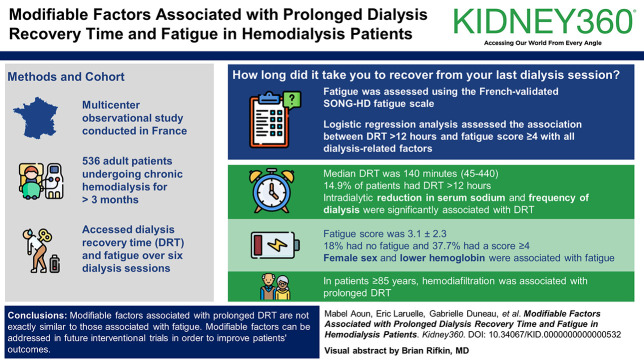
This multicenter observational study included adult patients, undergoing chronic hemodialysis for >3 months during December 2023. Patients admitted to hospital, with cognitive problems or active cancer were excluded. DRT was determined by asking over six sessions: Fatigue was assessed using the French-validated Standardized Outcomes in Nephrology-Hemodialysis fatigue scale. Logistic regression analysis assessed the association between DRT >12 hours and fatigue score ≥4 with all dialysis-related factors. A subanalysis of DRT-related factors was performed for very elderly patients aged 85 years and above.
A total of 536 patients and 2967 sessions were analyzed. The mean age was 68.1±14.3 years, 60.9% were male, 33.2% had diabetes, and 63.3% were on hemodiafiltration. The median dialysate sodium was 138 (136–140). The median DRT was 140 (45–440) minutes, and 14.9% of patients had DRT >12 hours. Fatigue score was 3.1±2.3, 18% had no fatigue, and 37.7% had a score ≥4. DRT was significantly associated with fatigue score. In multivariable regression analysis, intradialytic reduction in serum sodium and frequency of dialysis were significantly associated with DRT. Factors associated with fatigue included female sex and lower hemoglobin. In patients aged 85 years and above, hemodiafiltration was associated with prolonged DRT.
Modifiable factors associated with prolonged DRT are not exactly similar to those associated with fatigue. Intradialytic reduction in serum sodium and low frequency of dialysis are two independent factors associated with longer DRT, with hemodiafiltration associated with longer recovery in very elderly patients. The hemoglobin level is the modifiable independent factor associated with fatigue. These modifiable factors can be addressed in future interventional trials to improve patients' outcomes.
透析过程中血清钠的负变化是与延长透析恢复时间相关的独立因素。较低的血红蛋白是与血液透析患者疲劳相关的独立因素。年龄≥85 岁的患者使用血液透析滤过与透析恢复时间延长相关。
透析恢复时间(DRT)和疲劳是两个重要的患者报告结果,它们高度影响血液透析患者的幸福感和生存质量。本研究旨在确定与 DRT 和疲劳相关的所有可改变的透析相关因素,这些因素可在未来的临床试验中得到解决。
这是一项多中心观察性研究,纳入了 2023 年 12 月期间接受>3 个月慢性血液透析治疗的成年患者。排除了住院、有认知问题或有活动性癌症的患者。通过询问六次以上的时间来确定 DRT:使用经过法国验证的标准化肾脏病-血液透析疲劳量表评估疲劳。逻辑回归分析评估了与 DRT>12 小时和疲劳评分≥4 相关的所有与透析相关的因素。对年龄≥85 岁的非常老年患者进行了 DRT 相关因素的亚分析。
共分析了 536 名患者和 2967 次透析。平均年龄为 68.1±14.3 岁,60.9%为男性,33.2%患有糖尿病,63.3%接受血液透析滤过治疗。透析液钠中位数为 138(136-140)mmol/L。中位 DRT 为 140(45-440)分钟,14.9%的患者 DRT>12 小时。疲劳评分为 3.1±2.3,18%的患者无疲劳,37.7%的患者评分≥4。DRT 与疲劳评分显著相关。在多变量回归分析中,透析过程中血清钠的减少和透析频率与 DRT 显著相关。与疲劳相关的因素包括女性和较低的血红蛋白。在年龄≥85 岁的患者中,血液透析滤过与延长的 DRT 相关。
与延长 DRT 相关的可改变因素与疲劳并不完全相同。透析过程中血清钠的减少和透析频率低是与较长 DRT 相关的两个独立因素,血液透析滤过与非常老年患者的恢复时间延长相关。血红蛋白水平是与疲劳相关的可改变的独立因素。这些可改变的因素可以在未来的干预性试验中得到解决,以改善患者的预后。