Institute of Plant Sciences, University of Bern, Bern, Switzerland.
Department of Environmental Sciences, University of Basel, Basel, Switzerland.
Nat Commun. 2024 Aug 2;15(1):6535. doi: 10.1038/s41467-024-49643-w.
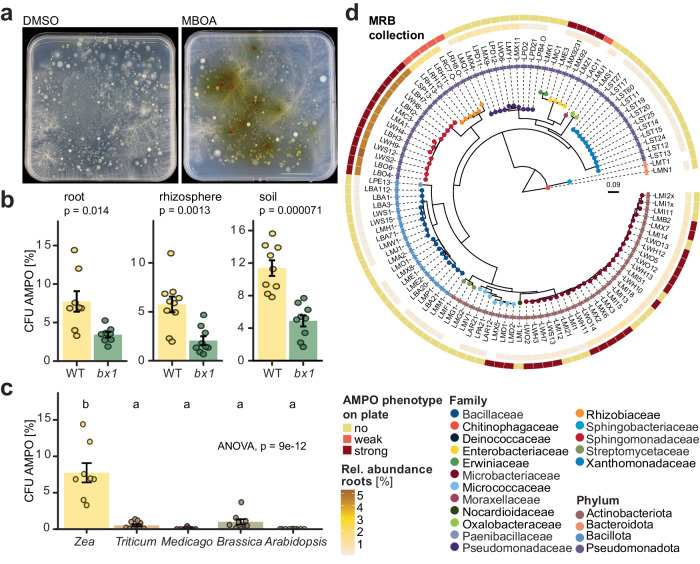
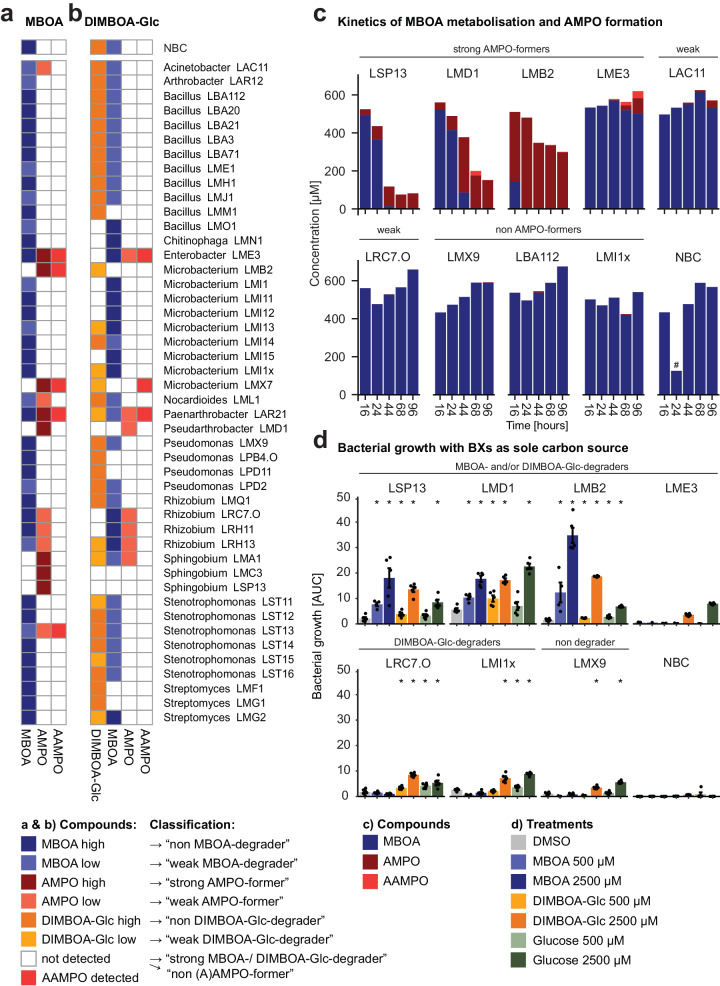
Root exudates contain specialised metabolites that shape the plant's root microbiome. How host-specific microbes cope with these bioactive compounds, and how this ability affects root microbiomes, remains largely unknown. We investigated how maize root bacteria metabolise benzoxazinoids, the main specialised metabolites of maize. Diverse and abundant bacteria metabolised the major compound in the maize rhizosphere MBOA (6-methoxybenzoxazolin-2(3H)-one) and formed AMPO (2-amino-7-methoxy-phenoxazin-3-one). AMPO forming bacteria were enriched in the rhizosphere of benzoxazinoid-producing maize and could use MBOA as carbon source. We identified a gene cluster associated with AMPO formation in microbacteria. The first gene in this cluster, bxdA encodes a lactonase that converts MBOA to AMPO in vitro. A deletion mutant of the homologous bxdA genes in the genus Sphingobium, did not form AMPO nor was it able to use MBOA as a carbon source. BxdA was identified in different genera of maize root bacteria. Here we show that plant-specialised metabolites select for metabolisation-competent root bacteria. BxdA represents a benzoxazinoid metabolisation gene whose carriers successfully colonize the maize rhizosphere and thereby shape the plant's chemical environmental footprint.
根系分泌物包含专门的代谢物,这些代谢物塑造了植物的根系微生物组。宿主特异性微生物如何应对这些生物活性化合物,以及这种能力如何影响根系微生物组,在很大程度上仍然未知。我们研究了玉米根细菌如何代谢苯并恶嗪类化合物,这是玉米的主要专门代谢物。多种多样且丰富的细菌代谢了玉米根际中的主要化合物 MBOA(6-甲氧基苯并恶唑啉-2(3H)-酮),并形成了 AMPO(2-氨基-7-甲氧基-吩嗪-3-酮)。形成 AMPO 的细菌在苯并恶嗪类化合物产生的玉米的根际中得到了富集,并且可以将 MBOA 用作碳源。我们在微生物中鉴定出与 AMPO 形成相关的基因簇。该基因簇中的第一个基因 bxdA 编码一种内酯酶,可在体外将 MBOA 转化为 AMPO。属于鞘氨醇单胞菌属的同源 bxdA 基因的缺失突变体既不能形成 AMPO,也不能将 MBOA 用作碳源。BxdA 存在于不同属的玉米根细菌中。在这里,我们表明植物特有的代谢物选择了具有代谢能力的根细菌。BxdA 代表一种苯并恶嗪类化合物代谢基因,其携带体成功地定植在玉米根际中,从而塑造了植物的化学环境足迹。