Department of Thoracic Surgery, The First Affiliated Hospital of Wenzhou Medical University, Wenzhou, China.
Department of Microbiology and Immunology, Institute of Molecular Virology and Immunology, School of Basic Medical Sciences, Wenzhou Medical University, Wenzhou, China.
Eur J Med Res. 2024 Aug 2;29(1):401. doi: 10.1186/s40001-024-02001-4.
Small-cell lung cancer (SCLC) is a leading cause of cancer-related death. However, the prognostic value of the tumor shrinkage rate (TSR) after chemotherapy for SCLC is still unknown.
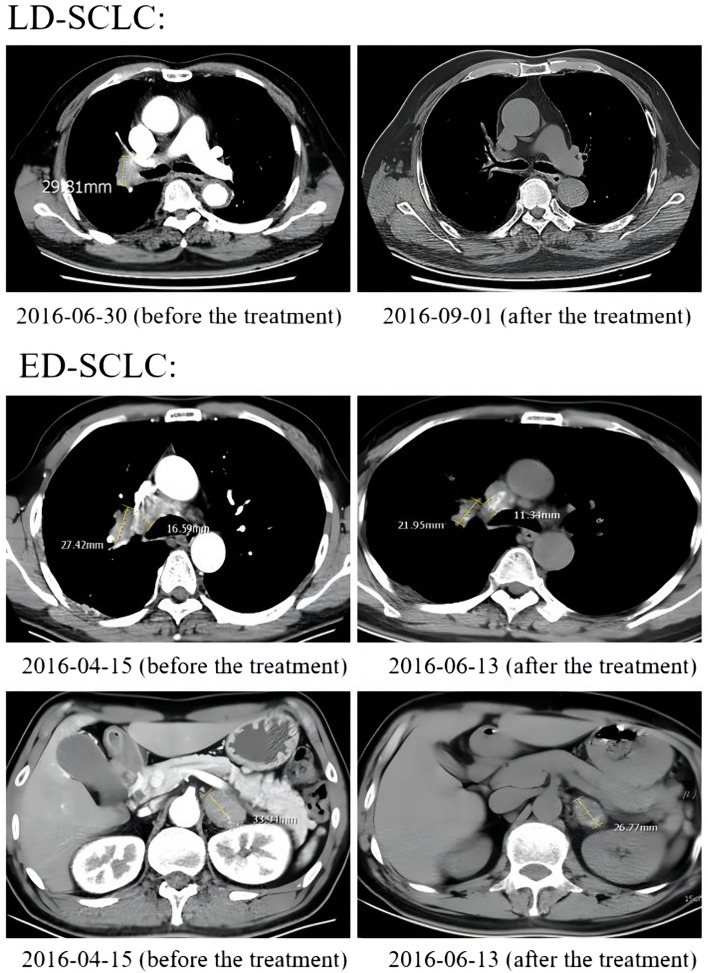
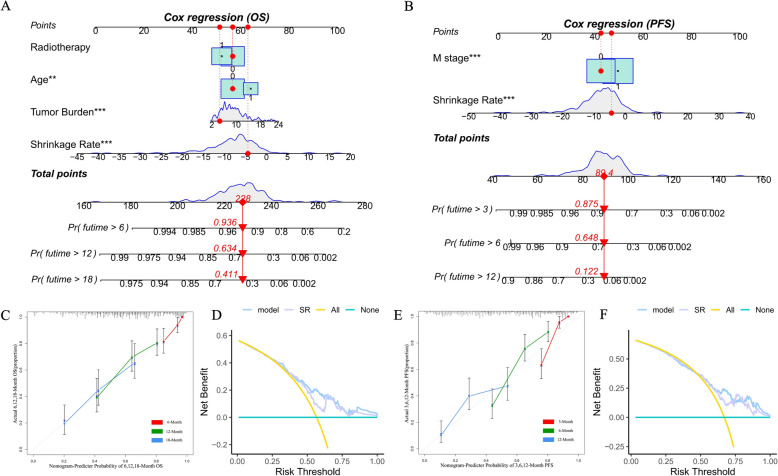
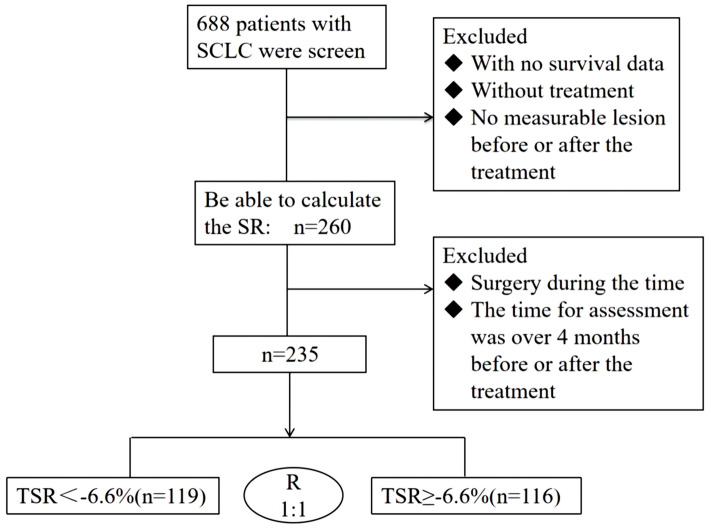
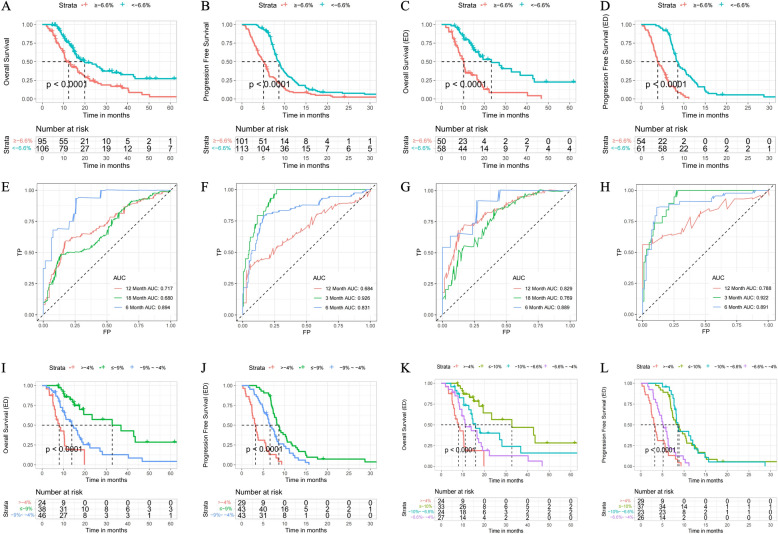
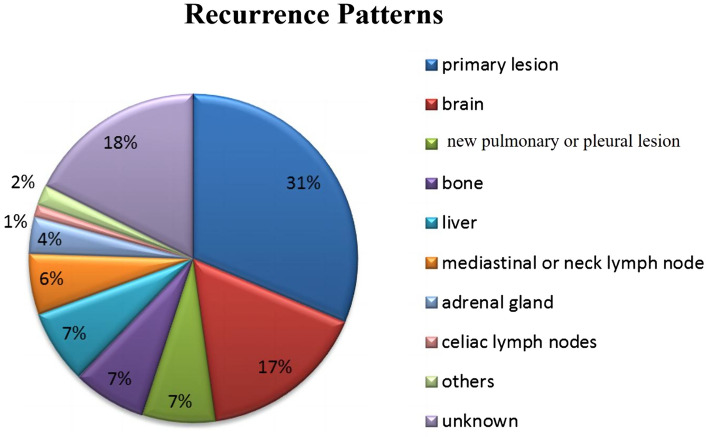
We performed a retrospective analysis of 235 patients with SCLC. The TSR cutoff was determined based on receiver-operating characteristic curve analysis. The associations of TSR with progression-free survival (PFS) and overall survival (OS) were assessed using univariate and multivariate Cox proportional hazards models. Survival curves were obtained by the Kaplan-Meier method and compared using the log-rank test. Recurrence patterns after first-line treatment were summarized in a pie chart. A nomogram was constructed to validate the predictive role of the TSR in SCLC.
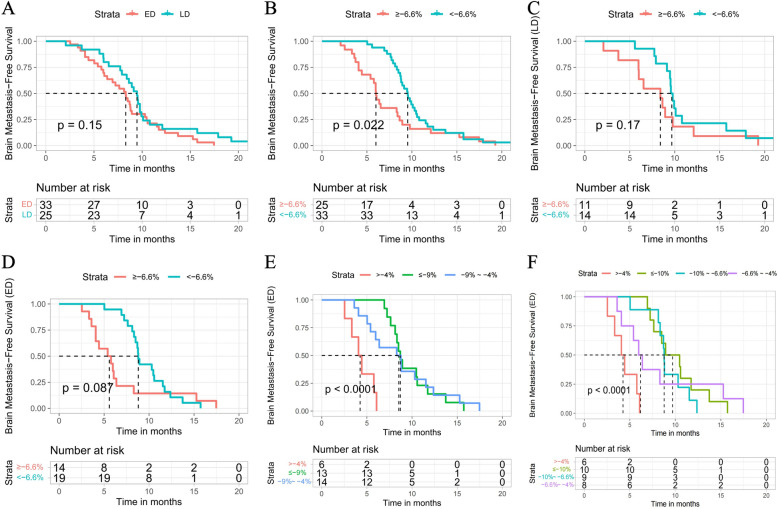
The TSR cutoff was identified to be - 6.6%. Median PFS and OS were longer in the group with a TSR < -6.6% than in the group with a TSR ≥ - 6.6%. PFS and OS were also longer in patients with extensive SCLC when the TSR was < - 6.6% than when it was > - 6.6%. Brain metastasis-free survival was better in the group with a TSR < - 6.6%. There was a significant positive correlation between TSR and PFS. Furthermore, univariate and multivariate regression analyses showed that the TSR, patient age, and previous radiotherapy were independent prognostic factors for OS while TSR and M stage were independent prognostic factors for PFS.
The TSR may prove to be a good indicator of OS and PFS in patients receiving chemotherapy-based first-line treatment for SCLC.
小细胞肺癌(SCLC)是癌症相关死亡的主要原因。然而,化疗后 SCLC 肿瘤退缩率(TSR)的预后价值尚不清楚。
我们对 235 例 SCLC 患者进行了回顾性分析。根据受试者工作特征曲线分析确定 TSR 截止值。使用单变量和多变量 Cox 比例风险模型评估 TSR 与无进展生存期(PFS)和总生存期(OS)的相关性。通过 Kaplan-Meier 方法获得生存曲线,并使用对数秩检验进行比较。总结一线治疗后复发模式的饼图。构建列线图以验证 TSR 在 SCLC 中的预测作用。
确定 TSR 截止值为-6.6%。与 TSR ≥-6.6%相比,TSR <-6.6%组的中位 PFS 和 OS 更长。当 TSR < -6.6%时,广泛期 SCLC 患者的 PFS 和 OS 也更长。TSR <-6.6%组的无脑转移生存更好。TSR 与 PFS 呈显著正相关。此外,单变量和多变量回归分析表明,TSR、患者年龄和既往放疗是 OS 的独立预后因素,而 TSR 和 M 期是 PFS 的独立预后因素。
TSR 可能是接受化疗为基础的一线治疗的 SCLC 患者 OS 和 PFS 的良好指标。