Department of Chemical Engineering, Pennsylvania State University, University Park, Pennsylvania, USA.
Microbiology Translational and Multidisciplinary (MicroTM)-Research Institute Biomedical A Coruña (INIBIC) and Microbiology Department of Hospital A Coruña (CHUAC), University of A Coruña (UDC), A Coruña, Spain.
Microb Biotechnol. 2024 Aug;17(8):e14543. doi: 10.1111/1751-7915.14543.
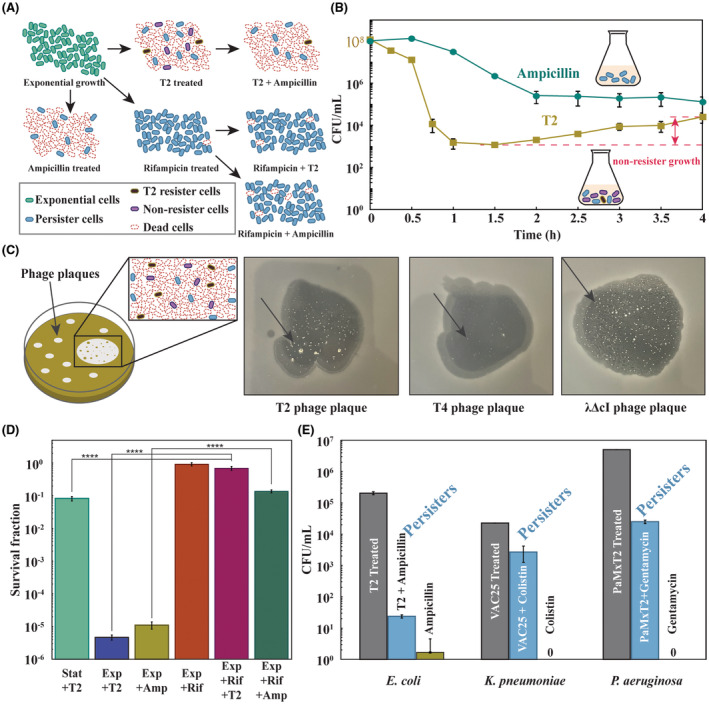
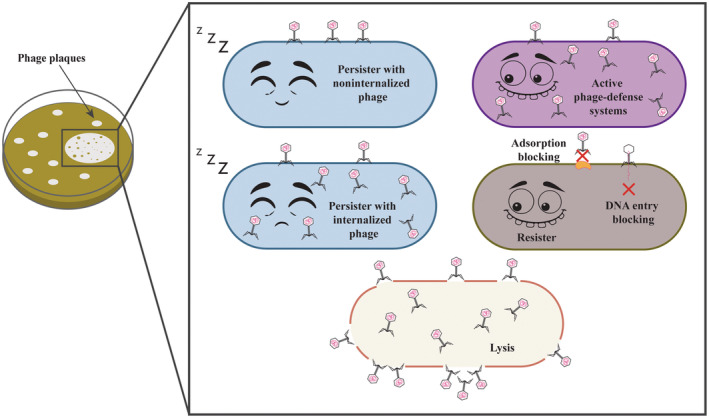
Arguably, the greatest threat to bacteria is phages. It is often assumed that those bacteria that escape phage infection have mutated or utilized phage-defence systems; however, another possibility is that a subpopulation forms the dormant persister state in a manner similar to that demonstrated for bacterial cells undergoing nutritive, oxidative, and antibiotic stress. Persister cells do not undergo mutation and survive lethal conditions by ceasing growth transiently. Slower growth and dormancy play a key physiological role as they allow host phage defence systems more time to clear the phage infection. Here, we investigated how bacteria survive lytic phage infection by isolating surviving cells from the plaques of T2, T4, and lambda (cI mutant) virulent phages and sequencing their genomes. We found that bacteria in plaques can escape phage attack both by mutation (i.e. become resistant) and without mutation (i.e. become persistent). Specifically, whereas T4-resistant and lambda-resistant bacteria with over a 100,000-fold less sensitivity were isolated from plaques with obvious genetic mutations (e.g. causing mucoidy), cells were also found after T2 infection that undergo no significant mutation, retain wild-type phage sensitivity, and survive lethal doses of antibiotics. Corroborating this, adding T2 phage to persister cells resulted in 137,000-fold more survival compared to that of addition to exponentially growing cells. Furthermore, our results seem general in that phage treatments with Klebsiella pneumonia and Pseudomonas aeruginosa also generated persister cells. Hence, along with resistant strains, bacteria also form persister cells during phage infection.
可以说,细菌面临的最大威胁是噬菌体。人们通常认为,那些逃避噬菌体感染的细菌已经发生了突变或利用了噬菌体防御系统;然而,另一种可能性是,一部分细菌会以类似于营养、氧化和抗生素应激下细菌细胞的方式进入休眠持久状态。持久细胞不会发生突变,而是通过短暂停止生长来存活于致死条件下。较慢的生长和休眠起着关键的生理作用,因为它们使宿主噬菌体防御系统有更多的时间清除噬菌体感染。在这里,我们通过从 T2、T4 和 lambda(cI 突变体)烈性噬菌体的噬菌斑中分离存活细胞并对其基因组进行测序,研究了细菌如何在裂解性噬菌体感染中存活。我们发现,噬菌斑中的细菌可以通过突变(即变得具有抗性)和不突变(即变得持久)来逃避噬菌体的攻击。具体来说,虽然从噬菌斑中分离出的 T4 抗性和 lambda 抗性细菌对噬菌体的敏感性降低了 10 万倍以上(例如,导致黏液性),但在 T2 感染后也发现了一些没有明显突变、保持野生型噬菌体敏感性并能在致死剂量抗生素下存活的细胞。这一点得到了证实,与添加到指数生长细胞相比,向持久细胞中添加 T2 噬菌体可使存活率提高 137000 倍。此外,我们的研究结果似乎具有普遍性,因为用肺炎克雷伯氏菌和铜绿假单胞菌进行噬菌体处理也产生了持久细胞。因此,细菌在噬菌体感染过程中除了形成抗性菌株外,还会形成持久细胞。