Department of Medicine, University of Otago, Christchurch, Christchurch, New Zealand
Department of General Practice and Primary Health Care, University of Auckland, Auckland, Aotearoa New Zealand.
BMJ Open. 2024 Aug 3;14(8):e084665. doi: 10.1136/bmjopen-2024-084665.
Gout is one of the most common forms of arthritis worldwide. Gout is particularly prevalent in Aotearoa/New Zealand and is estimated to affect 13.1% of Māori men, 22.9% of Pacific men and 7.4% of New Zealand European men. Effective long-term treatment requires lowering serum urate to <0.36 mmol/L. Allopurinol is the most commonly used urate-lowering medication worldwide. Despite its efficacy and safety, the allopurinol dose escalation treat-to-target serum urate strategy is difficult to implement and there are important inequities in allopurinol prescribing in Aotearoa. The escalation strategy is labour intensive, time consuming and costly for people with gout and the healthcare system. An easy and effective way to dose-escalate allopurinol is required, especially as gout disproportionately affects working-age Māori men and Pacific men, who frequently do not receive optimal care.
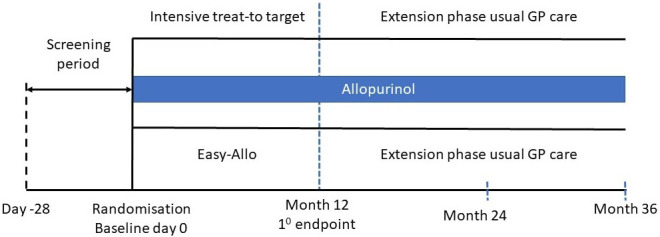
A 12-month non-inferiority randomised controlled trial in people with gout who have a serum urate ≥ 0.36 mmol/l will be undertaken. 380 participants recruited from primary and secondary care will be randomised to one of the two allopurinol dosing strategies: intensive nurse-led treat-to-target serum urate dosing (intensive treat-to-target) or protocol-driven dose escalation based on dose predicted by an allopurinol dosing model (Easy-Allo). The primary endpoint will be the proportion of participants who achieve target serum urate (<0.36 mmol/L) at 12 months.
The New Zealand Northern B Health and Disability Ethics Committee approved the study (2022 FULL 13478). Results will be disseminated in peer-reviewed journals and to participants.
ACTRN12622001279718p.
痛风是全球最常见的关节炎形式之一。痛风在新西兰特别普遍,据估计,13.1%的毛利男性、22.9%的太平洋岛民男性和 7.4%的新西兰欧洲男性患有痛风。有效的长期治疗需要将血清尿酸降低到<0.36mmol/L。别嘌醇是全球最常用的降尿酸药物。尽管别嘌醇具有疗效和安全性,但针对目标的血清尿酸逐步递增的别嘌醇剂量递增治疗策略难以实施,而且在新西兰,别嘌醇的处方存在重要的不平等现象。对于痛风患者及其医疗保健系统来说,这种递增策略既费力又费时,而且费用高昂。需要一种简单有效的方法来逐步递增别嘌醇剂量,尤其是因为痛风不成比例地影响到工作年龄的毛利男性和太平洋岛民男性,而他们往往无法获得最佳的治疗。
一项为期 12 个月的非劣效性随机对照试验将在血清尿酸≥0.36mmol/L的痛风患者中进行。将从初级和二级保健机构招募 380 名参与者,他们将被随机分配到两种别嘌醇剂量策略之一:密集型护士主导的针对目标的血清尿酸剂量(密集型针对目标)或基于别嘌醇剂量模型预测的方案驱动剂量递增(Easy-Allo)。主要终点是在 12 个月时达到目标血清尿酸(<0.36mmol/L)的参与者比例。
新西兰北部 B 健康和残疾伦理委员会批准了该研究(2022 年 FULL 13478)。结果将在同行评议的期刊和参与者中公布。
ACTRN12622001279718p。