Johnson Graham, Tabner Andrew, Tilbury Nicholas, Wesson Alistair, Hughes Gareth D, Elder Rebecca, Bryson Philip
University Hospitals of Derby and Burton NHS Foundation Trust, Royal Derby Hospital, Uttoxeter Road, Derby DE22 3NE, UK.
University of Nottingham School of Medicine, Queen's Medical Centre, Nottingham NG7 2UH, UK.
Resusc Plus. 2024 Jul 18;19:100724. doi: 10.1016/j.resplu.2024.100724. eCollection 2024 Sep.
The management of cardiorespiratory arrest in a diving bell presents multiple clinical, technical, and environmental considerations that standard resuscitation algorithms do not address, and no situation-specific algorithm exists. The development and testing of an algorithm to guide the management of cardiorespiratory arrest in a bell is described.
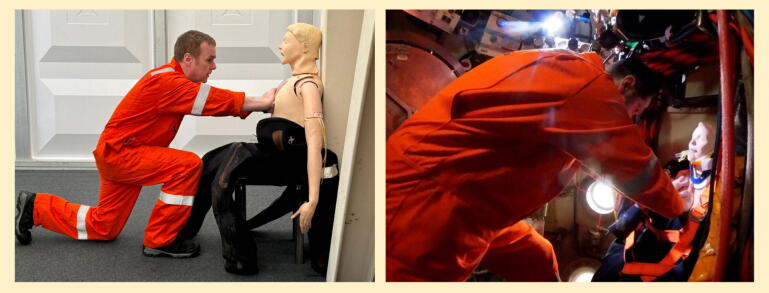
An iterative approach to algorithm development was used. Phase 1 involved a small multidisciplinary group and took place in a simulation centre and a decommissioned diving bell. The algorithm was then refined in a purpose-build simulation complex with repeated simulation by a group of divers, and with input from industry experts. ALS principles were followed unless contextual or technical factors necessitated deviation.
Clinical and technical aspects of the resuscitation are addressed. Key priorities that conflict with standard ALS principles are: prioritisation of rescue breaths; use of mechanical CPR when available; and the provision of CPR with the casualty in a seated position where necessary.
This is the first algorithm to guide the delivery of resuscitation in a diving bell. It incorporates adapted ALS principles and available data concerning compression technique effectiveness, and was informed by industry and clinical expertise. It provides guiding principles that can be adapted to setting-specific needs, and we would encourage its industry-wide international adoption.
潜水钟内心肺骤停的处理存在多种临床、技术和环境方面的考量,而标准的复苏算法并未涉及这些内容,且不存在针对特定情况的算法。本文描述了一种用于指导潜水钟内心肺骤停处理的算法的开发与测试过程。
采用迭代方法进行算法开发。第一阶段由一个小型多学科团队参与,在模拟中心和一艘退役潜水钟内开展工作。随后,该算法在一个专门建造的模拟综合设施中进行完善,由一组潜水员进行反复模拟,并吸纳行业专家的意见。除非情境或技术因素需要偏离,否则均遵循高级生命支持(ALS)原则。
阐述了复苏的临床和技术方面内容。与标准ALS原则相冲突的关键优先事项包括:优先进行人工呼吸;在有条件时使用机械心肺复苏;必要时让伤员坐姿接受心肺复苏。
这是首个指导潜水钟内复苏操作的算法。它融合了经过调整的ALS原则以及关于按压技术有效性的现有数据,并借鉴了行业和临床专业知识。它提供了可根据特定场景需求进行调整的指导原则,我们鼓励在全行业范围内国际采用该算法。