Akbari Mehran, Golitaleb Mohamad, Farahani Mahtab, Nikbakht Dorrin, Shahrodi Mohadese, Davodabady Fahimeh, Amini Nazanin, Harorani Mehdi
Molecular and Medicine Research Center, Khomein University of Medical Sciences, Khomein, Iran.
Department of Operating Room and Anesthesiology, Khomein University of Medical Sciences, Khomein, Iran.
Iran J Nurs Midwifery Res. 2024 Jul 2;29(3):337-342. doi: 10.4103/ijnmr.ijnmr_62_23. eCollection 2024 May-Jun.
Cancer and associated treatment methods present numerous complications, including anorexia and disturbances in sleep patterns. Consequently, the purpose of this study is to examine the impact of reflexology on the symptoms of anorexia and sleep quality among individuals afflicted with cancer.
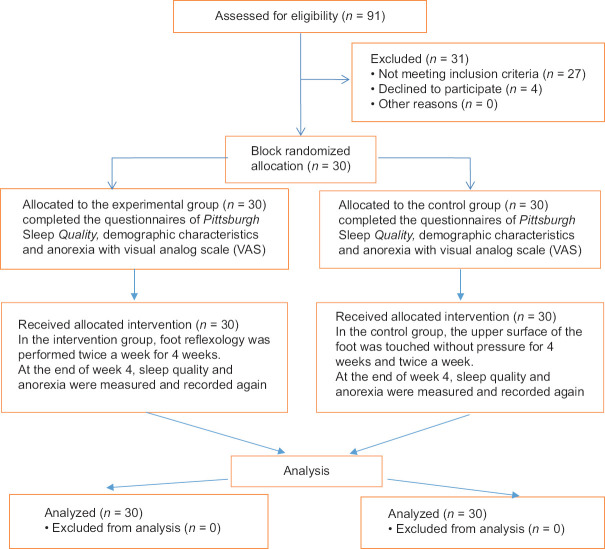
In this double-blinded randomized clinical trial, a total of 60 patients undergoing chemotherapy at Khansari Hospital, Arak, Iran, were selected using convenience sampling and then assigned to two groups of control and experimental using blocked randomization (30 patients in each group). The sample intervention group received reflexology in an exceedingly 4-week amount (two sessions a week), By contrast, the control group was administered a placebo treatment without exerting any pressure on the reflex points during the same time frame. Sleep quality and anorexia in patients were measured using a Pittsburgh questionnaire and visual analog scale before and right after the intervention. Eventually, the data were analyzed, and we used the tests of central tendency, dispersion, independent- and paired-samples -tests, and Chi-square.
The findings of the study revealed a significant improvement in sleep quality and reduction in anorexia symptoms among patients who received reflexology treatment scores ( < 0.001). Conversely, there was no significant difference in the control group before and after the intervention (without pressure effect on the foot points) ( > 0.05).
According to the positive effects on sleep quality and the reduction of anorexia symptoms, it is recommended to incorporate this therapeutic modality along with conventional medication for the treatment of individuals with cancer.
癌症及相关治疗方法会引发诸多并发症,包括食欲不振和睡眠模式紊乱。因此,本研究旨在探讨足部反射疗法对癌症患者食欲不振症状和睡眠质量的影响。
在这项双盲随机临床试验中,采用便利抽样法从伊朗阿拉克市汗萨里医院选取了60名正在接受化疗的患者,然后通过区组随机化将其分为对照组和试验组(每组30名患者)。试验组在为期4周的时间里接受反射疗法(每周两次)。相比之下,对照组在同一时间段接受安慰剂治疗,且不对反射点施加任何压力。在干预前后,使用匹兹堡问卷和视觉模拟量表对患者的睡眠质量和食欲不振情况进行测量。最后,对数据进行分析,我们使用了集中趋势、离散度、独立样本和配对样本检验以及卡方检验。
研究结果显示,接受反射疗法的患者在睡眠质量方面有显著改善,食欲不振症状有所减轻(<0.001)。相反,对照组在干预前后没有显著差异(对足部穴位无按压效果)(>0.05)。
鉴于反射疗法对睡眠质量和减轻食欲不振症状有积极作用,建议将这种治疗方式与传统药物结合用于癌症患者的治疗。