Department of Orthopaedic Surgery, Gunma University Graduate School of Medicine, Maebashi, Gunma, Japan.
Department of Orthopaedic Surgery, Zenshukai Hospital, Maebashi, Gunma, Japan.
Knee Surg Sports Traumatol Arthrosc. 2024 Dec;32(12):3141-3150. doi: 10.1002/ksa.12384. Epub 2024 Aug 5.
The optimal management of degenerative meniscal tears remains controversial. Extracorporeal shockwave therapy (ESWT) has been shown to promote tissue repair in both preclinical and clinical studies; however, its effect on degenerative meniscal tears remains unknown. This study aimed to examine whether ESWT improves meniscal degeneration.
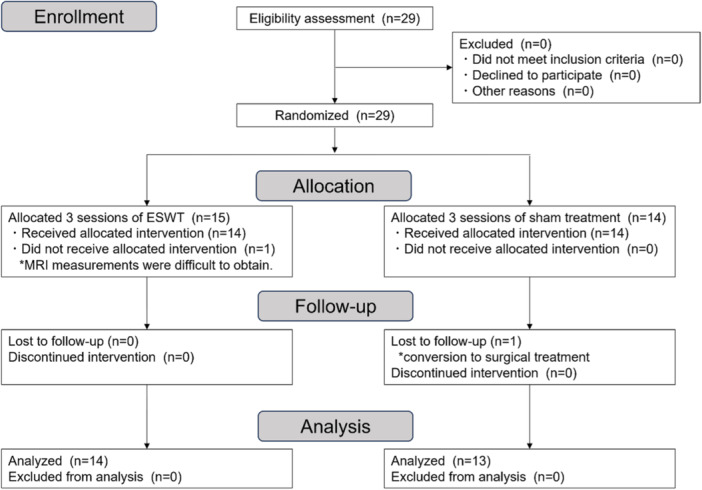
This randomized trial was conducted between 2020 and 2022 and involved patients with degenerative medial meniscal tears. Patients were allocated to receive either focused ESWT (0.25 mJ/mm, 2000 impulses, 3 sessions with a 1-week interval) or sham treatment. Patients were evaluated using magnetic resonance imaging (MRI) before treatment and at 12 months after treatment. The primary endpoint was improvement in meniscal degeneration, as assessed by the change in T2 relaxation time from baseline on MRI T2 mapping. Knee pain and clinical outcomes were also examined at the same time.
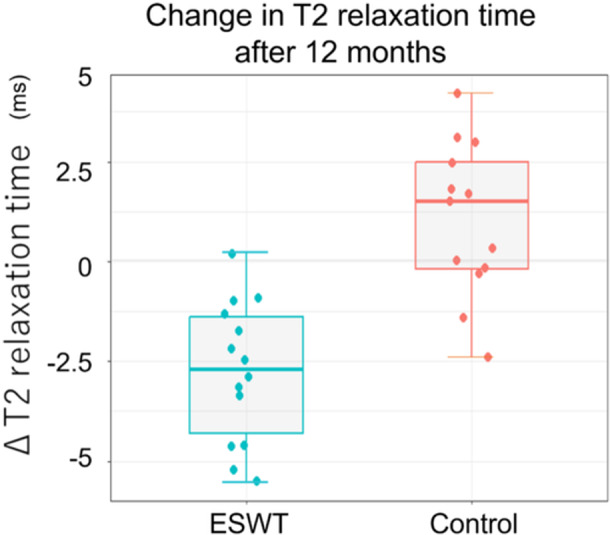
Of 29 randomized patients, 27 patients (mean age 63.9 ± 8.7 years; females 37%; ESWT group 14 patients; control group 13 patients) were included in the final analysis. At 12 months postintervention, patients in the ESWT group showed a greater decrease in the T2 relaxation time (ESWT group -2.9 ± 1.7 ms vs. control group 1.0 ± 1.9 ms; p < 0.001) and had less knee pain (p = 0.04). The clinical outcomes at 12 months post-treatment were not statistically significant. No adverse events were reported.
ESWT decreased the T2 relaxation time in the meniscus at 12 months post-treatment. ESWT also provided pain relief, but no differences were observed in clinical outcomes.
Level II.
退行性半月板撕裂的最佳治疗方法仍存在争议。体外冲击波疗法(ESWT)已在临床前和临床研究中显示出促进组织修复的作用;然而,其对退行性半月板撕裂的作用尚不清楚。本研究旨在探讨 ESWT 是否能改善半月板退变。
这是一项在 2020 年至 2022 年间进行的随机试验,涉及退行性内侧半月板撕裂患者。患者被分配接受聚焦 ESWT(0.25 mJ/mm,2000 次脉冲,间隔 1 周进行 3 次)或假治疗。患者在治疗前和治疗后 12 个月进行磁共振成像(MRI)评估。主要终点是通过 MRI T2 图谱上 T2 弛豫时间的变化评估半月板退变的改善情况。同时还检查了膝关节疼痛和临床结果。
在 29 名随机患者中,27 名患者(平均年龄 63.9±8.7 岁;女性 37%;ESWT 组 14 名患者;对照组 13 名患者)纳入最终分析。干预后 12 个月,ESWT 组的 T2 弛豫时间下降更大(ESWT 组-2.9±1.7 ms 比对照组 1.0±1.9 ms;p<0.001),膝关节疼痛减轻(p=0.04)。治疗后 12 个月的临床结果无统计学意义。无不良反应报告。
ESWT 可降低治疗后 12 个月半月板的 T2 弛豫时间。ESWT 还能缓解疼痛,但在临床结果方面没有差异。
II 级。