Department of Neuroscience, Center for Theoretical Neuroscience and Zuckerman Mind, Brain, and Behavior Institute, Columbia University, New York, NY 10027.
Department of Neurobiology, Stanford University, Stanford, CA 94305.
Proc Natl Acad Sci U S A. 2024 Aug 13;121(33):e2401032121. doi: 10.1073/pnas.2401032121. Epub 2024 Aug 5.
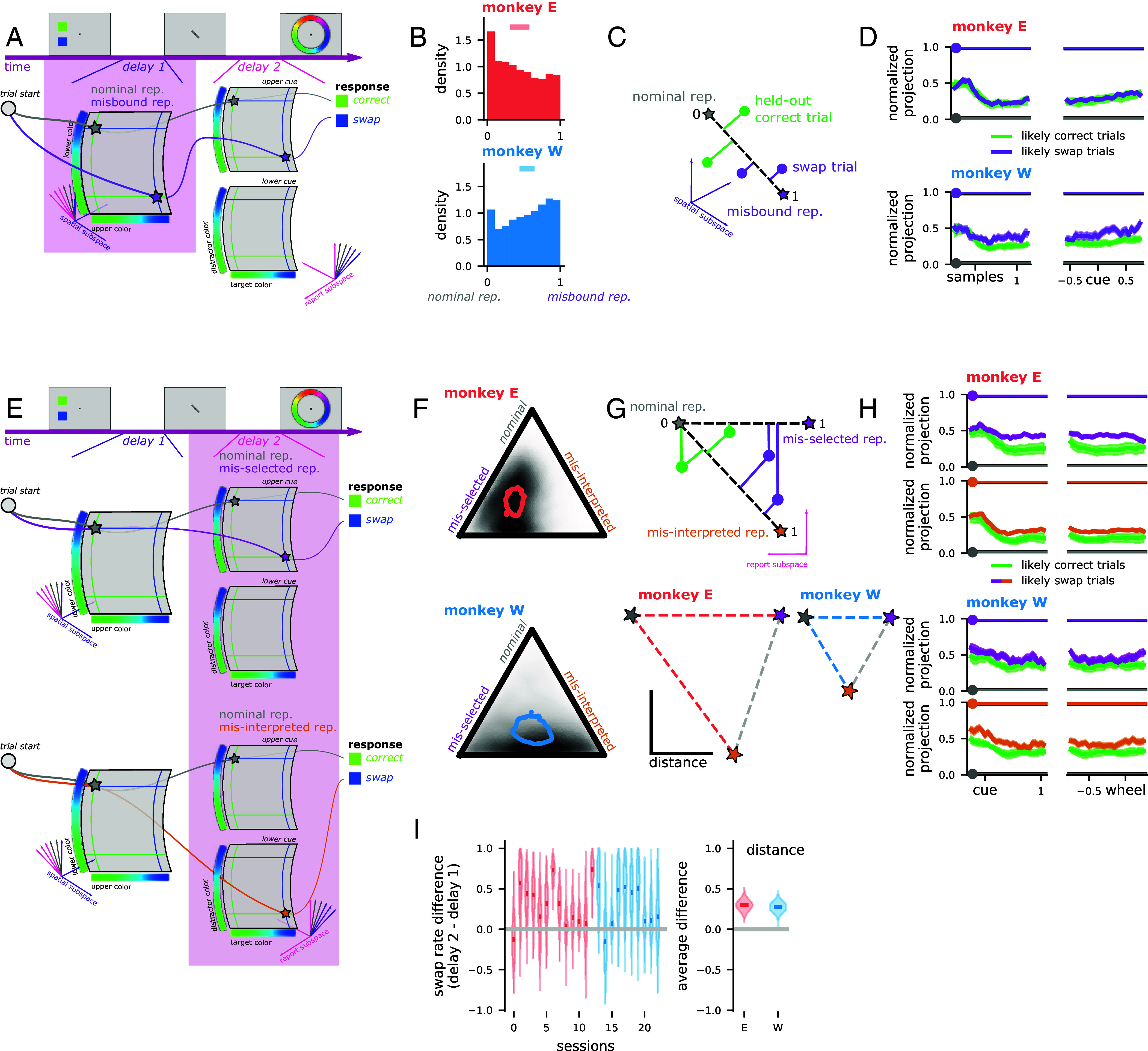
When making decisions in a cluttered world, humans and other animals often have to hold multiple items in memory at once-such as the different items on a shopping list. Psychophysical experiments in humans and other animals have shown remembered stimuli can sometimes become confused, with participants reporting chimeric stimuli composed of features from different stimuli. In particular, subjects will often make "swap errors" where they misattribute a feature from one object as belonging to another object. While swap errors have been described behaviorally and theoretical explanations have been proposed, their neural mechanisms are unknown. Here, we elucidate these neural mechanisms by analyzing neural population recordings from monkeys performing two multistimulus working memory tasks. In these tasks, monkeys were cued to report the color of an item that either was previously shown at a corresponding location or will be shown at the corresponding location. Animals made swap errors in both tasks. In the neural data, we find evidence that the neural correlates of swap errors emerged when correctly remembered information is selected from working memory. This led to a representation of the distractor color as if it were the target color, underlying the eventual swap error. We did not find consistent evidence that swap errors arose from misinterpretation of the cue or errors during encoding or storage in working memory. These results provide evidence that swap errors emerge during selection of correctly remembered information from working memory, and highlight this selection as a crucial-yet surprisingly brittle-neural process.
在纷繁复杂的世界中做决策时,人类和其他动物常常需要同时记住多个项目——比如购物清单上的不同物品。人类和其他动物的心理物理学实验表明,被记住的刺激有时会混淆,参与者会报告由不同刺激的特征组成的混合刺激。特别是,被试通常会犯“交换错误”,即将一个物体的特征错误地归因于另一个物体。虽然已经在行为上描述了交换错误,并提出了理论解释,但它们的神经机制尚不清楚。在这里,我们通过分析猴子在执行两个多刺激工作记忆任务时的神经群体记录来阐明这些神经机制。在这些任务中,猴子被提示报告一个物品的颜色,该物品要么之前在相应位置显示过,要么将在相应位置显示。动物在这两个任务中都犯了交换错误。在神经数据中,我们发现了证据表明,当从工作记忆中正确地选择记忆信息时,交换错误的神经相关性就会出现。这导致了对干扰色的表示,就好像它是目标色一样,最终导致了交换错误。我们没有发现一致的证据表明交换错误是由于对线索的误解或在工作记忆中的编码或存储过程中的错误引起的。这些结果提供了证据表明,交换错误是在从工作记忆中选择正确记忆的信息时出现的,并强调了这种选择是一个关键但令人惊讶的脆弱的神经过程。