Giacon Martina, Cargnin Sarah, Allena Marta, Greco Rosaria, Zanaboni Anna Maria, Facchetti Sara, De Icco Roberto, Sances Grazia, Ghiotto Natascia, Guaschino Elena, Martinelli Daniele, Tassorelli Cristina, Terrazzino Salvatore
Department of Pharmaceutical Sciences, University of Piemonte Orientale "A. Avogadro", Largo Donegani 2, Novara, 28100, Italy.
Department of Health Sciences, Università del Piemonte Orientale (UPO), Novara, Italy.
Neurol Sci. 2025 Jan;46(1):303-312. doi: 10.1007/s10072-024-07724-0. Epub 2024 Aug 6.
To confirm a previously reported association of TRPV1 rs8065080 with the risk of transformation from episodic (EM) to chronic migraine (CM) and to extend knowledge about the role of other TRPV1 single nucleotide polymorphisms (SNPs), we first investigated the impact of three TRPV1 SNPs (rs8065080, rs222747 and rs222749) on the risk of migraine chronification in a case-control study. A systematic review and meta-analysis were then conducted to summarize the accumulated findings.
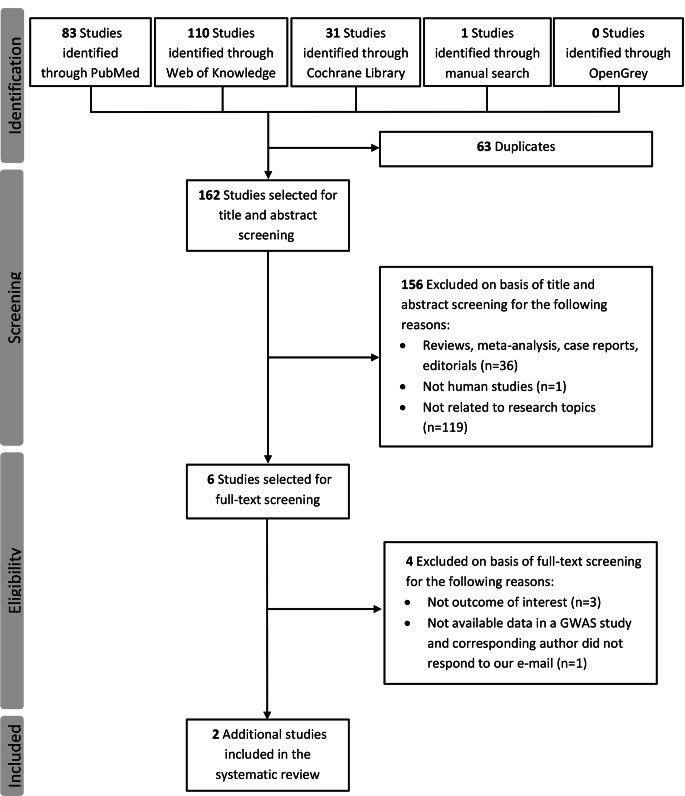
Genotyping of the selected TRPV1 SNPs was performed using TaqMan real-time PCR in 167 EM and 182 CM participants. Crude and adjusted odds ratios with associated 95% confidence intervals were calculated in the log-additive, dominant, and recessive genetic models. A comprehensive literature search was performed in PubMed, Web of Knowledge, Cochrane Library, and OpenGrey until February 2024.
In our case-control study, no association was found between TRPV1 SNPs and the risk of migraine chronification, both in the unadjusted logistic regression models and after adjustment for confounding clinical variables. The results of the meta-analysis with a total of 241 participants with EM and 223 with CM confirmed no association between TRPV1 SNPs and the risk of migraine chronification in any of the genetic models tested.
The results of the present case-control study and meta-analysis exclude a major role of TRPV1 rs8065080, rs222747, and rs222749 as risk factors for migraine chronification. However, further research is needed to investigate the gene-gene and gene-environment interactions of TRPV1 SNPs on the risk of transformation from episodic to chronic migraine.
为证实先前报道的瞬时受体电位香草酸亚型1(TRPV1)基因rs8065080与发作性偏头痛(EM)转变为慢性偏头痛(CM)风险之间的关联,并拓展对其他TRPV1单核苷酸多态性(SNP)作用的认识,我们首先在一项病例对照研究中调查了3个TRPV1 SNP(rs8065080、rs222747和rs222749)对偏头痛慢性化风险的影响。随后进行了系统评价和荟萃分析以总结累积研究结果。
采用TaqMan实时聚合酶链反应对167例EM参与者和182例CM参与者进行所选TRPV1 SNP的基因分型。在对数相加、显性和隐性遗传模型中计算粗比值比和调整后的比值比以及相关的95%置信区间。截至2024年2月,在PubMed、Web of Knowledge、Cochrane图书馆和OpenGrey中进行了全面的文献检索。
在我们的病例对照研究中,无论是在未调整的逻辑回归模型中还是在对混杂临床变量进行调整后,均未发现TRPV1 SNP与偏头痛慢性化风险之间存在关联。对总共241例EM参与者和223例CM参与者进行的荟萃分析结果证实,在任何测试的遗传模型中,TRPV1 SNP与偏头痛慢性化风险之间均无关联。
本病例对照研究和荟萃分析结果排除了TRPV1 rs8065080、rs222747和rs222749作为偏头痛慢性化危险因素的主要作用。然而,需要进一步研究来调查TRPV1 SNP在发作性偏头痛转变为慢性偏头痛风险方面的基因-基因和基因-环境相互作用。