Department of Brain Sciences, Imperial College London, London, United Kingdom.
Care Research and Technology Centre, UK Dementia Research Institute, Imperial College London, London, United Kingdom.
JMIR Aging. 2024 Aug 6;7:e52582. doi: 10.2196/52582.
Markerless motion capture (MMC) uses video cameras or depth sensors for full body tracking and presents a promising approach for objectively and unobtrusively monitoring functional performance within community settings, to aid clinical decision-making in neurodegenerative diseases such as dementia.
The primary objective of this systematic review was to investigate the application of MMC using full-body tracking, to quantify functional performance in people with dementia, mild cognitive impairment, and Parkinson disease.
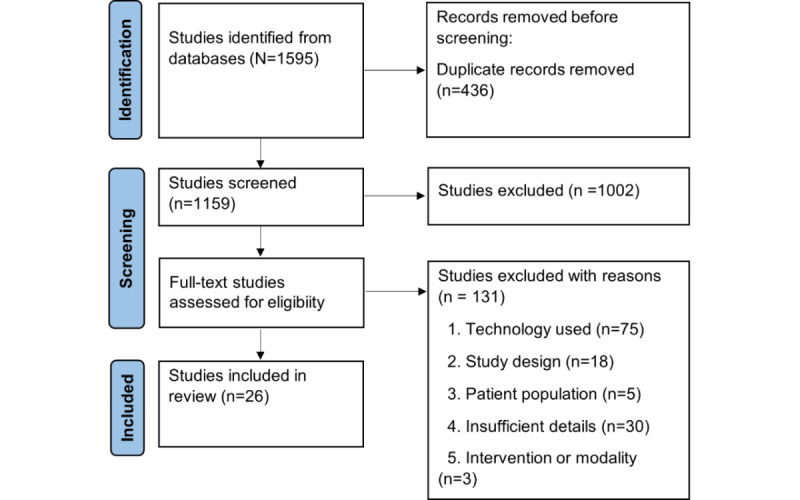
A systematic search of the Embase, MEDLINE, CINAHL, and Scopus databases was conducted between November 2022 and February 2023, which yielded a total of 1595 results. The inclusion criteria were MMC and full-body tracking. A total of 157 studies were included for full-text screening, out of which 26 eligible studies that met the selection criteria were included in the review. .
Primarily, the selected studies focused on gait analysis (n=24), while other functional tasks, such as sit to stand (n=5) and stepping in place (n=1), were also explored. However, activities of daily living were not evaluated in any of the included studies. MMC models varied across the studies, encompassing depth cameras (n=18) versus standard video cameras (n=5) or mobile phone cameras (n=2) with postprocessing using deep learning models. However, only 6 studies conducted rigorous comparisons with established gold-standard motion capture models.
Despite its potential as an effective tool for analyzing movement and posture in individuals with dementia, mild cognitive impairment, and Parkinson disease, further research is required to establish the clinical usefulness of MMC in quantifying mobility and functional performance in the real world.
无标记运动捕捉(MMC)使用摄像机或深度传感器进行全身跟踪,为在社区环境中客观且不引人注目的监测功能性能提供了一种很有前途的方法,有助于痴呆等神经退行性疾病的临床决策。
本系统评价的主要目的是调查使用全身跟踪的 MMC 在痴呆、轻度认知障碍和帕金森病患者中的功能表现的应用。
在 2022 年 11 月至 2023 年 2 月期间,对 Embase、MEDLINE、CINAHL 和 Scopus 数据库进行了系统搜索,共产生了 1595 项结果。纳入标准为 MMC 和全身跟踪。共有 157 项研究进行了全文筛选,其中 26 项符合入选标准的研究纳入了本综述。
首先,选定的研究主要集中在步态分析(n=24),而其他功能任务,如坐站(n=5)和原地踏步(n=1)也进行了探索。然而,在任何纳入的研究中都没有评估日常生活活动。研究中 MMC 模型各不相同,包括深度摄像机(n=18)与标准摄像机(n=5)或带深度学习模型后处理的手机摄像机(n=2)。然而,只有 6 项研究与既定的运动捕捉黄金标准模型进行了严格的比较。
尽管 MMC 作为一种分析痴呆、轻度认知障碍和帕金森病患者运动和姿势的有效工具具有潜力,但仍需要进一步的研究来确定 MMC 在量化现实世界中移动性和功能表现的临床实用性。