KITE Research Institute, Toronto Rehabilitation Institute-University Health Network (UHN) Toronto ON M5G 1L7 Canada.
Institute of Biomedical Engineering, University of Toronto Toronto ON M5S 1A1 Canada.
IEEE J Transl Eng Health Med. 2022 Jun 3;10:2100511. doi: 10.1109/JTEHM.2022.3180231. eCollection 2022.
Parkinson's disease (PD) presents with motor symptoms such as bradykinesia, rigidity, and tremor that can affect gait. To monitor changes associated with disease progression or medication use, quantitative gait assessment is often performed during clinical visits. Conversely, vision-based solutions have been proposed for monitoring gait quality in non-clinical settings.
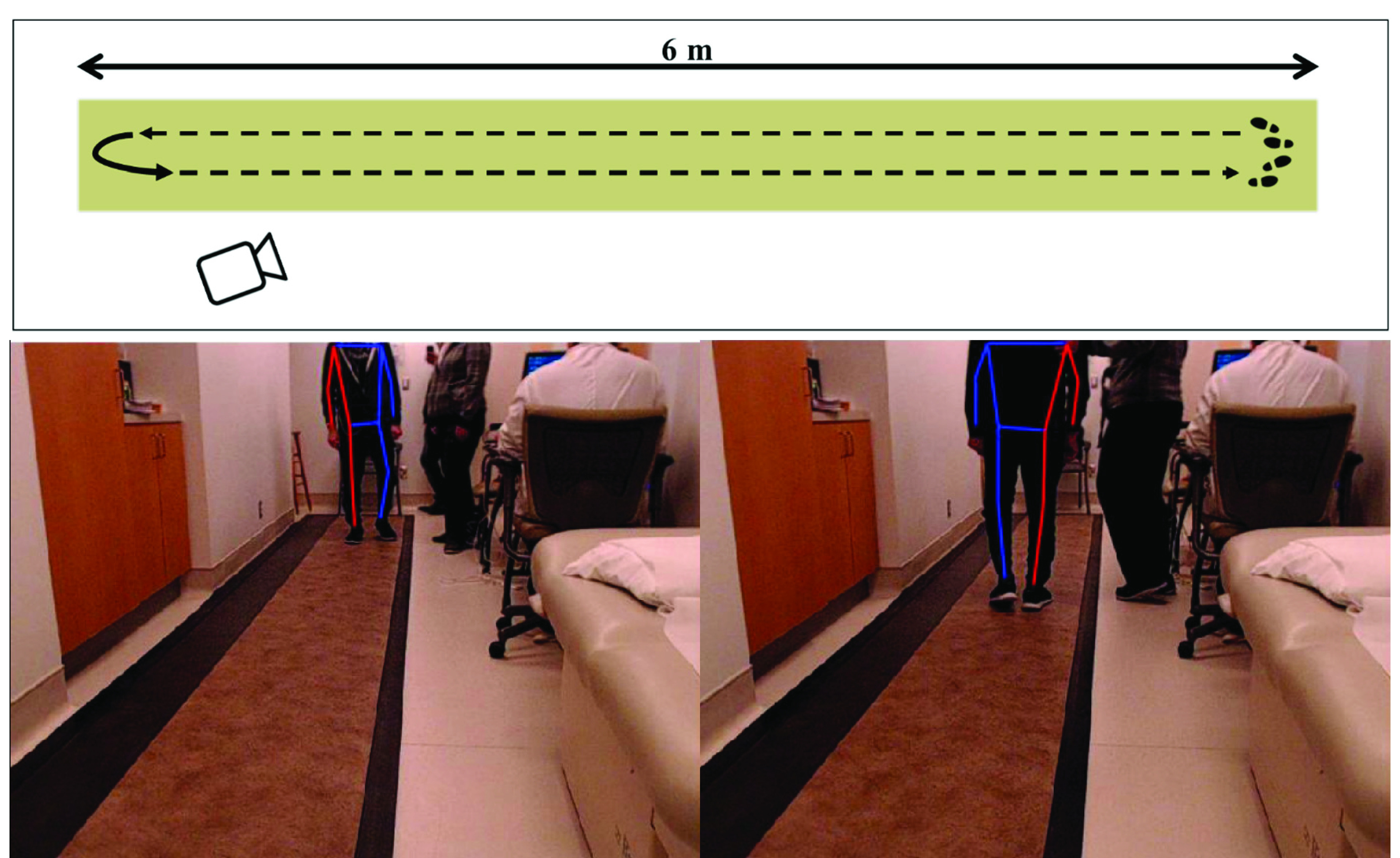
We use three 2D human pose-estimation libraries (AlphaPose, Detectron, OpenPose) and one 3D library (ROMP) to calculate gait features from color video, and correlate them with those extracted by a Zeno instrumented walkway in older adults with PD. We calculate video-based gait features using a manual and automated heel-strike detection algorithm, and compare the correlations when the participants walk towards and away from the camera separately.
Based on analysis of 67 bidirectional walking bouts from 25 adults with PD, moderate to strong positive correlations were identified between the number of steps, cadence, as well as the mean and coefficient of variation of step width calculated from Zeno and video using 2D pose-estimation libraries. We noted that our automated heel-strike annotation method struggled to identify short steps.
Gait features calculated from 2D joint trajectories are more strongly correlated with the Zeno than analogous gait features calculated from ROMP. Based on our analysis, videos processed with 2D pose-estimation libraries can be used for longitudinal gait monitoring in individuals with PD. Future work will seek to improve the prediction of gait features using a comprehensive machine learning model to predict gait features directly from color video without relying on intermediate extraction of joint trajectories.
帕金森病(PD)表现为运动症状,如运动迟缓、僵硬和震颤,这些症状可能会影响步态。为了监测与疾病进展或药物使用相关的变化,通常在临床就诊期间进行定量步态评估。相反,基于视觉的解决方案已被提出用于监测非临床环境中的步态质量。
我们使用三个 2D 人体姿态估计库(AlphaPose、Detectron、OpenPose)和一个 3D 库(ROMP)从彩色视频中计算步态特征,并将其与 PD 老年患者使用 Zeno 仪器化步道提取的特征进行相关分析。我们使用手动和自动足跟触地检测算法计算基于视频的步态特征,并分别比较参与者向相机和远离相机行走时的相关性。
基于对 25 名 PD 成年人的 67 次双向行走回合的分析,从 Zeno 和视频中使用 2D 姿态估计库计算得出的步数、步频以及步宽的平均值和变异系数之间存在中度到高度正相关。我们注意到,我们的自动足跟触地标记方法难以识别短步。
从 2D 关节轨迹计算得出的步态特征与 Zeno 比从 ROMP 计算得出的类似步态特征更相关。基于我们的分析,使用 2D 姿态估计库处理的视频可用于 PD 患者的纵向步态监测。未来的工作将寻求使用全面的机器学习模型来改善步态特征的预测,该模型可以直接从彩色视频预测步态特征,而无需依赖关节轨迹的中间提取。