Sheffield Teaching Hospitals NHS Foundation Trust, Sheffield, UK.
University of Sheffield, Sheffield, UK
Emerg Med J. 2024 Oct 23;41(11):678-685. doi: 10.1136/emermed-2023-213772.
D-dimer is the only biomarker currently recommended in guidelines for the diagnosis of acute aortic syndrome (AAS). We undertook a systematic review to determine whether any alternative biomarkers could be useful in AAS diagnosis.
We searched electronic databases (including MEDLINE, EMBASE and the Cochrane Library) from inception to February 2024. Diagnostic studies were eligible if they examined biomarkers other than D-dimer for diagnosing AAS compared with a reference standard test in people presenting to the ED with symptoms of AAS. Case-control studies were identified but excluded due to high risk of bias. Selection of studies, data extraction and risk of bias assessments using the Quality Assessment of Diagnostic Accuracy Studies 2 (QUADAS-2) tool were undertaken independently by at least two reviewers. We used narrative synthesis to summarise the findings.
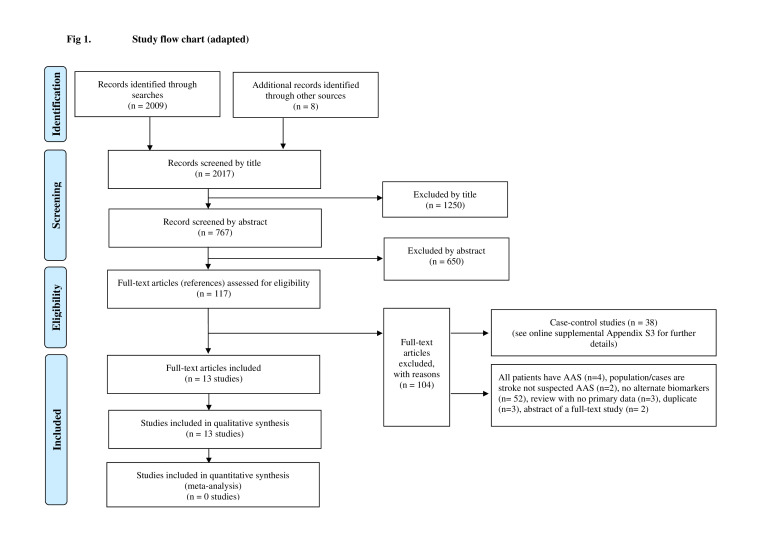
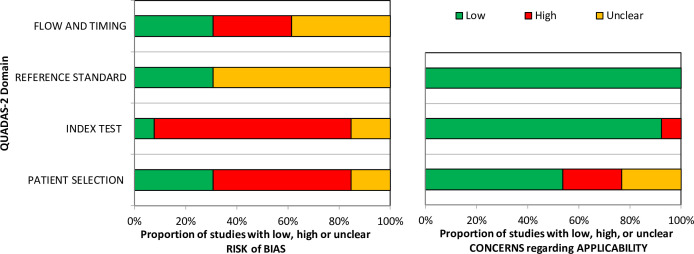
We identified 2017 citations, included 13 cohort studies (n=76-999), and excluded 38 case-control studies. Methodological quality was variable, with most included studies having unclear or high risk of bias and applicability concerns in at least one item of the QUADAS-2 tool. Only two studies reported biomarkers with sensitivity and specificity comparable to D-dimer (ie, >90% and >50%, respectively). Wang reported 99.1% sensitivity and 84.9% specificity for soluble ST2; however, these findings conflicted with estimates of 58% sensitivity and 70.8% specificity reported in another study. Chun and Siu reported 95.6% sensitivity and 56.1% specificity for neutrophil count, but this has not been confirmed elsewhere.
There are many potential alternative biomarkers for AAS but few have been evaluated in more than one study, study designs are often weak and reported biomarker accuracy is modest or inconsistent between studies. Alternative biomarkers to D-dimer are not ready for routine clinical use.
CRD42022252121.
D-二聚体是目前急性主动脉综合征(AAS)诊断指南中唯一推荐的生物标志物。我们进行了一项系统评价,以确定是否有其他替代生物标志物可用于 AAS 诊断。
我们从开始到 2024 年 2 月搜索了电子数据库(包括 MEDLINE、EMBASE 和 Cochrane 图书馆)。如果诊断研究检查了除 D-二聚体以外的生物标志物来诊断 AAS,并与急诊科出现 AAS 症状的患者的参考标准测试进行比较,则符合入选标准。由于偏倚风险高,我们确定了病例对照研究,但将其排除在外。至少由两名评审员独立进行研究选择、数据提取和使用诊断准确性研究质量评估工具 2(QUADAS-2)评估偏倚风险。我们使用叙述性综合方法总结研究结果。
我们确定了 2017 篇文献,纳入了 13 项队列研究(n=76-999),排除了 38 项病例对照研究。方法学质量参差不齐,大多数纳入的研究在 QUADAS-2 工具的至少一个项目中存在不明确或高偏倚风险和适用性问题。只有两项研究报告的生物标志物的敏感性和特异性与 D-二聚体相当(即分别为>90%和>50%)。Wang 报道可溶性 ST2 的敏感性为 99.1%,特异性为 84.9%;然而,这些发现与另一项研究报告的 58%敏感性和 70.8%特异性估计值相矛盾。Chun 和 Siu 报道中性粒细胞计数的敏感性为 95.6%,特异性为 56.1%,但其他地方尚未得到证实。
有许多潜在的 AAS 替代生物标志物,但很少有研究对其进行了超过一次评估,研究设计往往很薄弱,报告的生物标志物准确性在不同研究之间也不尽相同或不一致。替代 D-二聚体的生物标志物尚未准备好常规临床使用。
PROSPERO 注册号:CRD42022252121。