Discipline of Psychiatry, Adelaide Medical School, The University of Adelaide, Adelaide, SA, Australia.
Asrat Woldeyes Health Science Campus, Debre Berhan University, Debre Berhan, Ethiopia.
Transl Psychiatry. 2024 Aug 6;14(1):322. doi: 10.1038/s41398-024-02998-6.
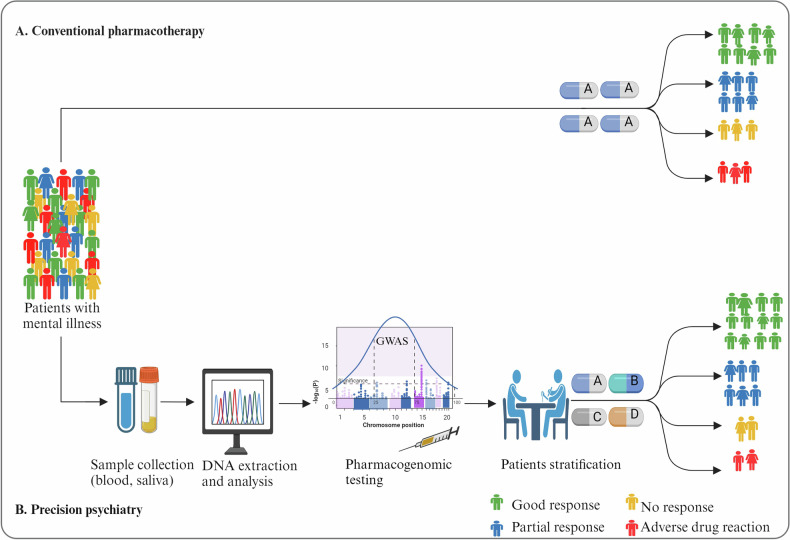
In the past two decades, significant progress has been made in the development of polygenic scores (PGSs). One specific application of PGSs is the development and potential use of pharmacogenomic- scores (PGx-scores) to identify patients who can benefit from a specific medication or are likely to experience side effects. This systematic review comprehensively evaluates published PGx-score studies in psychiatry and provides insights into their potential clinical use and avenues for future development. A systematic literature search was conducted across PubMed, EMBASE, and Web of Science databases until 22 August 2023. This review included fifty-three primary studies, of which the majority (69.8%) were conducted using samples of European ancestry. We found that over 90% of PGx-scores in psychiatry have been developed based on psychiatric and medical diagnoses or trait variants, rather than pharmacogenomic variants. Among these PGx-scores, the polygenic score for schizophrenia (PGS) has been most extensively studied in relation to its impact on treatment outcomes (32 publications). Twenty (62.5%) of these studies suggest that individuals with higher PGS have negative outcomes from psychotropic treatment - poorer treatment response, higher rates of treatment resistance, more antipsychotic-induced side effects, or more psychiatric hospitalizations, while the remaining studies did not find significant associations. Although PGx-scores alone accounted for at best 5.6% of the variance in treatment outcomes (in schizophrenia treatment resistance), together with clinical variables they explained up to 13.7% (in bipolar lithium response), suggesting that clinical translation might be achieved by including PGx-scores in multivariable models. In conclusion, our literature review found that there are still very few studies developing PGx-scores using pharmacogenomic variants. Research with larger and diverse populations is required to develop clinically relevant PGx-scores, using biology-informed and multi-phenotypic polygenic scoring approaches, as well as by integrating clinical variables with these scores to facilitate their translation to psychiatric practice.
在过去的二十年中,多基因评分(PGS)的发展取得了重大进展。PGS 的一个具体应用是开发和潜在使用药物基因组学评分(PGx-scores),以确定哪些患者可以从特定药物中受益或可能出现副作用。本系统评价全面评估了精神病学中已发表的 PGx-score 研究,并深入了解了它们在临床应用中的潜力和未来发展方向。我们在 PubMed、EMBASE 和 Web of Science 数据库中进行了系统的文献检索,检索时间截至 2023 年 8 月 22 日。本综述纳入了 53 项原始研究,其中大多数(69.8%)研究的样本来自欧洲血统。我们发现,精神病学中超过 90%的 PGx-scores 是基于精神和医学诊断或特质变体而不是药物基因组学变体开发的。在这些 PGx-scores 中,精神分裂症的多基因评分(PGS)与治疗结果的关系研究最为广泛(32 项研究)。其中 20 项(62.5%)研究表明,PGS 较高的个体接受精神药物治疗的结局较差,包括治疗反应较差、治疗抵抗率较高、抗精神病药物引起的副作用更多或更多的精神病住院,而其余研究未发现显著相关性。尽管 PGx-scores 单独解释了治疗结果(精神分裂症治疗抵抗)中最好的 5.6%的方差,但与临床变量一起,它们最多可以解释 13.7%(双相锂反应)的方差,这表明通过将 PGx-scores 纳入多变量模型,可能实现临床转化。总之,我们的文献综述发现,使用药物基因组学变体开发 PGx-scores 的研究仍然很少。需要开展更大规模、更多样化人群的研究,以开发具有生物学意义和多表型的多基因评分方法,并将临床变量与这些评分相结合,以促进其向精神科实践的转化。