Watanabe Shinya, Yamamoto Masaaki, Aiyama Hitoshi, Sugii Narushi, Matsuda Masahide, Akutsu Hiroyoshi, Ishikawa Eiichi
Department of Neurosurgery, Institute of Medicine, University of Tsukuba, Tsukuba, Japan.
Department of Neurosurgery, Mito Kyodo General Hospital, Tsukuba University Hospital, Mito Area Medical Education Center, Mito, Ibaraki, Japan.
Surg Neurol Int. 2024 Jul 26;15:257. doi: 10.25259/SNI_148_2024. eCollection 2024.
Treatment outcome data of stereotactic radiosurgery (SRS) for vestibular schwannomas (VS) in patients ≥75 years (late elderly) are lacking. Approximately 39% of patients ≥75 years with VS were reported to experience severe facial palsy after surgical removal. This study compared the treatment outcomes post-SRS for VS between patients ≥75 and 65-74 years (early elderly).
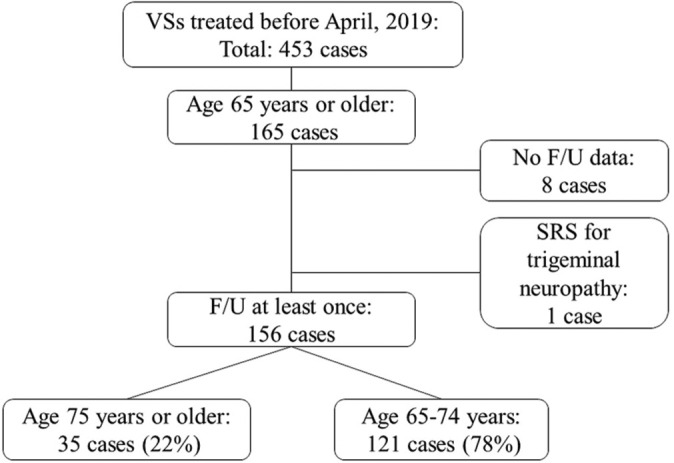
Of 453 patients who underwent gamma knife SRS for VS, 156 were ≥65 years old. The late and early elderly groups comprised 35 and 121 patients, respectively. The median tumor volume was 4.4 cc, and the median radiation dose was 12.0 Gy.
The median follow-up periods were 37 and 56 months in the late and early elderly groups, respectively. Tumor volume control was observed in 27 (88%) and 95 (83%) patients ( = 0.78), while additional procedures were required in 2 (6%) and 6 (6%) patients ( = 1.00) in the late and early elderly groups, respectively. At the 60 and 120 months post-SRS, the cumulative tumor control rates were 87%, 75%, 85%, and 73% ( = 0.81), while the cumulative clinical control rates were 93% and 87%, 95%, and 89% ( = 0.80), in the late and early elderly groups, respectively. In the early elderly group, two patients experienced facial pain, and one experienced facial palsy post-SRS; there were no adverse effects in the late elderly group (both = 1.00).
SRS is effective for VS and beneficial in patients ≥75 years old as it preserves the facial nerve.
缺乏关于≥75岁(高龄老人)患者前庭神经鞘瘤(VS)的立体定向放射外科治疗(SRS)的治疗结果数据。据报道,在≥75岁的VS患者中,约39%在手术切除后出现严重面瘫。本研究比较了≥75岁和65 - 74岁(老年前期)患者VS的SRS治疗后结果。
在453例行VS伽玛刀SRS治疗的患者中,156例年龄≥65岁。高龄老人组和老年前期组分别有35例和121例患者。肿瘤体积中位数为4.4立方厘米,放射剂量中位数为12.0 Gy。
高龄老人组和老年前期组的中位随访期分别为37个月和56个月。分别在27例(88%)和95例(83%)患者中观察到肿瘤体积得到控制(P = 0.78),高龄老人组和老年前期组分别有2例(6%)和6例(6%)患者需要额外的治疗(P = 1.00)。在SRS后60个月和120个月时,高龄老人组和老年前期组的累积肿瘤控制率分别为87%、75%、85%和73%(P = 0.81),累积临床控制率分别为93%和87%、95%和89%(P = 0.80)。在老年前期组中,2例患者在SRS后出现面部疼痛,1例出现面瘫;高龄老人组无不良反应(两者P = 1.00)。
SRS对VS有效,对≥75岁的患者有益,因为它能保留面神经。