Hong Lauren, Ye Tianzheng, Wang Tian Zi, Srijay Divya, Zhao Lin, Watson Rio, Vincoff Sophia, Chen Tianlai, Kholina Kseniia, Goel Shrey, DeLisa Matthew P, Chatterjee Pranam
Department of Biomedical Engineering, Duke University.
Robert F. Smith School of Chemical and Biomolecular Engineering, Cornell University, Ithaca, NY, USA.
Res Sq. 2024 Jul 26:rs.3.rs-4670386. doi: 10.21203/rs.3.rs-4670386/v1.
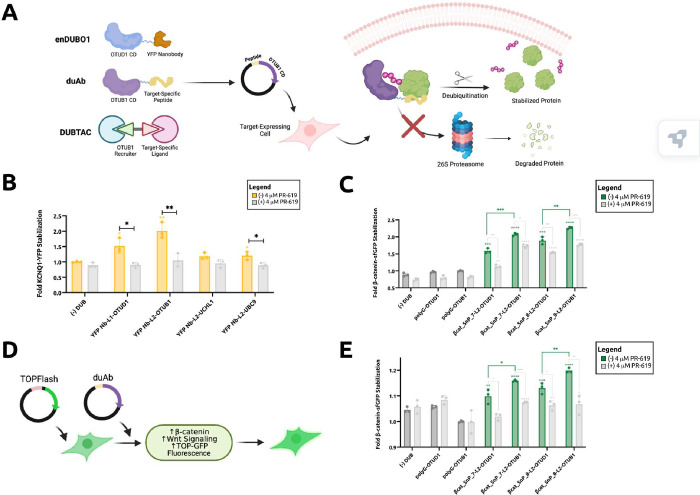
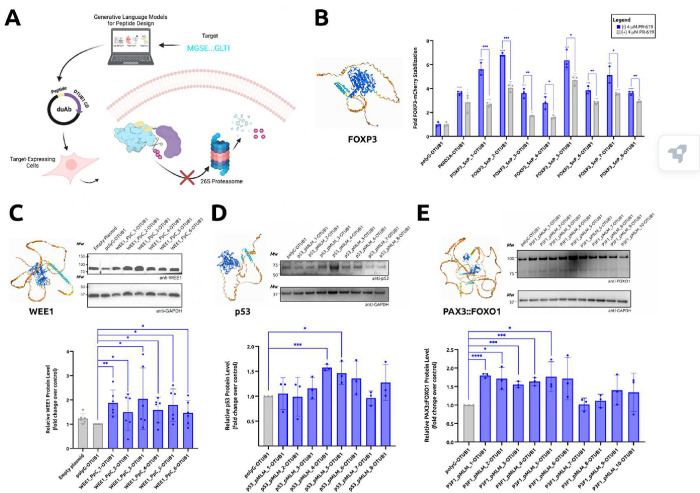
Dysregulated protein degradation via the ubiquitin-proteasomal pathway can induce numerous disease phenotypes, including cancer, neurodegeneration, and diabetes. Stabilizing improperly ubiquitinated proteins via target-specific deubiquitination is thus a critical therapeutic goal. Building off the major advances in targeted protein degradation (TPD) using bifunctional small-molecule degraders, targeted protein stabilization (TPS) modalities have been described recently. However, these rely on a limited set of chemical linkers and warheads, which are difficult to generate de novo for new targets and do not exist for classically "undruggable" targets. To address the limited reach of small molecule-based degraders, we previously engineered ubiquibodies (uAbs) by fusing computationally-designed "guide" peptides to E3 ubiquitin ligase domains for modular, CRISPR-analogous TPD. Here, we expand the TPS target space by engineering "deubiquibodies" (duAbs) via fusion of computationally-designed guides to the catalytic domain of the potent OTUB1 deubiquitinase. In human cells, duAbs effectively stabilize exogenous and endogenous proteins in a DUB-dependent manner. To demonstrate duAb modularity, we swap in new target-binding peptides designed via our generative language models to stabilize diverse target proteins, including key tumor suppressor proteins such as p53 and WEE1, as well as heavily-disordered fusion oncoproteins, such as PAX3::FOXO1. In total, our duAb system represents a simple, programmable, CRISPR-analogous strategy for TPS.
通过泛素 - 蛋白酶体途径的蛋白质降解失调可诱发多种疾病表型,包括癌症、神经退行性疾病和糖尿病。因此,通过靶向特异性去泛素化来稳定泛素化不当的蛋白质是一个关键的治疗目标。基于使用双功能小分子降解剂在靶向蛋白质降解(TPD)方面取得的重大进展,最近已经描述了靶向蛋白质稳定化(TPS)方法。然而,这些方法依赖于有限的一组化学连接子和弹头,这些难以从头为新靶点生成,并且对于经典的“不可成药”靶点不存在。为了解决基于小分子的降解剂作用范围有限的问题,我们之前通过将计算设计的“引导”肽与E3泛素连接酶结构域融合来构建泛素抗体(uAbs),用于模块化的、类似CRISPR的TPD。在这里,我们通过将计算设计的引导序列与强效OTUB1去泛素酶的催化结构域融合来构建“去泛素抗体”(duAbs),从而扩展TPS靶点空间。在人类细胞中,duAbs以DUB依赖的方式有效地稳定外源和内源蛋白质。为了证明duAb的模块化,我们换入通过生成语言模型设计的新的靶标结合肽,以稳定多种靶标蛋白,包括关键的肿瘤抑制蛋白如p53和WEE1,以及高度无序的融合癌蛋白,如PAX3::FOXO1。总的来说,我们的duAb系统代表了一种用于TPS的简单、可编程、类似CRISPR的策略。