Berger Vera Christina, Fierz Ronja, Kolm Isabel, Leeners Brigitte, Betschart Cornelia
Department of Gynecology, University Hospital of Zurich, Zurich, Switzerland.
Medical School, University of Zurich, Zurich, Switzerland.
Int J Womens Health. 2024 Aug 2;16:1337-1347. doi: 10.2147/IJWH.S448861. eCollection 2024.
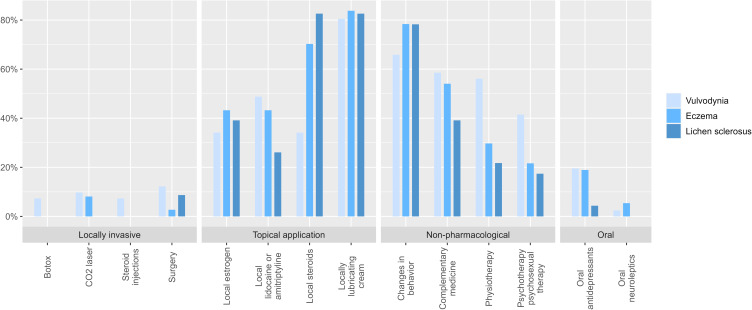
Genital pain treatment regimens range from local or systemic pharmacological to non-pharmacological, manual and psychosexual therapies with poor to moderate evidence for their efficiency. The aim of this study was to evaluate the subjective therapeutic response (genital pain relief) of different treatment modalities for vulvodynia and the most prevalent other vulvar pathologies, chronic vulvar eczema and lichen sclerosus by means of a cross-sectional survey.
A questionnaire-based cohort study that included 128 vulvodynia, 116 eczema and 79 lichen sclerosus patients was used. All patients attended the vulvar clinic at the University Hospital of Zurich. The patients who had been treated were surveyed from January to October 2022, using a customized online questionnaire consisting of 37 questions on symptoms and treatment outcomes for guideline-recommended treatment modalities. The study was approved by the Cantonal Ethics Review Board of Zurich.
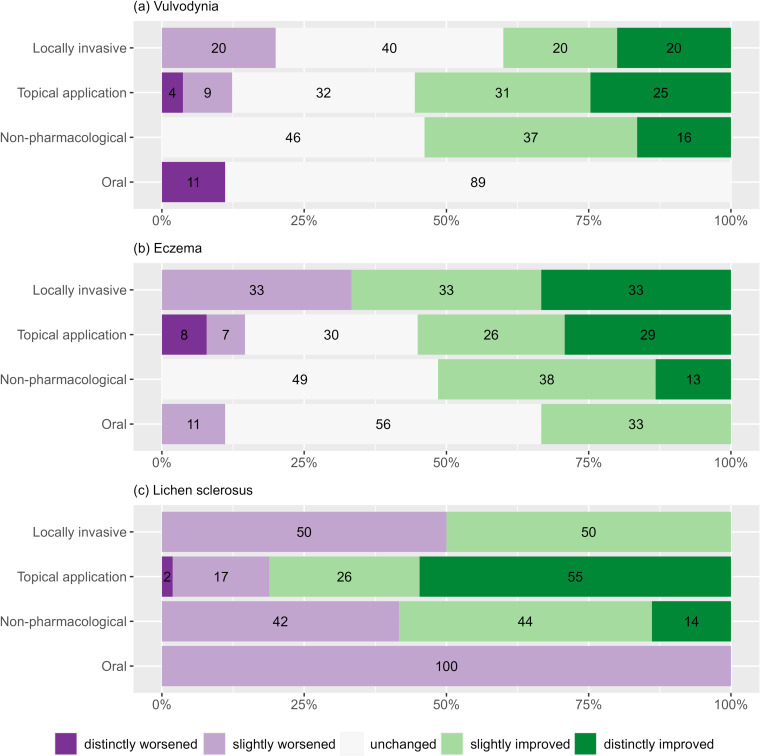
Altogether, 41 patients with vulvodynia, 37 with vulvar eczema and 23 with lichen sclerosus returned the questionnaire. The three groups were similar regarding pain characteristics and comorbidities. All three patient groups reported having benefited from non-pharmacological treatment (improvement rate vulvodynia 54%; eczema 51%; lichen sclerosus 58%), from topical (55%; 55%; 75%) and from locally invasive (46%; 66%; 50%) treatments. Overall, there was no significant difference in subjective treatment outcome between non-pharmacological, locally invasive, and topical treatments for vulvodynia, eczema, and lichen sclerosus. However, the use of oral medication was reported to be significantly less effective (p-value 0.050).
In conclusion, we found that in the patients' perception, topical, invasive and non-pharmacological treatments, but not oral medications, are helpful for genital pain relief in women with vulvodynia, vulvar eczema, and lichen sclerosus. Therefore, we recommend an escalating therapy approach with first-line non-pharmacological treatments together with topical therapies.
生殖器疼痛的治疗方案多种多样,从局部或全身药物治疗到非药物、手法及性心理治疗,但其疗效证据不足或仅为中等。本研究旨在通过横断面调查评估不同治疗方式对外阴痛以及其他最常见的外阴疾病(慢性外阴湿疹和硬化性苔藓)的主观治疗反应(生殖器疼痛缓解情况)。
采用基于问卷的队列研究,纳入了128例外阴痛患者、116例湿疹患者和79例硬化性苔藓患者。所有患者均前往苏黎世大学医院的外阴诊所就诊。对2022年1月至10月期间接受过治疗的患者进行调查,使用一份定制的在线问卷,该问卷包含37个关于指南推荐治疗方式的症状和治疗结果的问题。本研究获得了苏黎世州伦理审查委员会的批准。
共有41例外阴痛患者、37例外阴湿疹患者和23例硬化性苔藓患者返回了问卷。三组在疼痛特征和合并症方面相似。所有三组患者均报告从非药物治疗(外阴痛改善率54%;湿疹51%;硬化性苔藓58%)、局部治疗(55%;55%;75%)和局部侵入性治疗(46%;66%;50%)中获益。总体而言,对于外阴痛、湿疹和硬化性苔藓,非药物治疗、局部侵入性治疗和局部治疗在主观治疗结果上无显著差异。然而,据报告口服药物的效果明显较差(p值0.050)。
总之,我们发现,在患者认知中,局部治疗、侵入性治疗和非药物治疗对患有外阴痛、外阴湿疹和硬化性苔藓的女性缓解生殖器疼痛有帮助,但口服药物无效。因此,我们建议采用逐步升级的治疗方法,一线采用非药物治疗并结合局部治疗。