Sánchez-Rodríguez E Cuauhtémoc, López Vasthi J
Department of Hyperbaric Medicine, General Hospital Agustin O'Horan, Servicios de Salud de Yucatan (SSY), Mérida, Yucatán, Mexico.
Department of Hyperbaric Medicine, Faculty of Medicine of National Autonomous University of México (UNAM), Mexico City, Mexico.
Front Neurol. 2024 Jul 23;15:1389703. doi: 10.3389/fneur.2024.1389703. eCollection 2024.
The morbidity and mortality of acute ischemic hypoxic encephalopathy in newborns have not been dramatically modified over the last 20 years. The purpose of this review is to describe the use of hyperbaric oxygenation therapy (HBOT) in the management of acute ischemic hypoxic encephalopathy in newborns.
A review of the medical literature was conducted on the use of HBOT in the pathophysiology of this condition and its impact on outcomes of patients treated at an early stage.
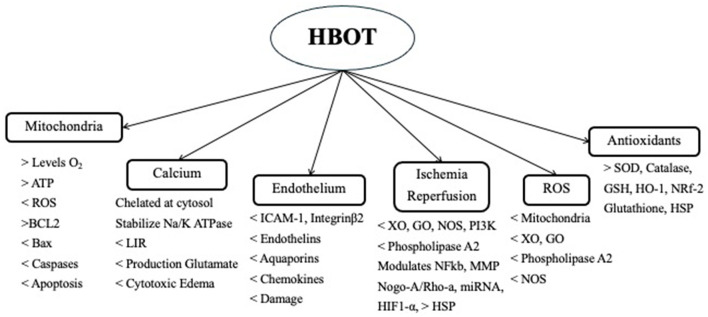
When HBOT is administered promptly, it can promote the survival of the penumbra, modulate the cytokine storm, modify inflammatory cascades, restore mitochondrial function, inhibit apoptosis, reinstate cellular communication and cytoskeleton function, reinstall the functioning of the kinase system, reduce cytotoxic and tissue edema, promote microcirculation, and provide an antioxidant effect. All these secondary mechanisms aid in saving, rescuing, and protecting the marginal tissue.
When used promptly, HBOT is a non-invasive adjunct treatment that can preserve the marginal tissue affected by ischemia, hypoxia, meet the metabolic needs of the penumbra, reduce inflammatory cascades, prevent the extension of the damaged tissue, and modulate ischemia-reperfusion injury.
在过去20年里,新生儿急性缺血缺氧性脑病的发病率和死亡率并未得到显著改善。本综述的目的是描述高压氧治疗(HBOT)在新生儿急性缺血缺氧性脑病管理中的应用。
对医学文献进行了回顾,内容涉及HBOT在该病症病理生理学中的应用及其对早期治疗患者预后的影响。
及时进行HBOT时,它可以促进半暗带存活,调节细胞因子风暴,改变炎症级联反应,恢复线粒体功能,抑制细胞凋亡,恢复细胞通讯和细胞骨架功能,恢复激酶系统功能,减轻细胞毒性和组织水肿,促进微循环,并提供抗氧化作用。所有这些次要机制有助于挽救、拯救和保护边缘组织。
及时使用时,HBOT是一种非侵入性辅助治疗方法,可保护受缺血、缺氧影响的边缘组织,满足半暗带的代谢需求,减少炎症级联反应,防止受损组织扩展,并调节缺血再灌注损伤。