Rogers S K, Nichols K L, Ahamadeen N, Shanahan M L, Rand K L
Department of Psychology, Indiana University Indianapolis, Indianapolis, IN, United States.
Center for Innovations in Quality Effectiveness and Safety, Michael E. DeBakey VA Medical Center, Houston, TX, United States.
Front Pain Res (Lausanne). 2024 Jul 23;5:1365193. doi: 10.3389/fpain.2024.1365193. eCollection 2024.
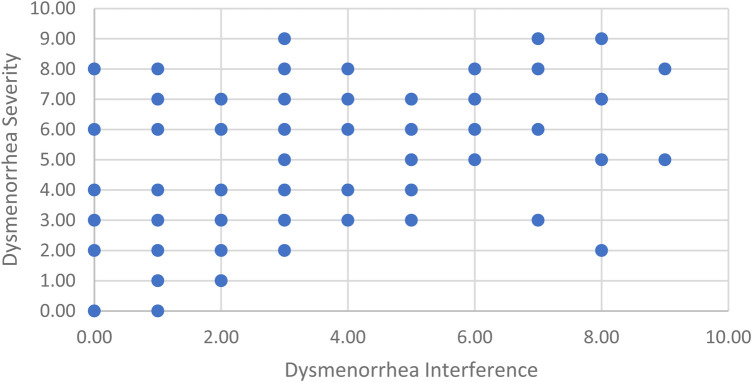
Dysmenorrhea is associated with increased risk of chronic pain and hyperalgesia. Menstruating individuals with dysmenorrhea are more likely to have elevated pain reactivity when experiencing experimental pain, than those without. However, no study has examined intragroup differences in reactions to experimentally induced pain for individuals with dysmenorrhea. The main aim of this study was to examine the relative roles of dysmenorrhea severity and interference in the experience of experimentally-induced pain.
Participants were 120 menstruating individuals involved in a larger research study examining the influence of expectations on experimentally-induced pain. As part of the study, participants completed an online questionnaire regarding demographic and menstrual information and participated in a cold pressor task. Participants were randomized into four groups based on the manipulation of two independent variables: (1) high vs. low expectations about pain severity (pain-expectations); (2) and high vs. low expectations about one's pain tolerance (self-expectations). Participants verbally rated their pain severity throughout the cold pressor task using a 0-10 scale. Regression analyses were conducted examining the relationships between dysmenorrhea experience (i.e., average severity and interference) and cold pressor data [pain severity ratings and pain tolerance (i.e., total time in the cold pressor)], controlling for the manipulated expectations and age. Then, moderation analyses were conducted examining expectation group differences.
When controlling for manipulated expectations and age, dysmenorrhea severity significantly predicted initial pain severity rating ( = 0.022) but did not predict final pain severity rating ( = 0.263) or pain tolerance ( = 0.120). Dysmenorrhea interference did not predict initial pain severity rating ( = 0.106), final pain severity rating ( = 0.134), or pain tolerance ( = 0.360). A moderation analysis indicated that the relationship between dysmenorrhea severity and initial pain severity rating was not moderated by pain-expectations, (1) = 0.412, = 0.521.
During an experimentally-induced pain task, dysmenorrhea severity but not interference predicted initial pain severity rating, such that higher levels of dysmenorrhea severity predicted greater initial pain severity rating. This suggests individuals with more severe dysmenorrhea pain may experience greater initial sensitivity to pain and be at risk for increased sensitivity to acute pain and potentially the development of chronic pain.
痛经与慢性疼痛和痛觉过敏风险增加有关。与无痛经的经期个体相比,患有痛经的个体在经历实验性疼痛时更有可能具有更高的疼痛反应性。然而,尚无研究考察痛经个体对实验性诱导疼痛反应的组内差异。本研究的主要目的是考察痛经严重程度和干扰因素在实验性诱导疼痛体验中的相对作用。
参与者为120名参与一项更大规模研究的经期个体,该研究考察预期对实验性诱导疼痛的影响。作为研究的一部分,参与者完成了一份关于人口统计学和月经信息的在线问卷,并参与了一项冷加压任务。参与者根据两个自变量的操控被随机分为四组:(1)对疼痛严重程度的高预期与低预期(疼痛预期);(2)对自身疼痛耐受性的高预期与低预期(自我预期)。在整个冷加压任务过程中,参与者使用0至10分的量表对他们的疼痛严重程度进行口头评分。进行回归分析以考察痛经体验(即平均严重程度和干扰因素)与冷加压数据[疼痛严重程度评分和疼痛耐受性(即冷加压总时长)]之间的关系,同时控制操控的预期和年龄。然后,进行调节分析以考察预期组间差异。
在控制操控的预期和年龄后,痛经严重程度显著预测了初始疼痛严重程度评分(β = 0.022),但未预测最终疼痛严重程度评分(β = 0.263)或疼痛耐受性(β = 0.120)。痛经干扰因素未预测初始疼痛严重程度评分(β = 0.106)、最终疼痛严重程度评分(β = 0.134)或疼痛耐受性(β = 0.360)。调节分析表明,痛经严重程度与初始疼痛严重程度评分之间的关系未受到疼痛预期的调节,F(1)= 0.412,p = 0.521。
在实验性诱导疼痛任务期间,痛经严重程度而非干扰因素预测了初始疼痛严重程度评分,即痛经严重程度越高,初始疼痛严重程度评分越高。这表明痛经疼痛更严重的个体可能对疼痛具有更高的初始敏感性,并且有对急性疼痛敏感性增加以及潜在发展为慢性疼痛的风险。