Quintana-Ortiz Edgar Uriel, Bautista-López Germán Ramón, Bernal-Ruiz Enrique Alfredo, Solórzano-Vázquez Marco Alejandro, Hernández-Gonzále Martha Alicia, Solorio-Meza Sergio Eduardo
Instituto Mexicano del Seguro Social, Centro Médico Nacional del Bajío, Hospital de Especialidades No. 1, Servicio de Cardiología. León, Guanajuato, México.
Instituto Mexicano del Seguro Social, Centro Médico Nacional del Bajío, Hospital de Especialidades No. 1, Servicio de Cardiología Intervencionista. León, Guanajuato, México.
Rev Med Inst Mex Seguro Soc. 2024 Jan 8;62(1):1-8. doi: 10.5281/zenodo.10278143.
The debate on percutaneous coronary intervention (PCI) of the unprotected left main coronary artery (LMCA) has been constant over time.
To investigate the clinical and procedural characteristics and cardiovascular outcomes of PCI of unprotected LMCA.
Observational study which included patients with unprotected LMCA disease undergoing PCI; patients with cardiogenic shock prior to the procedure were excluded. We describe the clinical and angiographic characteristics, as well as the major adverse cardiac and cerebrovascular events (MACCE) according to the year of the procedure.
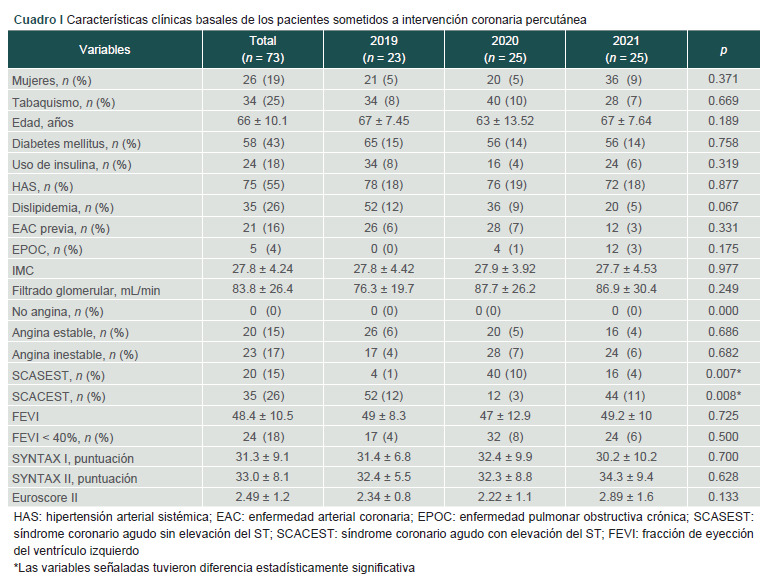
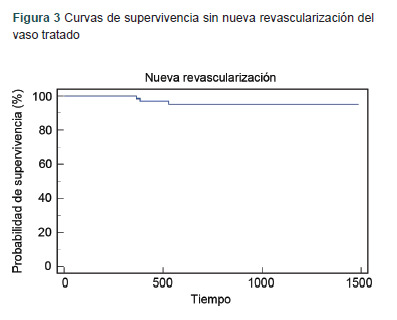
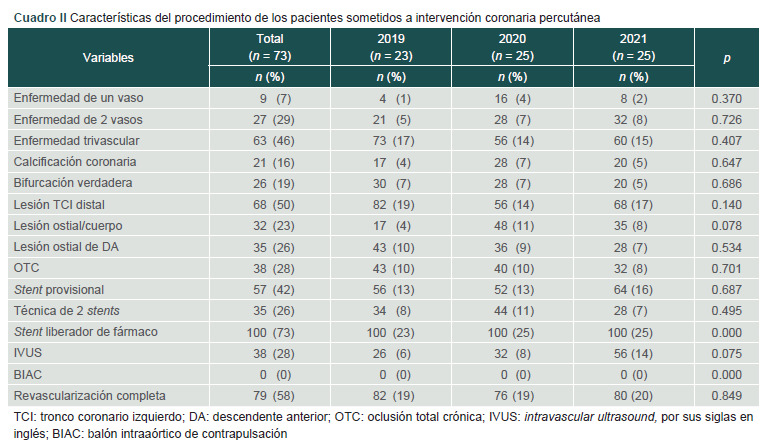
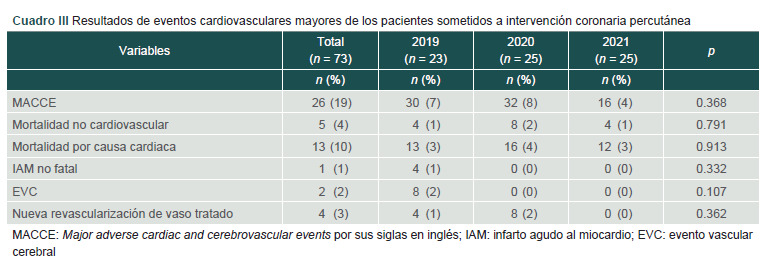
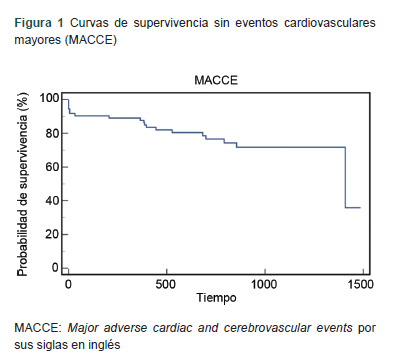
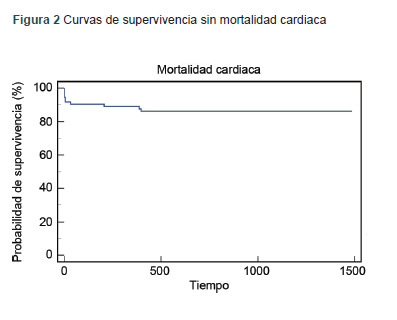
We included 73 patients, with a SYNTAX I score of 31.2 ± 9.1, mostly with ST-elevation acute coronary syndrome (35%). There was a higher frequency of triple vessel coronary disease (63%) and distal LMCA lesions (35%). The provisional stent technique was the most used for distal lesions (58%) and the 2-stent technique for bifurcation lesions (78%), supported by intravascular ultrasound (IVUS) in 38%. During follow-up, 19 presented MACCE (26%), out of which cardiac death occurred in 13%, non-cardiovascular death in 5%, non-fatal acute myocardial infarction in 1%, cerebrovascular event in 2%, and revascularization of the treated vessel in 4%.
It was observed a similar frequency to the one appearing in other studies of cardiovascular events, mainly in patients with intermediate risk, which supports the increasing use of percutaneous intervention in this population.
关于无保护左主干冠状动脉(LMCA)经皮冠状动脉介入治疗(PCI)的争论一直存在。
探讨无保护LMCA的PCI的临床和手术特征及心血管结局。
观察性研究,纳入接受PCI的无保护LMCA疾病患者;排除术前出现心源性休克的患者。我们根据手术年份描述临床和血管造影特征,以及主要不良心脑血管事件(MACCE)。
我们纳入了73例患者,SYNTAX I评分为31.2±9.1,大多数为ST段抬高型急性冠状动脉综合征(35%)。三支冠状动脉疾病(63%)和LMCA远端病变(35%)的发生率较高。临时支架技术最常用于远端病变(58%),双支架技术用于分叉病变(78%),38%的病例采用血管内超声(IVUS)辅助。随访期间,19例出现MACCE(26%),其中心脏死亡占13%,非心血管死亡占5%,非致命性急性心肌梗死占1%,脑血管事件占2%,治疗血管再血管化占4%。
观察到心血管事件的发生率与其他研究相似,主要发生在中度风险患者中,这支持了在该人群中越来越多地使用经皮介入治疗。