From the Departments of Neurology (J.G., A.S.C.-P., N.D., J.M., A.D.S., A.W.W., D.W.) and Psychiatry (E.M., D.W.), and Biostatistics and Epidemiology (S.X.X.), University of Pennsylvania, Philadelphia; Department of Biostatistics (C.G., C.C.-G., C.S.C.), University of Iowa; Department of Psychiatry (R.D.D.), Rutgers University, Newark, NJ; Department of Old Age Psychiatry (D.A.), Kings College London, UK; Neurological Institute (R.N.A.), Tel Aviv Sourasky Medical Center, Israel; Department of Neurology (R.N.A.), Columbia University Irving Medical Center, New York, NY; Department of Neurology (M.J.B.), Virginia Commonwealth University, Richmond, VA; Department of Neurology (L.C.), University of Pittsburgh, PA; The Michael J. Fox Foundation for Parkinson's Research (J.L.E.), New York, NY; James J. and Joan A. Gardner Family Center for Parkinson's Disease and Movement Disorders (A.J.E.), Department of Neurology, University of Cincinnati; Cleveland Clinic (J.B.L.), Neurological Institute, Lou Ruvo Center for Brain Health, OH; Department of Neuroscience (I.L.), University of California San Diego; Parkinson's Disease Research, Education and Clinical Center (PADRECC) (J.M., D.W.), Crescenz Veteran's Affairs Medical Center, Philadelphia, PA; Department of Neurology (I.H.R.), University of Rochester, NY; Department of Neurology (L.R.), Johns Hopkins University, Baltimore, MD; and Department of Neurology (T.S.), Northwestern University, Chicago, IL; Departments of Neurology and Psychiatry and Behavioral Sciences (M.K.Y.), Baylor College of Medicine, Houston, TX.
Neurology. 2024 Sep 10;103(5):e209699. doi: 10.1212/WNL.0000000000209699. Epub 2024 Aug 7.
It is widely cited that dementia occurs in up to 80% of patients with Parkinson disease (PD), but studies reporting such high rates were published over two decades ago, had relatively small samples, and had other limitations. We aimed to determine long-term dementia risk in PD using data from two large, ongoing, prospective, observational studies.
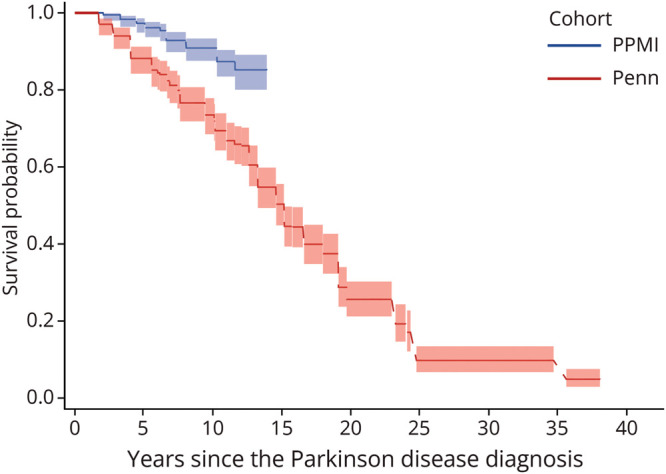
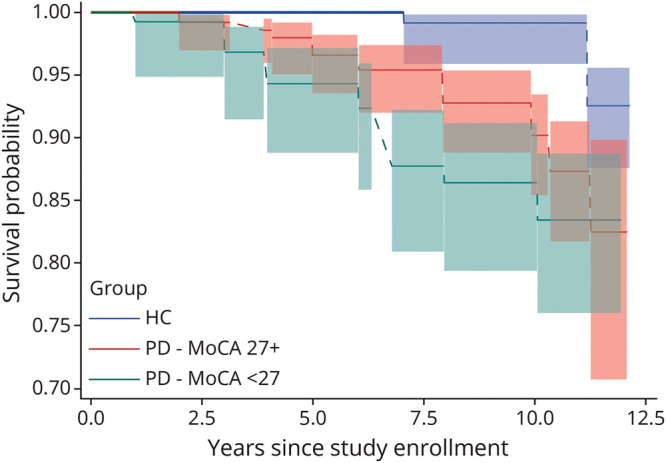
Participants from the Parkinson's Progression Markers Initiative (PPMI), a multisite international study, and a long-standing PD research cohort at the University of Pennsylvania (Penn), a single site study at a tertiary movement disorders center, were recruited. PPMI enrolled de novo, untreated PD participants and Penn a convenience cohort from a large clinical center. For PPMI, a cognitive battery is administered annually, and a site investigator makes a cognitive diagnosis. At Penn, a comprehensive cognitive battery is administered either annually or biennially, and a cognitive diagnosis is made by expert consensus. Interval-censored survival curves were fit for time from PD diagnosis to stable dementia diagnosis for each cohort, using cognitive diagnosis of dementia as the primary end point and Montreal Cognitive Assessment (MoCA) score <21 and Movement Disorder Society-Unified Parkinson's Disease Rating Scale (MDS-UPDRS) Part I cognition score ≥3 as secondary end points for PPMI. In addition, estimated dementia probability by PD disease duration was tabulated for each study and end point.
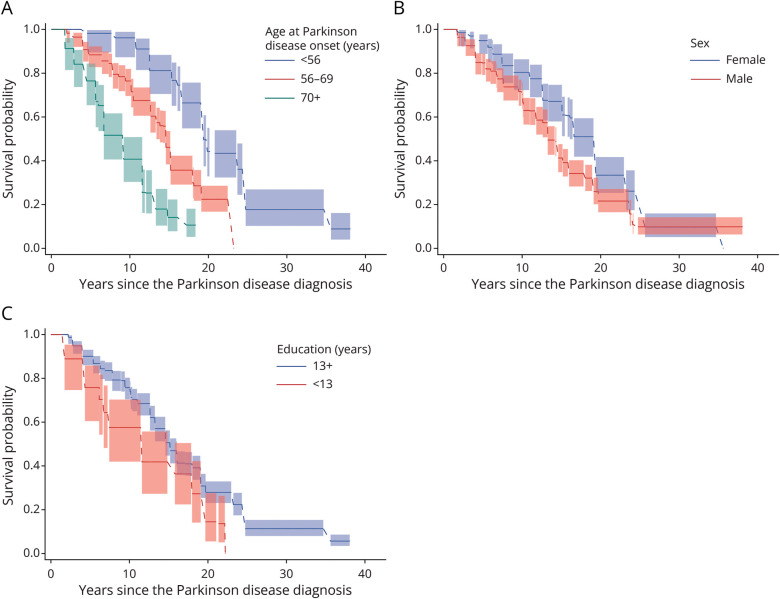
For the PPMI cohort, 417 participants with PD (mean age 61.6 years, 65% male) were followed, with an estimated probability of dementia at year 10 disease duration of 9% (site investigator diagnosis), 15% (MoCA), or 12% (MDS-UPDRS Part I cognition). For the Penn cohort, 389 participants with PD (mean age 69.3 years, 67% male) were followed, with 184 participants (47% of cohort) eventually diagnosed with dementia. The interval-censored curve for the Penn cohort had a median time to dementia of 15 years (95% CI 13-15); the estimated probability of dementia was 27% at 10 years of disease duration, 50% at 15 years, and 74% at 20 years.
Results from two large, prospective studies suggest that dementia in PD occurs less frequently, or later in the disease course, than previous research studies have reported.
帕金森病(PD)患者中有高达 80%的人会发生痴呆,但报告如此高发病率的研究是在二十多年前发表的,样本量相对较小,且存在其他局限性。我们旨在使用来自两项大型、正在进行的、前瞻性、观察性研究的数据来确定 PD 患者的长期痴呆风险。
这项研究招募了帕金森病进展标志物倡议(PPMI)的参与者,这是一项多地点国际研究,以及宾夕法尼亚大学(宾夕法尼亚州)的一个长期 PD 研究队列,这是一个在三级运动障碍中心的单一地点研究。PPMI 招募了未经治疗的新发 PD 参与者,而宾夕法尼亚州则从一个大型临床中心招募了一个方便的队列。对于 PPMI,每年进行一次认知测试,由现场调查员进行认知诊断。在宾夕法尼亚州,每年或每两年进行一次全面的认知测试,并由专家共识进行认知诊断。对于每个队列,使用痴呆的认知诊断作为主要终点,蒙特利尔认知评估(MoCA)<21 和运动障碍协会统一帕金森病评定量表(MDS-UPDRS)第 I 部分认知评分≥3 作为次要终点,为每个队列拟合从 PD 诊断到稳定痴呆诊断的时间的间隔censored 生存曲线。此外,为每个研究和终点列出了按 PD 病程估计的痴呆概率。
对于 PPMI 队列,417 名 PD 患者(平均年龄 61.6 岁,65%为男性)接受了随访,在第 10 年疾病病程时的痴呆估计概率为 9%(现场调查员诊断)、15%(MoCA)或 12%(MDS-UPDRS 第 I 部分认知)。对于宾夕法尼亚州队列,389 名 PD 患者(平均年龄 69.3 岁,67%为男性)接受了随访,其中 184 名患者(队列的 47%)最终被诊断为痴呆。宾夕法尼亚州队列的间隔censored 曲线的痴呆中位时间为 15 年(95%CI 13-15);估计的痴呆概率为 10 年病程时为 27%,15 年时为 50%,20 年时为 74%。
两项大型前瞻性研究的结果表明,PD 中的痴呆发生频率较低,或在疾病过程中较晚发生,与以前的研究报告不同。