Sugawara Hiroyuki, Saito Atsushi, Yokoyama Saori, Chiba Hirofumi
Department of Respiratory Medicine and Allergology, Sapporo Medical University School of Medicine, S1W16 Chuoku Sapporo, Sapporo, Hokkaido, 060-8543, Japan.
Sugawara Internal Medicine and Respiratory Clinic, Tomakomai, 053-0821, Japan.
Respir Res. 2024 Aug 7;25(1):300. doi: 10.1186/s12931-024-02921-z.
In recent years, the incorporation of LAMAs into asthma therapy has been expected to enhance symptom control. However, a significant number of patients with asthma continue to experience poorly managed symptoms. There have been limited investigations on LAMA-induced airway alterations in asthma treatment employing IOS. In this study, we administered a LAMA to patients with poorly controlled asthma, evaluated clinical responses and respiratory function, and investigated airway changes facilitated by LAMA treatments using the IOS.
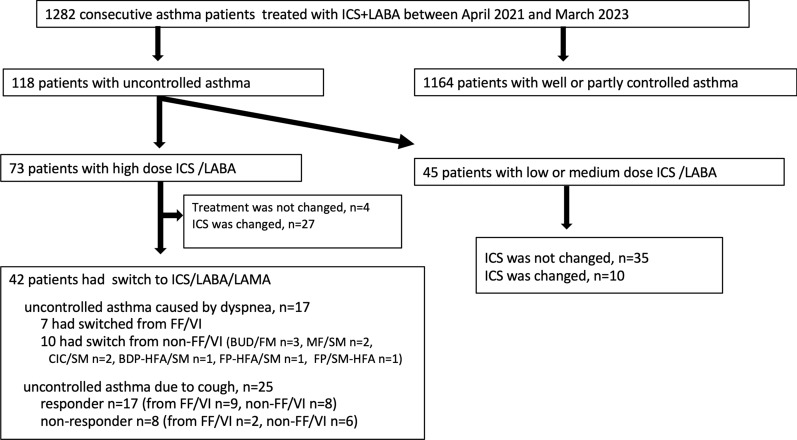
Of a total of 1282 consecutive patients with asthma, 118 exhibited uncontrolled symptoms. Among them, 42 switched their treatment to high-dose fluticasone furoate/umeclidinium/vilanterol (FF/UMEC/VI) (ICS/LABA/LAMA). The patients were then assessed using AHQ-33 or LCQ and ACT. Spirometry parameters (such as FEV or MMEF) and IOS parameters (such as R20 or AX) were measured and compared before and after exacerbations and the addition of LAMA.
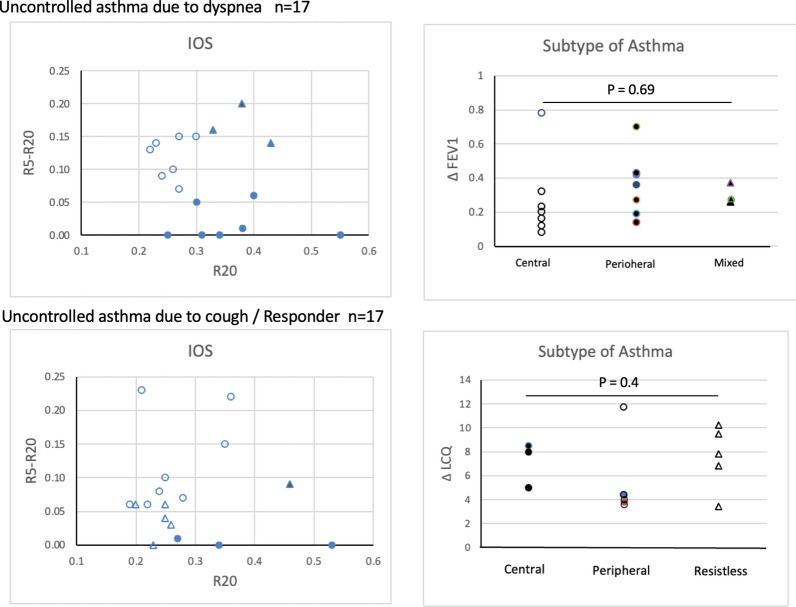
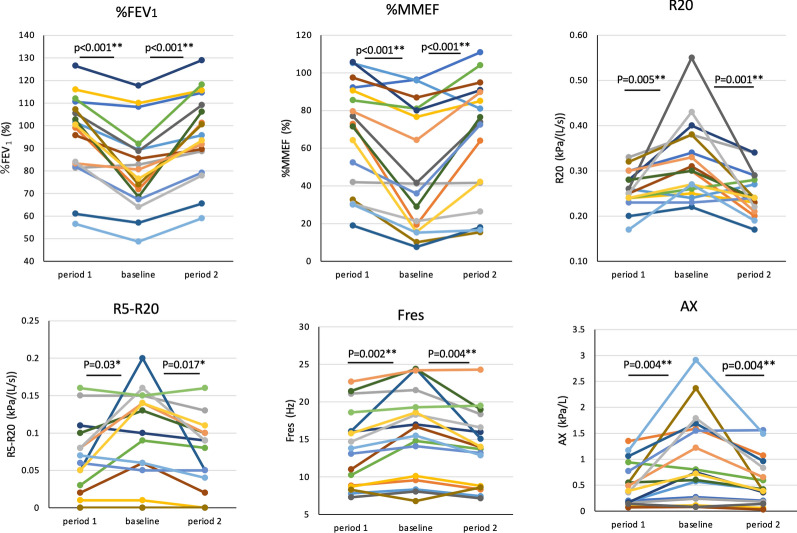
Of the 42 patients, 17 who switched to FF/UMEC/VI caused by dyspnea exhibited decreased pulmonary function between period 1 and baseline, followed by an increase in pulmonary function between baseline and period 2. Significant differences were observed in IOS parameters such as R20, R5-R20, Fres, or AX between period 1 and baseline as well as between baseline and period 2. Among the patients who switched to inhaler due to cough, 25 were classified as responders (n = 17) and nonresponders (n = 8) based on treatment outcomes. Among nonresponders, there were no significant differences in spirometry parameters such as FEV or PEF and IOS parameters such as R20 or AX between period 1 and baseline. However, among responders, significant differences were observed in all IOS parameters, though not in most spirometry parameters, between period 1 and baseline. Furthermore, significant differences were noted between baseline and period 2 in terms of FEV, %MMEF, %PEF, and all IOS parameters.
ICS/LABA/LAMA demonstrates superiority over ICS/LABA in improving symptoms and lung function, which is primarily attributed to the addition of LAMA. Additionally, IOS revealed the effectiveness of LAMA across all airway segments, particularly in the periphery. Hence, LAMA can be effective against various asthma phenotypes characterized by airway inflammation, even in real-world cases.
近年来,长效抗胆碱能药物(LAMA)被纳入哮喘治疗有望增强症状控制。然而,仍有相当数量的哮喘患者症状控制不佳。关于在哮喘治疗中使用脉冲振荡法(IOS)研究LAMA引起的气道改变的调查有限。在本研究中,我们对症状控制不佳的哮喘患者给予LAMA,评估临床反应和呼吸功能,并使用IOS研究LAMA治疗引起的气道变化。
在总共1282例连续的哮喘患者中,118例表现出症状未得到控制。其中,42例将治疗方案改为高剂量糠酸氟替卡松/乌美溴铵/维兰特罗(FF/UMEC/VI)(吸入性糖皮质激素/长效β2受体激动剂/LAMA)。然后使用哮喘控制问卷-33(AHQ-33)或莱斯特咳嗽问卷(LCQ)以及哮喘控制测试(ACT)对患者进行评估。在病情加重期和添加LAMA前后测量并比较肺功能仪参数(如第一秒用力呼气容积(FEV)或最大呼气中期流速(MMEF))和IOS参数(如R20或气道反应性(AX))。
在这42例患者中,17例因呼吸困难改为FF/UMEC/VI治疗的患者在第1阶段和基线之间肺功能下降,随后在基线和第2阶段之间肺功能增加。在第1阶段与基线之间以及基线与第2阶段之间,在IOS参数如R20、R5-R20、呼吸阻力(Fres)或AX方面观察到显著差异。在因咳嗽改为吸入治疗的患者中,根据治疗结果将25例分为反应者(n = 17)和无反应者(n = 8)。在无反应者中,第1阶段与基线之间在肺功能仪参数如FEV或呼气峰值流速(PEF)以及IOS参数如R20或AX方面没有显著差异。然而,在反应者中,第1阶段与基线之间在所有IOS参数方面观察到显著差异,尽管在大多数肺功能仪参数方面没有差异。此外,在基线与第2阶段之间,在FEV、%MMEF、%PEF和所有IOS参数方面观察到显著差异。
吸入性糖皮质激素/长效β2受体激动剂/LAMA在改善症状和肺功能方面显示出优于吸入性糖皮质激素/长效β2受体激动剂,这主要归因于添加了LAMA。此外,IOS显示LAMA在所有气道节段均有效,尤其是在外周气道。因此,即使在实际病例中,LAMA对以气道炎症为特征的各种哮喘表型也可能有效。