Airway Disease Section, National Heart and Lung Institute, Imperial College, London, UK.
PROMISE Department of Medicine, University of Palermo, Palermo, Italy.
Int J Chron Obstruct Pulmon Dis. 2020 Oct 7;15:2433-2440. doi: 10.2147/COPD.S269001. eCollection 2020.
There is a clear correlation between small airways dysfunction and poor clinical outcomes in patients with chronic obstructive pulmonary disease (COPD), and it is therefore important that inhalation therapy (both bronchodilator and anti-inflammatory) can deposit in the small airways. Two single-inhaler triple therapy (SITT) combinations are currently approved for the maintenance treatment of COPD: extrafine formulation beclomethasone dipropionate/formoterol fumarate/glycopyrronium bromide (BDP/FF/GB), and non-extrafine formulation fluticasone furoate/vilanterol/umeclidinium (FluF/VI/UMEC). This study evaluated the lung deposition of the inhaled corticosteroid (ICS), long-acting β-agonist (LABA), and long-acting muscarinic antagonist (LAMA) components of these two SITTs.
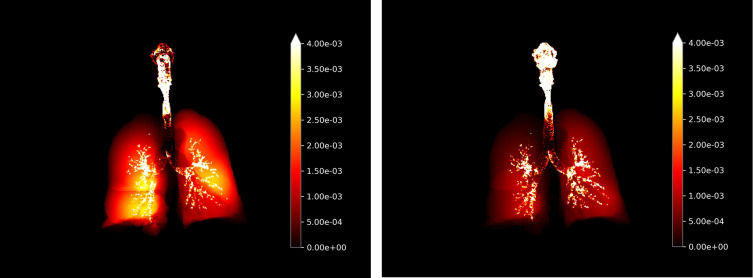
Lung deposition was estimated in-silico using functional respiratory imaging, a validated technique that uses aerosol delivery performance profiles, patients' high-resolution computed tomography (HRCT) lung scans, and patient-derived inhalation profiles to simulate aerosol lung deposition.
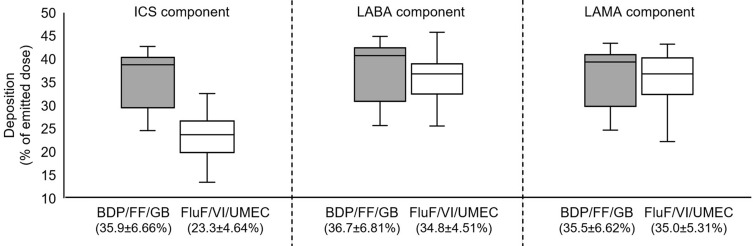
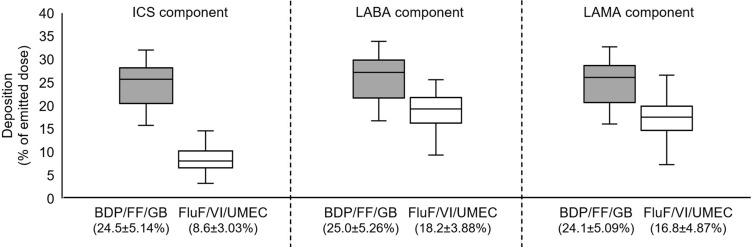
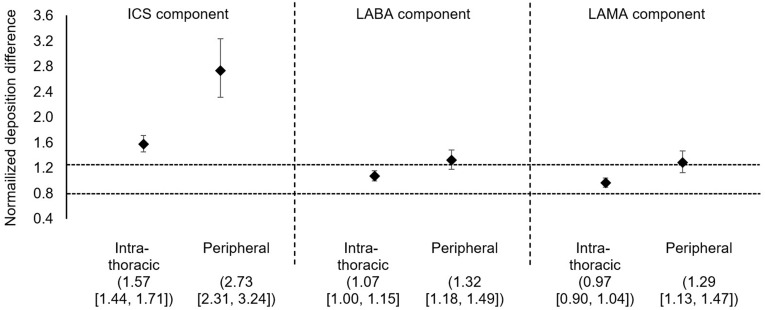
HRCT scan data from 20 patients with COPD were included in these analyses, who had post-bronchodilator forced expiratory volume in 1 second (FEV) ranging from 19.3% to 66.0% predicted. For intrathoracic deposition (as a percentage of the emitted dose), deposition of the ICS component was higher from BDP/FF/GB than FluF/VI/UMEC; the two triple therapies had similar performance for both the LABA component and the LAMA component. Peripheral deposition of all three components was higher with BDP/FF/GB than FluF/VI/UMEC. Furthermore, the ratios of central to peripheral deposition for all three components of BDP/FF/GB were <1, indicating greater peripheral than central deposition (0.48±0.13, 0.48±0.13 and 0.49±0.13 for BDP, FF and GB, respectively; 1.96±0.84, 0.97±0.34 and 1.20±0.48 for FluF, VI and UMEC, respectively).
Peripheral (small airways) deposition of all three components (ICS, LABA, and LAMA) was higher from BDP/FF/GB than from FluF/VI/UMEC, based on profiles from patients with moderate to very severe COPD. This is consistent with the extrafine formulation of BDP/FF/GB.
在慢性阻塞性肺疾病(COPD)患者中,小气道功能障碍与临床预后不良之间存在明显的相关性,因此吸入疗法(包括支气管扩张剂和抗炎药)能够在小气道中沉积是很重要的。目前有两种单吸入器三联疗法(SITT)组合被批准用于 COPD 的维持治疗:精细配方丙酸倍氯米松/富马酸福莫特罗/格隆溴铵(BDP/FF/GB)和非精细配方糠酸氟替卡松/维兰特罗/乌美溴铵(FluF/VI/UMEC)。本研究评估了这两种 SITT 中吸入性皮质类固醇(ICS)、长效β-激动剂(LABA)和长效抗胆碱能药物(LAMA)成分的肺部沉积情况。
使用功能呼吸成像进行了体内沉积的计算估计,这是一种经过验证的技术,它使用气溶胶输送性能曲线、患者的高分辨率计算机断层扫描(HRCT)肺部扫描和患者衍生的吸入曲线来模拟气溶胶肺部沉积。
对 20 名 COPD 患者的 HRCT 扫描数据进行了分析,这些患者支气管扩张剂后的一秒用力呼气量(FEV)在 19.3%至 66.0%预计值之间。对于胸内沉积(占发射剂量的百分比),BDP/FF/GB 中的 ICS 成分的沉积高于 FluF/VI/UMEC;两种三联疗法在 LABA 成分和 LAMA 成分方面表现相似。所有三种成分的外周沉积均高于 BDP/FF/GB。此外,BDP/FF/GB 中所有三种成分的中央到外周沉积的比值均<1,表明外周沉积多于中央沉积(BDP、FF 和 GB 分别为 0.48±0.13、0.48±0.13 和 0.49±0.13;FluF、VI 和 UMEC 分别为 1.96±0.84、0.97±0.34 和 1.20±0.48)。
基于中至重度 COPD 患者的情况,BDP/FF/GB 中所有三种成分(ICS、LABA 和 LAMA)的外周(小气道)沉积均高于 FluF/VI/UMEC。这与 BDP/FF/GB 的精细配方一致。