Huang Wuqing, Gan Zhaojing, Gao Ziting, Lin Qiaofen, Li Xiaojiang, Xie Wenhui, Gao Zesen, Zhou Zhixian, Qiu Ziyi, Qiu Weihong, Du Shanshan, Chen Liangwan, Hong Huashan, Ye Weimin
Department of Epidemiology and Health Statistics, School of Public Health, Fujian Medical University, University Town, No 1, Xue Yuan Road, Fujian, 350108, China.
Department of Geriatrics, Fujian Key Laboratory of Vascular Aging, Fujian Institute of Geriatrics, Union Hospital, Fujian Medical University,, Fujian, 350001, China.
BMC Med. 2024 Aug 7;22(1):325. doi: 10.1186/s12916-024-03546-1.
Obesity has been linked to arterial stiffness, while no consensus was reached on the association. We aimed to clarify the association of general and central obesity with arterial stiffness by combining observational studies and Mendelian randomization (MR) study.
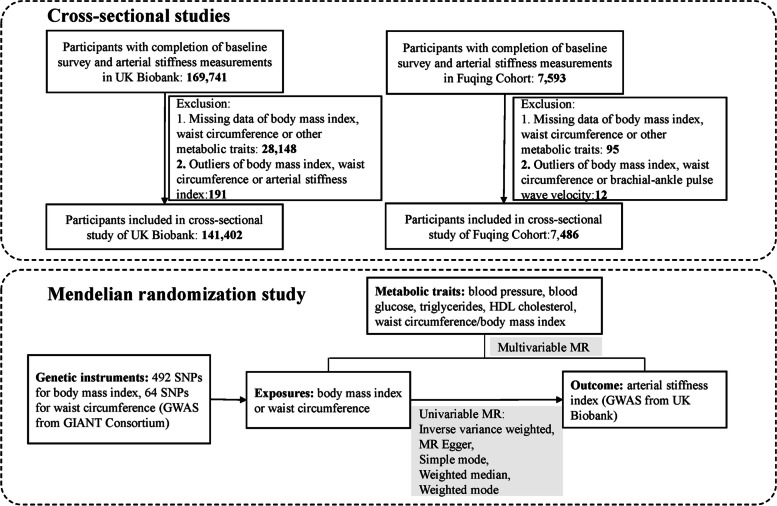
Two cross-sectional studies were performed in UK Biobank and Fuqing Cohort, respectively. Two-sample MR study was conducted using summary data of GWASs from GIANT consortium and UK Biobank. General obesity and central obesity were measured using body mass index (BMI) and waist circumference (WC), respectively. Arterial stiffness was measured by arterial stiffness index (ASI) in UK Biobank or branchial-ankle pulse wave velocity (baPWV) in Fuqing Cohort.
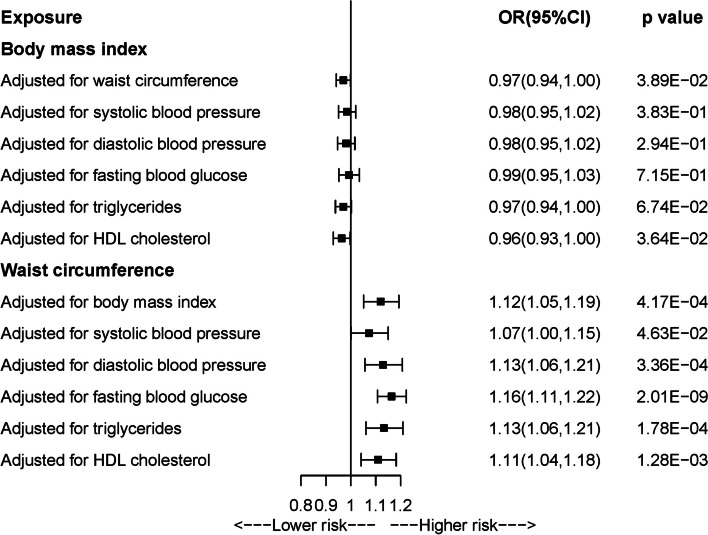
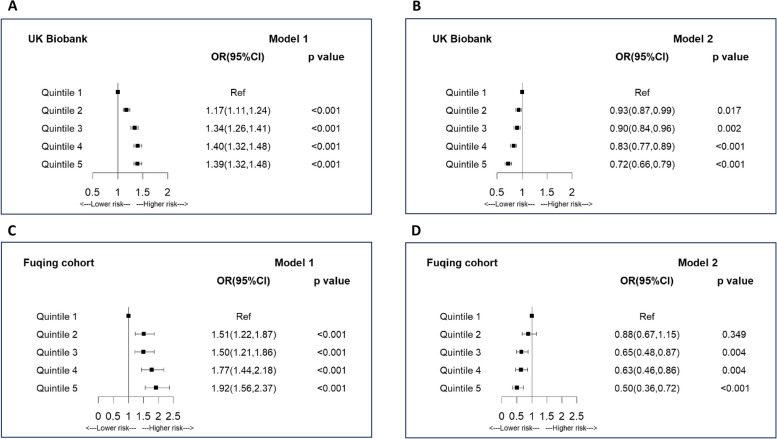
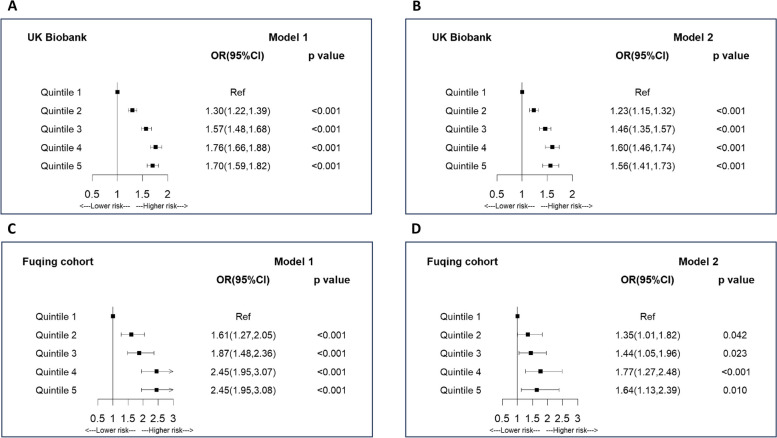
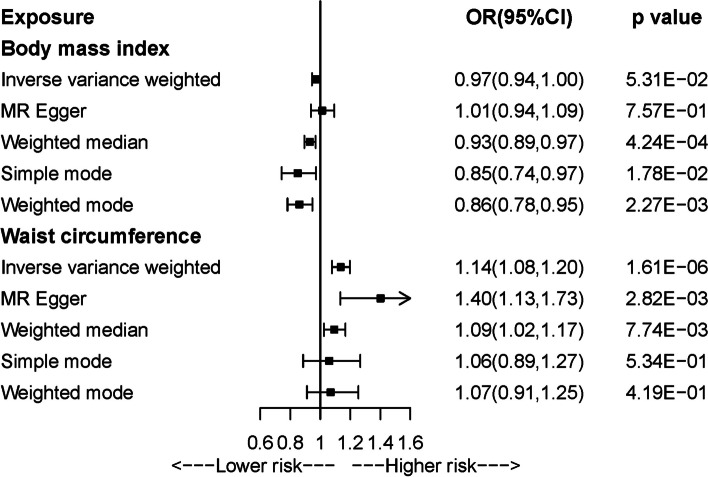
Two observational studies found a consistent positive association of BMI and WC with arterial stiffness when adjusting for age, sex, education, smoking, alcohol drinking, physical activity, and LDL cholesterol. However, when additionally adjusting for metabolic traits (i.e., systolic blood pressure, diastolic blood pressure, blood glucose, triglycerides, high-density lipoprotein cholesterol, and WC or BMI), the association with BMI changed to be inverse. As compared to the lowest quintile group, the adjusted ORs across groups of second to fifth quintile were 0.93, 0.90, 0.83, and 0.72 in UK Biobank and 0.88, 0.65, 0.63, and 0.50 in Fuqing Cohort. In contrast, the positive relationship with WC remained stable with the adjusted ORs of 1.23, 1.46, 1.60, and 1.56 in UK Biobank and 1.35, 1.44, 1.77, and 1.64 in Fuqing Cohort. MR analyses provided supportive evidence of the negative association with BMI (OR = 0.97, 95%CI = 0.94-1.00) and the positive association with WC (OR = 1.14, 95%CI = 1.08-1.20).
Observational and genetic analyses provide concordant results that central obesity is independently related to arterial stiffness, while the role of general obesity depends on metabolic status.
肥胖与动脉僵硬度有关,但对此关联尚未达成共识。我们旨在通过结合观察性研究和孟德尔随机化(MR)研究来阐明一般肥胖和中心性肥胖与动脉僵硬度之间的关联。
分别在英国生物银行和福清队列中进行了两项横断面研究。使用来自GIANT联盟和英国生物银行的全基因组关联研究(GWAS)汇总数据进行两样本MR研究。一般肥胖和中心性肥胖分别使用体重指数(BMI)和腰围(WC)来衡量。在英国生物银行中通过动脉僵硬度指数(ASI)测量动脉僵硬度,在福清队列中通过臂踝脉搏波速度(baPWV)测量。
两项观察性研究发现,在调整年龄、性别、教育程度、吸烟、饮酒、身体活动和低密度脂蛋白胆固醇后,BMI和WC与动脉僵硬度呈一致的正相关。然而,当进一步调整代谢特征(即收缩压、舒张压、血糖、甘油三酯、高密度脂蛋白胆固醇以及WC或BMI)时,与BMI的关联变为负相关。与最低五分位数组相比,在英国生物银行中,第二至第五五分位数组的调整后比值比分别为0.93、0.90、0.83和0.72,在福清队列中分别为0.88、0.65、0.63和0.50。相比之下,与WC的正相关关系保持稳定,在英国生物银行中调整后比值比分别为1.23、1.46、1.60和1.56,在福清队列中分别为1.35、1.44、1.77和1.64。MR分析为与BMI的负相关(比值比=0.97,95%置信区间=0.94 - 1.00)和与WC的正相关(比值比=1.14,95%置信区间=1.08 - 1.20)提供了支持性证据。
观察性和基因分析提供了一致的结果,即中心性肥胖与动脉僵硬度独立相关,而一般肥胖的作用取决于代谢状态。