Fu Qi-Rui, Peng Sha, Zhu Chang-Qing, Chen Lu-Si, Sun Yan, Li Wan-Mei
Department of Endocrinology, Guangzhou Twelfth People' s Hospital (Guangzhou Occupational Disease Prevention and Treatment Hospital, Guangzhou Otolaryngology-Head and Neck Surgery Hospital), Guangzhou, China.
Department of Pediatrics, Air Force Hospital of PLA Southern Theater, Guangzhou, China.
Skin Res Technol. 2024 Aug;30(8):e13919. doi: 10.1111/srt.13919.
Diabetes mellitus (DM) presents impediment to wound healing. While ultraviolet B (UVB) exposure showed therapeutic potential in various skin conditions, its capacity to mediate diabetic wound healing remains unclear. To investigate the efficacy of UVB on wound healing and its underlying basis.
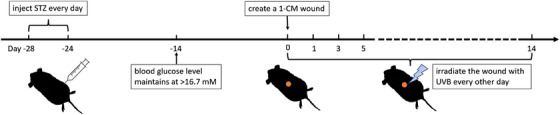
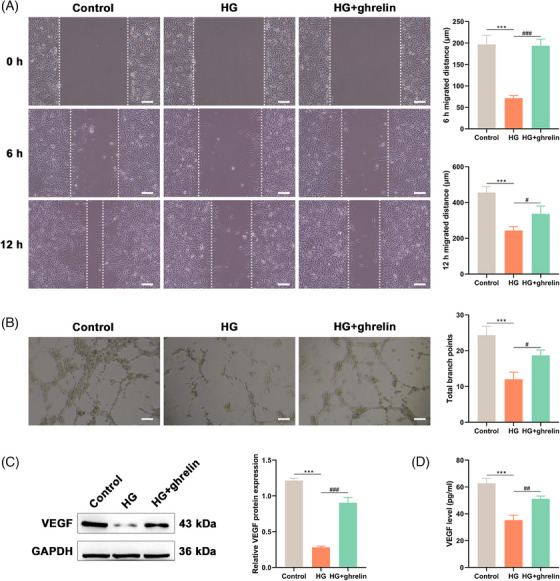
Male C57BL/6 mice were subjected to the high-fat diet followed by streptozotocin administration to establish the diabetic model. Upon confirmation of diabetes, full-thickness wounds were inflicted and the treatment group received UVB radiation at 50 mJ/cm for 5 min every alternate day for 2 weeks. Wound healing rate was then assessed, accompanied by evaluations of blood glucose, lipid profiles, CD31 expression, and concentrations of ghrelin and leptin. Concurrently, in vitro studies were executed to evaluate the protective role of ghrelin on human umbilical vein endothelial cells (HUVEC) under high glucose (HG) conditions.
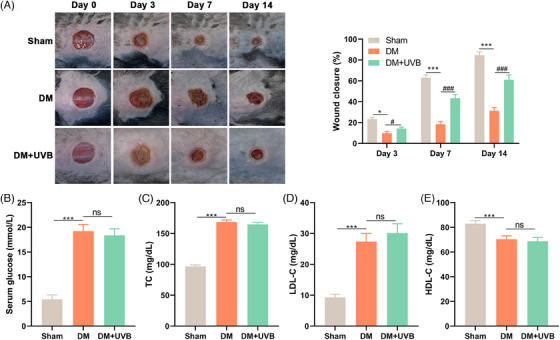
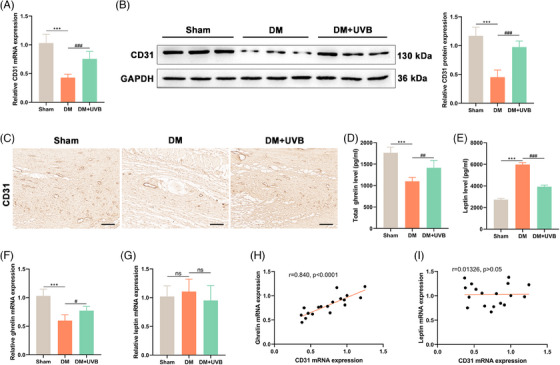
Post UVB exposure, there was a marked acceleration in wound healing in DM mice without alterations in hyperglycemia and lipid profiles. Compared to non-UVB-exposed mice, the UVB group showed enhanced angiogenesis manifested by a surge in CD31 expression. This trend appeared to be in harmony with the elevated ghrelin levels. In vitro experiments indicated that ghrelin significantly enhanced the migratory pace and angiogenic properties of HUVEC under HG-induced stress, potentially mediated by an upregulation in vascular endothelial growth factor expression.
UVB exposure bolstered wound healing in diabetic mice, plausibly mediated through augmented angiogenesis induced by ghrelin secretion. Such findings underscore the vast potential of UVB-induced ghrelin in therapeutic strategies targeting diabetic wound healing.
糖尿病(DM)对伤口愈合造成阻碍。虽然紫外线B(UVB)照射在多种皮肤疾病中显示出治疗潜力,但其介导糖尿病伤口愈合的能力仍不明确。本研究旨在探讨UVB对伤口愈合的疗效及其潜在机制。
雄性C57BL/6小鼠先给予高脂饮食,随后注射链脲佐菌素以建立糖尿病模型。确认糖尿病后,造成全层伤口,治疗组每隔一天接受50 mJ/cm的UVB辐射,持续5分钟,共2周。然后评估伤口愈合率,并同时评估血糖、血脂、CD31表达以及胃饥饿素和瘦素的浓度。同时,进行体外研究以评估胃饥饿素在高糖(HG)条件下对人脐静脉内皮细胞(HUVEC)的保护作用。
UVB照射后,糖尿病小鼠的伤口愈合明显加速,且血糖和血脂水平无变化。与未接受UVB照射的小鼠相比,UVB组的血管生成增强,表现为CD31表达增加。这一趋势似乎与胃饥饿素水平升高一致。体外实验表明,胃饥饿素在HG诱导的应激下显著提高了HUVEC的迁移速度和血管生成特性,这可能是由血管内皮生长因子表达上调介导的。
UVB照射促进了糖尿病小鼠的伤口愈合,可能是通过胃饥饿素分泌增加诱导的血管生成增强来介导的。这些发现强调了UVB诱导的胃饥饿素在针对糖尿病伤口愈合的治疗策略中的巨大潜力。