Yen Patrick Szu-Ying, Tu Hung-Pin, Huang Shu-Hung, Lee Su-Shin
School of Medicine, Kaohsiung Medical University, Kaohsiung, Taiwan.
Department of Public Health and Environmental Medicine, School of Medicine, College of Medicine, Kaohsiung Medical University, Taiwan.
Int J Med Sci. 2024 Jul 9;21(10):1799-1805. doi: 10.7150/ijms.95372. eCollection 2024.
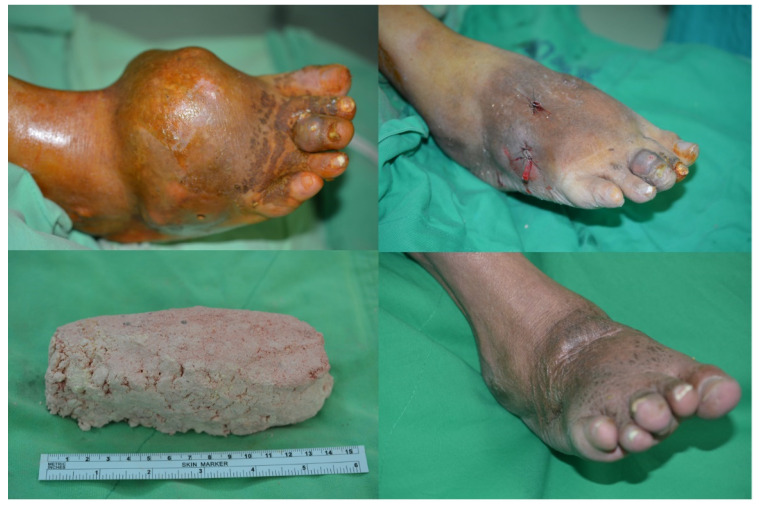
Current treatments with urate-lowering therapy (ULT) are effective for most patients with gout. However, approximately 10% of these patients do not respond well to ULT and develop chronic tophus lesions. This study aimed to evaluate the efficacy of surgery involving the shaver technique against chronic tophus lesions. This single-center, retrospective cohort study included 217 patients who had cumulatively undergone 303 shaver-assisted procedures between 2002 and 2018. Surgical outcomes were assessed in terms of the length of hospital stay (LOS) and wound healing time. LOS and wound healing time were longer in patients with a preoperative tophus infection and lower extremity lesions than in those without infection and with upper extremity lesions (respectively, LOS: 12.7 vs. 8.6 days; wound healing time: 22.7 vs. 16.3 days). However, factors such as age, sex, body mass index, renal function, or uricemia level exerted no significant effect on surgical outcomes. Surgery involving the shaver technique should be performed before tophus infection. Clinical outcomes tend to be better for upper extremity lesions than for lower extremity lesions.
目前的降尿酸治疗(ULT)对大多数痛风患者有效。然而,这些患者中约有10%对ULT反应不佳,并出现慢性痛风石病变。本研究旨在评估采用刨削技术的手术治疗慢性痛风石病变的疗效。这项单中心回顾性队列研究纳入了217例患者,他们在2002年至2018年间累计接受了303次刨削辅助手术。根据住院时间(LOS)和伤口愈合时间评估手术结果。术前有痛风石感染和下肢病变的患者的LOS和伤口愈合时间比无感染和上肢病变的患者更长(LOS分别为:12.7天对8.6天;伤口愈合时间为:22.7天对16.3天)。然而,年龄、性别、体重指数、肾功能或血尿酸水平等因素对手术结果没有显著影响。应在痛风石感染前进行采用刨削技术的手术。上肢病变的临床结果往往优于下肢病变。