Carroll Darian T, Miller Allie, Fuhr Jennifer, Elsakr Joseph M, Ricciardi Valerie, Del Bene Alexa N, Stephens Stedman, Krystofiak Evan, Lindsley Sarah R, Kirigiti Melissa, Takahashi Diana L, Dean Tyler A, Wesolowski Stephanie R, McCurdy Carrie E, Friedman Jacob E, Aagaard Kjersti M, Kievit Paul, Gannon Maureen
Department of Molecular Physiology and Biophysics, Vanderbilt University, Nashville, TN, United States.
Department of Medicine, Vanderbilt University Medical Center, Nashville, TN, United States.
Front Endocrinol (Lausanne). 2024 Jul 24;15:1417437. doi: 10.3389/fendo.2024.1417437. eCollection 2024.
Using a non-human primate (NHP) model of maternal Western-style diet (mWSD) feeding during pregnancy and lactation, we previously reported altered offspring beta:alpha cell ratio and insulin hyper-secretion Mitochondria are known to maintain beta-cell function by producing ATP for insulin secretion. In response to nutrient stress, the mitochondrial network within beta cells undergoes morphological changes to maintain respiration and metabolic adaptability. Given that mitochondrial dynamics have also been associated with cellular fate transitions, we assessed whether mWSD exposure was associated with changes in markers of beta-cell maturity and/or mitochondrial morphology that might explain the offspring islet phenotype.
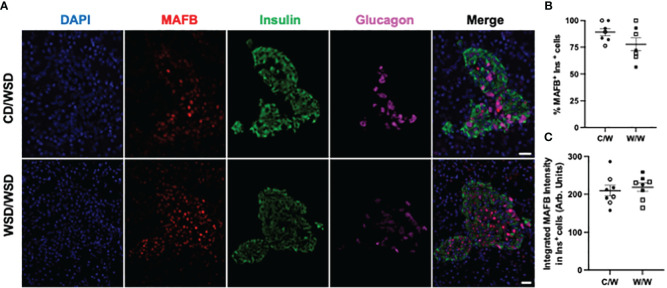
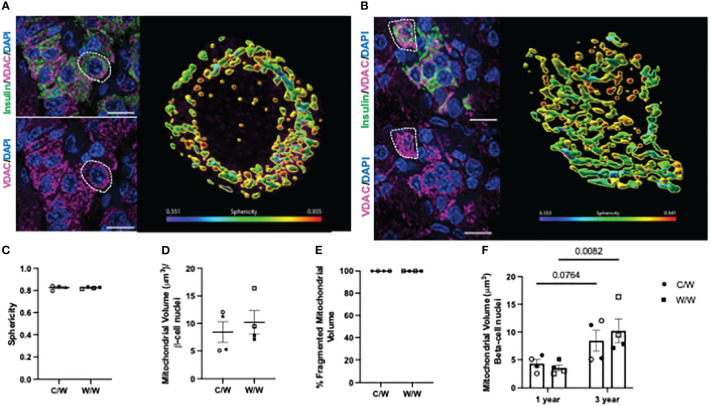
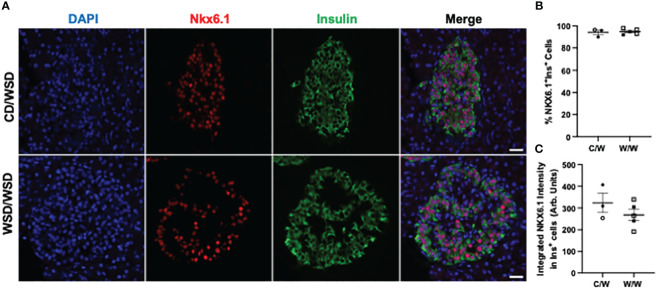
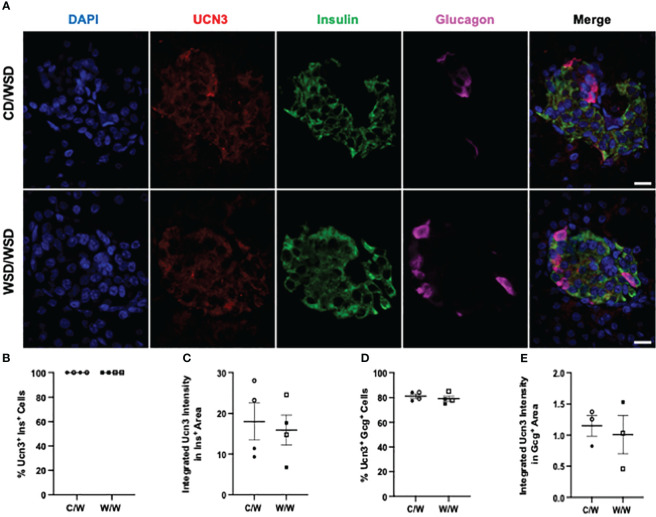
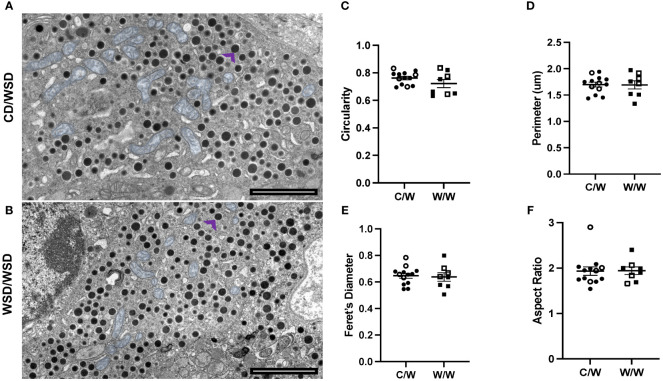
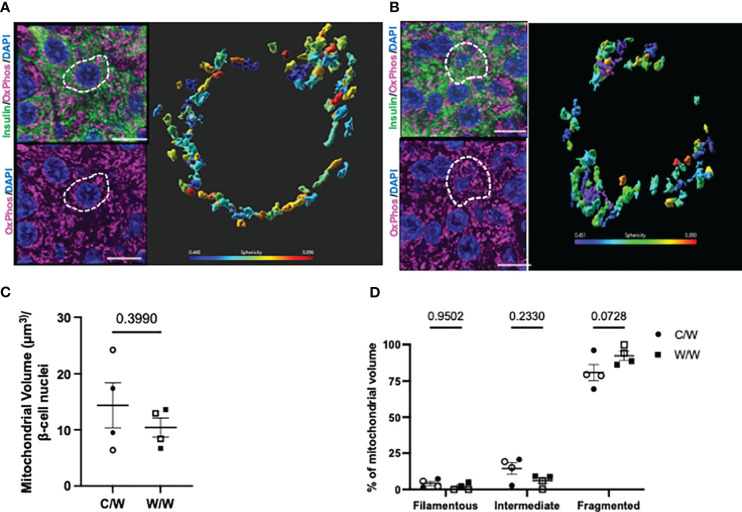
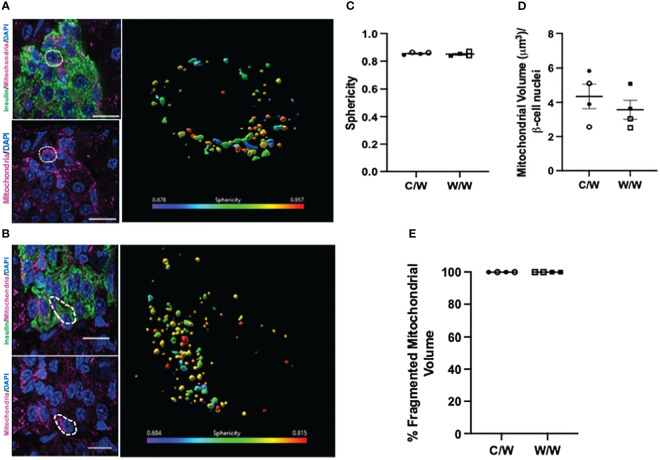
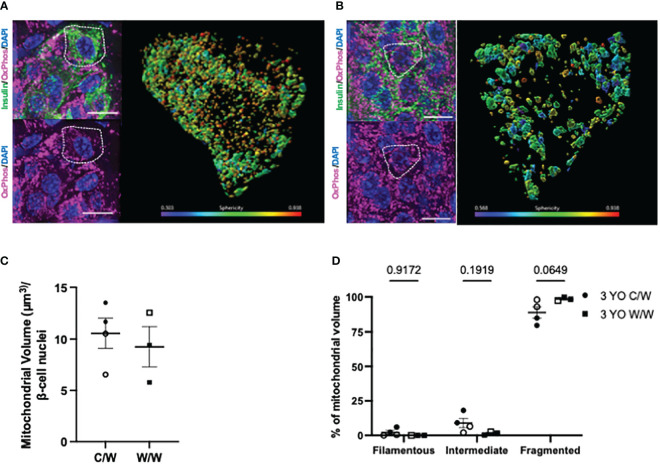
We evaluated the expression of beta-cell identity/maturity markers (NKX6.1, MAFB, UCN3) via florescence microscopy in islets of Japanese macaque pre-adolescent (1 year old) and peri-adolescent (3-year-old) offspring born to dams fed either a control diet or WSD during pregnancy and lactation and weaned onto WSD. Mitochondrial morphology in NHP offspring beta cells was analyzed in 2D by transmission electron microscopy and in 3D using super resolution microscopy to deconvolve the beta-cell mitochondrial network.
There was no difference in the percent of beta cells expressing key maturity markers in NHP offspring from WSD-fed dams at 1 or 3 years of age; however, beta cells of WSD-exposed 3 year old offspring showed increased levels of NKX6.1 per beta cell at 3 years of age. Regardless of maternal diet, the beta-cell mitochondrial network was found to be primarily short and fragmented at both ages in NHP; overall mitochondrial volume increased with age. and lactational exposure to maternal WSD consumption may increase mitochondrial fragmentation.
Despite mWSD consumption having clear developmental effects on offspring beta:alpha cell ratio and insulin secretory response to glucose, this does not appear to be mediated by changes to beta-cell maturity or the beta-cell mitochondrial network. In general, the more fragmented mitochondrial network in NHP beta cells suggests greater ability for metabolic flexibility.
我们之前报道过,在怀孕和哺乳期使用母体西式饮食(mWSD)喂养的非人灵长类动物(NHP)模型,后代的β细胞与α细胞比例会发生改变,且会出现胰岛素高分泌。已知线粒体通过产生三磷酸腺苷(ATP)来维持β细胞功能,以供胰岛素分泌。在营养应激状态下,β细胞内的线粒体网络会发生形态变化,以维持呼吸作用和代谢适应性。鉴于线粒体动态变化也与细胞命运转变相关,我们评估了暴露于mWSD是否与β细胞成熟标志物和/或线粒体形态变化有关,这些变化可能解释后代胰岛表型。
我们通过荧光显微镜评估了日本猕猴青春期前(1岁)和青春期前后(3岁)后代胰岛中β细胞身份/成熟标志物(NKX6.1、MAFB、UCN3)的表达,这些后代的母亲在怀孕和哺乳期喂食对照饮食或WSD,并在断奶后继续喂食WSD。通过透射电子显微镜在二维层面分析NHP后代β细胞中的线粒体形态,并使用超分辨率显微镜在三维层面进行分析,以解卷积β细胞线粒体网络。
在1岁或3岁时,来自喂食WSD的母猴的NHP后代中,表达关键成熟标志物的β细胞百分比没有差异;然而,在3岁时,暴露于WSD的3岁后代的β细胞中,每个β细胞的NKX6.1水平有所增加。无论母体饮食如何,在NHP的两个年龄段中,β细胞线粒体网络主要都是短而碎片化的;总体线粒体体积随年龄增长而增加。哺乳期暴露于母体WSD摄入可能会增加线粒体碎片化。
尽管摄入mWSD对后代β细胞与α细胞比例以及胰岛素对葡萄糖的分泌反应有明显的发育影响,但这似乎不是由β细胞成熟度或β细胞线粒体网络的变化介导的。一般来说,NHPβ细胞中线粒体网络碎片化程度越高,表明其代谢灵活性越强。