Za Pierangelo, Papalia Giuseppe Francesco, Russo Fabrizio, Vasta Sebastiano, Vadalà Gianluca, Papalia Rocco
Department of Orthopaedics and Trauma Surgery, Università Campus Bio-Medico di Roma, Rome, Italy.
Research Unit of Orthopaedic and Trauma Surgery, Fondazione Policlinico Universitario Campus Bio-Medico, Rome, Italy.
Ann Jt. 2024 Jul 5;9:31. doi: 10.21037/aoj-23-67. eCollection 2024.
Severe acute respiratory syndrome coronavirus 2 (SARS-CoV-2) is the virus responsible for coronavirus disease 2019 (COVID-19). Patients with COVID-19 manifested symptoms mainly related to the respiratory system, but also the musculoskeletal system can be involved. COVID-19 has been described as a possible cause of knee osteonecrosis (ON). A systematic review was performed to investigate the hypothetical correlation between COVID-19 and knee ON.
Inclusion criteria were all articles reporting cases of knee ON after a diagnosis of SARS-CoV-2 infection. Considering that COVID-19 is an emerging disease, all levels of evidence studies were included.
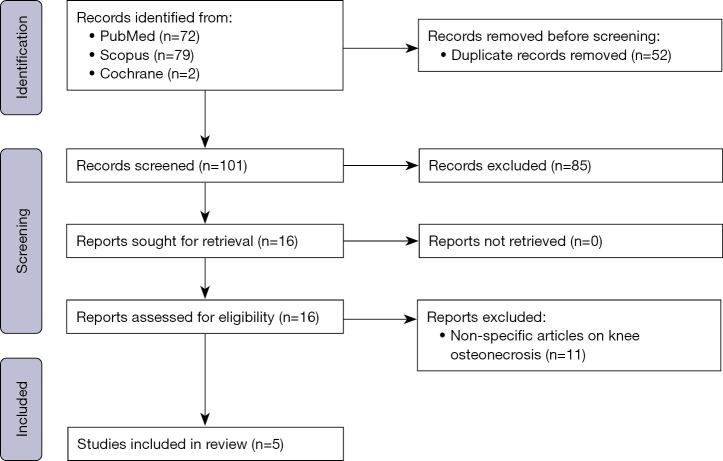
Finally, two case series and three case reports were included. We extracted data regarding demographic and clinical characteristics, details of magnetic resonance imaging (MRI), use of corticosteroids (CCS), temporal correlation between ON and COVID-19, treatment of the lesion and its outcomes. A total of seven cases of post-COVID knee ON have been described. Knee pain arose on average 11 weeks after the diagnosis of COVID-19. All patients had knee MRI showing ON. CCS were used to treat COVID-19-related symptoms in four cases. Conservative treatment was successful in five patients.
The correlation between COVID-19 and ON remains unclear. Probably post-COVID-19 ON has a multifactorial origin in which factors related to the patient, consequences of COVID-19 and CCS therapy add up to cause a reduction of blood supply and bone vitality until ON is triggered. A greater number of patients is needed to clarify the role of COVID-19 in the etiopathogenesis of knee ON.
严重急性呼吸综合征冠状病毒2(SARS-CoV-2)是导致2019冠状病毒病(COVID-19)的病毒。COVID-19患者表现出的症状主要与呼吸系统有关,但肌肉骨骼系统也可能受累。COVID-19已被描述为膝关节骨坏死(ON)的一个可能病因。本研究进行了一项系统综述,以调查COVID-19与膝关节ON之间的假设相关性。
纳入标准为所有报告SARS-CoV-2感染诊断后膝关节ON病例的文章。鉴于COVID-19是一种新出现的疾病,纳入了所有证据水平的研究。
最终纳入了两个病例系列和三篇病例报告。我们提取了有关人口统计学和临床特征、磁共振成像(MRI)细节、皮质类固醇使用情况(CCS)、ON与COVID-19之间的时间相关性、病变治疗及其结果的数据。共描述了7例COVID-19后膝关节ON病例。膝关节疼痛平均在COVID-19诊断后11周出现。所有患者的膝关节MRI均显示ON。4例患者使用CCS治疗COVID-19相关症状。5例患者保守治疗成功。
COVID-19与ON之间的相关性仍不明确。COVID-19后ON可能有多种因素,其中与患者相关的因素、COVID-19的后果和CCS治疗共同作用,导致血液供应和骨活力降低,直至引发ON。需要更多患者来阐明COVID-19在膝关节ON发病机制中的作用。