Darounkola Moein Abolhasani, Ebrahimzadeh Elahe, Borji Hassan, Khoshvaght Mohammadreza
Department of Pathobiology, Faculty of Veterinary Medicine, Ferdowsi University of Mashhad, Mashhad, Iran.
Vet Med Sci. 2024 Sep;10(5):e1554. doi: 10.1002/vms3.1554.
BACKGROUND/OBJECTIVE: The cestode Echinococcus granulosus causes cystic echinococcosis, a zoonotic parasitic infection that constitutes a significant public health risk. This parasite has been documented to have potential reservoirs and carriers among wild canids, namely wolves, foxes and jackals. This study aimed to determine the prevalence and molecular characteristics of E. granulosus sensu lato species/genotypes among wild canids in three northern, northeastern and north-western Iran regions.
From 2019 to 2022, 93 wild canid carcasses (69 jackals), (22 foxes) and (2 wolves) were collected that were killed in car accidents or illnesses. Analyses of morphology and morphometry were performed to verify the presence of E. granulosus. To determine E. granulosus s.l. species/genotypes, polymerase chain reaction (PCR)-RFLP (ITS1) was performed utilizing the Bsh1236I (BstUI) restriction enzyme. COX1, NADH1 and ITS1 gene sequencing were also performed to confirm the PCR-RFLP results.
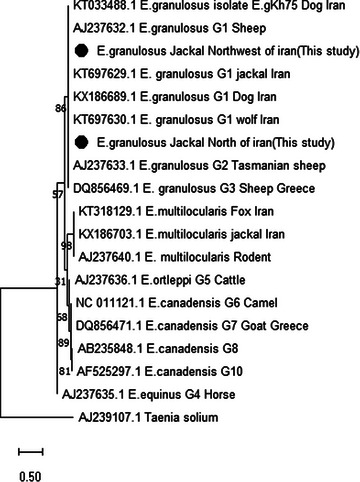
During this study, 93 wild canids were examined, and 3.2% (95% CI: 0%-7%) of the 93 were infected with Echinococcus. The north-western region of Iran showed two out of 30 jackals (6.6%) infected with adult Echinococcus compared to one out of 35 jackals (2.8%) in the northern region. DNA from Echinococcus was detected in these individuals by PCR. Based on PCR-RFLP analysis of the ITS1 gene and sequencing of COX1, NADH1 and ITS1 gene, E. granulosus sensu stricto genotype was confirmed in the jackals that had been infected.
Evidence shows that E. granulosus occurs in jackals in Iran, with the E. granulosus s.s. genotype being the most common. This parasite has been identified as a zoonotic parasite with a genotype that can be transmitted to livestock and humans. Establishing effective control measures to prevent the spread of echinococcosis and ensure public health is crucial.
背景/目的:细粒棘球绦虫可引发囊型包虫病,这是一种人畜共患的寄生虫感染病,对公共卫生构成重大风险。据记载,这种寄生虫在狼、狐狸和豺等野生犬科动物中存在潜在宿主和携带者。本研究旨在确定伊朗北部、东北部和西北部三个地区野生犬科动物中细粒棘球绦虫复合种/基因型的流行情况及分子特征。
2019年至2022年期间,收集了93具野生犬科动物尸体(69只豺、22只狐狸和2只狼),这些动物均死于车祸或疾病。通过形态学和形态测量分析来验证细粒棘球绦虫的存在。为确定细粒棘球绦虫复合种的种类/基因型,利用Bsh1236I(BstUI)限制性内切酶进行聚合酶链反应(PCR)-限制性片段长度多态性分析(ITS1)。还进行了COX1、NADH1和ITS1基因测序以确认PCR-RFLP结果。
在本研究中,共检查了93只野生犬科动物,其中93只中有3.2%(95%可信区间:0%-7%)感染了棘球绦虫。伊朗西北部地区30只豺中有2只(6.6%)感染了成年棘球绦虫,而北部地区35只豺中有1只(2.8%)感染。通过PCR在这些个体中检测到了棘球绦虫的DNA。基于ITS1基因的PCR-RFLP分析以及COX1、NADH1和ITS1基因测序,在已感染的豺中确认了狭义细粒棘球绦虫基因型。
有证据表明伊朗的豺体内存在细粒棘球绦虫,其中狭义细粒棘球绦虫基因型最为常见。这种寄生虫已被确认为一种人畜共患寄生虫,其基因型可传播给家畜和人类。制定有效的控制措施以预防包虫病传播并确保公众健康至关重要。