Tanaka Marenao, Gohda Tomohito, Kamei Nozomu, Murakoshi Maki, Sato Tatsuya, Kubota Mitsunobu, Sanuki Michiyoshi, Ishiwata Erika, Endo Keisuke, Suzuki Yusuke, Furuhashi Masato
Department of Cardiovascular, Renal and Metabolic Medicine, Sapporo Medical University School of Medicine, Sapporo, Japan.
Tanaka Medical Clinic, Yoichi, Japan.
Endocr Connect. 2024 Oct 14;13(11). doi: 10.1530/EC-24-0343. Print 2024 Nov 1.
Fatty acid-binding protein 4 (FABP4) is an adipokine that plays significant roles in the development of insulin resistance and atherosclerosis. High levels of soluble tumor necrosis factor receptors (TNFRs) including TNFR1 and TNFR2 are associated with renal dysfunction and increased mortality in patients with diabetes mellitus (DM). However, the association between circulating levels of FABP4 and TNFRs remains unclear.
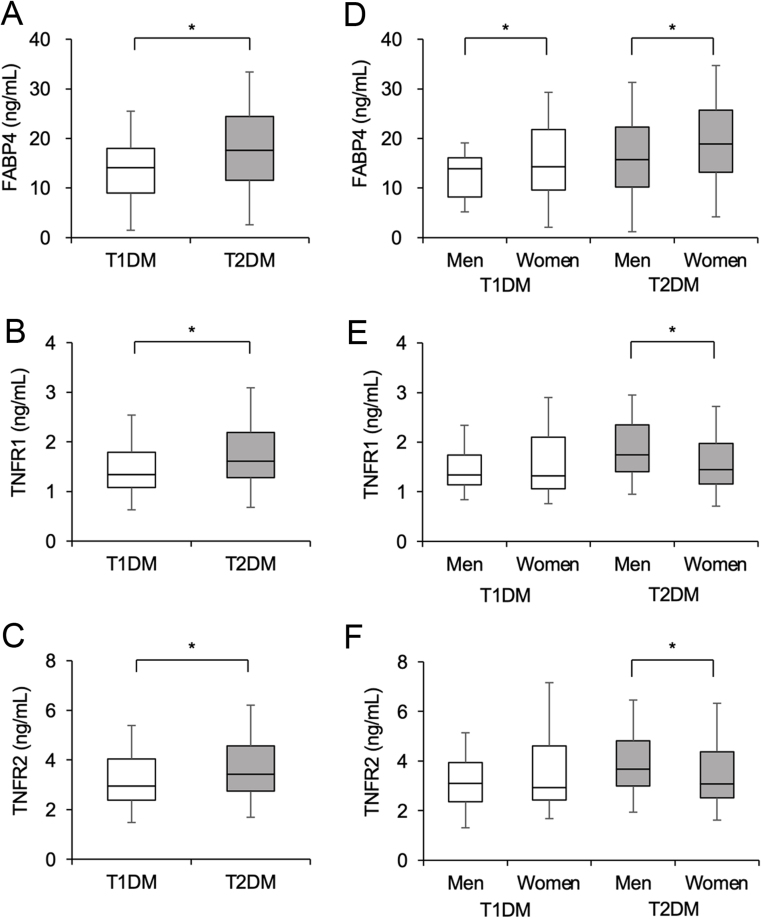
We investigated the associations of FABP4 with TNFRs and metabolic markers in Japanese patients with type 1 DM (T1DM, n = 76, men/women: 31/45) and type 2 DM (T2DM, n = 575, men/women: 312/263).
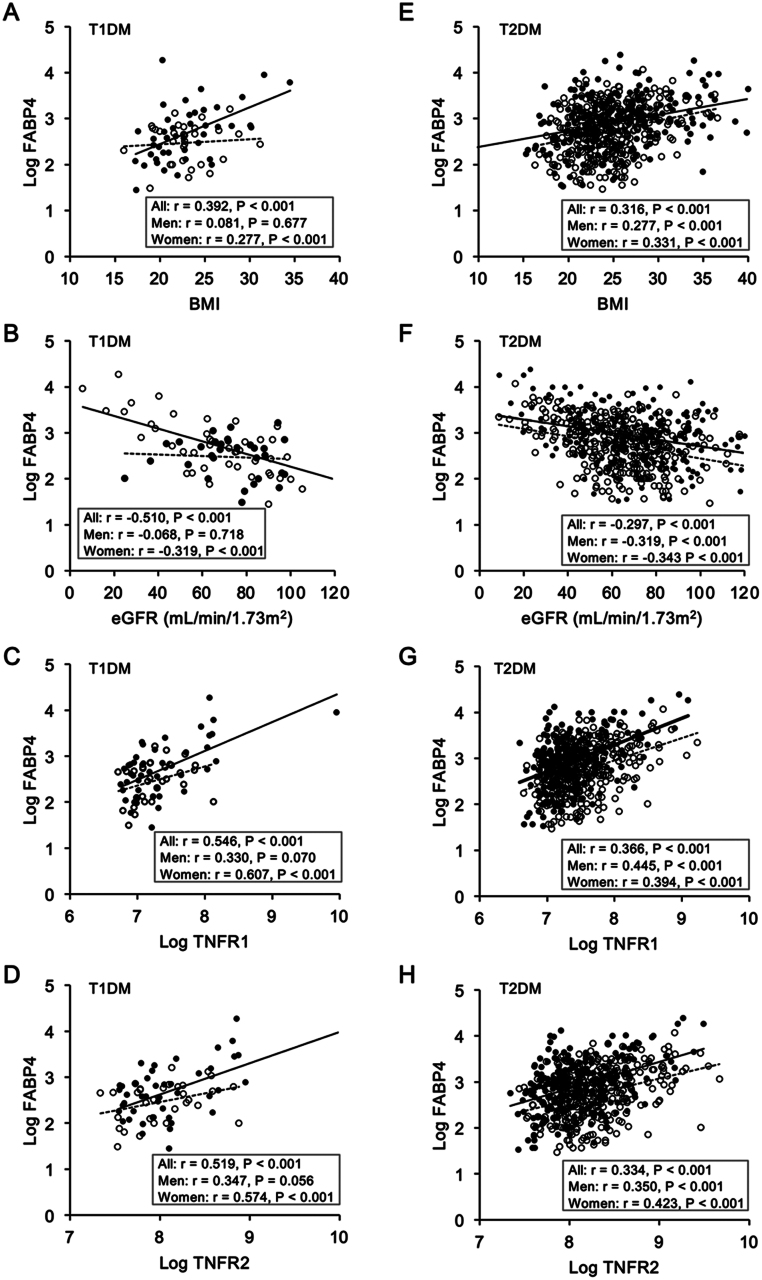
FABP4 concentration was positively correlated with levels of TNFR1 and TNFR2 in both patients with T1DM and those with T2DM. Multivariable regression analyses showed that there were independent associations of FABP4 concentration with body mass index (BMI) and estimated glomerular filtration rate (eGFR) after adjustment for age and sex in both patients with T1DM and those with T2DM. FABP4 concentration was independently associated with circulating levels of TNFR1 and TNFR2 after adjustment for the confounders in patients with T2DM but not in those with T1DM. Similarly, levels of TNFR1 and TNFR2 were independently associated with FABP4 concentration after adjustment for age, sex, systolic blood pressure, duration of DM and levels of eGFR, high-density lipoprotein cholesterol, and C-reactive protein in patients with T2DM but not in those with T1DM.
FABP4 concentration is independently associated with levels of TNFRs in patients with DM, but the association is more evident in patients with T2DM than in those with T1DM.
脂肪酸结合蛋白4(FABP4)是一种脂肪因子,在胰岛素抵抗和动脉粥样硬化的发展中起重要作用。包括肿瘤坏死因子受体1(TNFR1)和肿瘤坏死因子受体2(TNFR2)在内的高水平可溶性肿瘤坏死因子受体与糖尿病(DM)患者的肾功能不全和死亡率增加有关。然而,FABP4循环水平与肿瘤坏死因子受体之间的关联仍不清楚。
我们调查了日本1型糖尿病(T1DM,n = 76,男性/女性:31/45)和2型糖尿病(T2DM,n = 575,男性/女性:312/263)患者中FABP4与肿瘤坏死因子受体及代谢标志物之间的关联。
T1DM患者和T2DM患者的FABP4浓度均与TNFR1和TNFR2水平呈正相关。多变量回归分析显示,在调整年龄和性别后,T1DM患者和T2DM患者的FABP4浓度与体重指数(BMI)和估计肾小球滤过率(eGFR)均存在独立关联。在调整T2DM患者的混杂因素后,FABP4浓度与TNFR1和TNFR2的循环水平独立相关,但在T1DM患者中并非如此。同样,在调整T2DM患者的年龄、性别、收缩压、糖尿病病程以及eGFR、高密度脂蛋白胆固醇和C反应蛋白水平后,TNFR1和TNFR2水平与FABP4浓度独立相关,但在T1DM患者中并非如此。
糖尿病患者的FABP4浓度与肿瘤坏死因子受体水平独立相关,但这种关联在T2DM患者中比在T1DM患者中更明显。