Department of Population Sciences, City of Hope, 1500 East Duarte Road, Duarte, CA, 91010, USA.
SWOG Statistics and Data Management Center, Fred Hutchinson Cancer Center, Seattle, WA, USA.
BMC Cancer. 2024 Aug 8;24(1):976. doi: 10.1186/s12885-024-12660-5.
With a median age at diagnosis of 70, lung cancer remains a significant public health challenge for older Americans. Surgery is a key component in treating most patients with non-metastatic lung cancer. These patients experience postoperative pain, fatigue, loss of respiratory capacity, and decreased physical function. Data on quality of life (QOL) in older adults undergoing lung cancer surgery is limited, and few interventions are designed to target the needs of older adults and their family caregivers (FCGs). The primary aim of this comparative effectiveness trial is to determine whether telephone-based physical activity coaching before and after surgery will be more beneficial than physical activity self-monitoring alone for older adults and their FCGs.
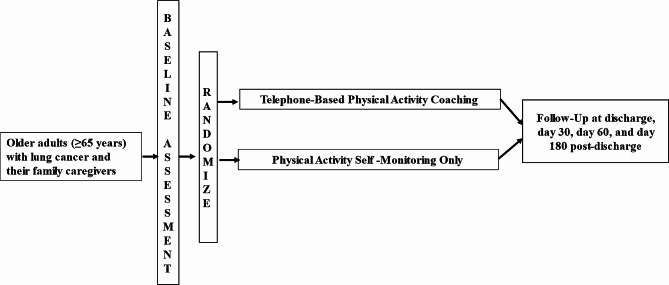
In this multicenter comparative effectiveness trial, 382 older adults (≥ 65 years) with lung cancer and their FCGs will be recruited before surgery and randomized to either telephone-based physical activity coaching or physical activity self-monitoring alone. Participants allocated to the telephone-based coaching comparator will receive five telephone sessions with coaches (1 pre and 4 post surgery), an intervention resource manual, and a wristband pedometer. Participants in the self-monitoring only arm will receive American Society of Clinical Oncology (ASCO) physical activity information and wristband pedometers. All participants will be assessed at before surgery (baseline), at discharge, and at days 30, 60, and 180 post-discharge. The primary endpoint is the 6-minute walk test (6MWT) at 30 days post-discharge. Geriatric assessment, lower extremity function, self-reported physical function, self-efficacy, and QOL will also be assessed.
The trial will determine whether this telephone-based physical activity coaching approach can enhance postoperative functional capacity and QOL outcomes for older adults with lung cancer and their FCGs. Trial results will provide critical findings to inform models of postoperative care for older adults with cancer and their FCGs.
ClinicalTrials.gov Identifier: NCT06196008.
肺癌的中位诊断年龄为 70 岁,对于美国的老年人来说,这仍然是一个重大的公共健康挑战。手术是治疗大多数非转移性肺癌患者的关键组成部分。这些患者会经历术后疼痛、疲劳、呼吸能力丧失和身体功能下降。关于接受肺癌手术的老年人的生活质量(QOL)数据有限,很少有干预措施旨在满足老年人及其家庭照顾者(FCG)的需求。这项比较有效性试验的主要目的是确定手术前后基于电话的身体活动指导是否比单独进行身体活动自我监测对老年人及其 FCG 更有益。
在这项多中心比较有效性试验中,将招募 382 名年龄在 65 岁以上的肺癌患者及其 FCG,并在手术前进行随机分组,分为基于电话的身体活动指导组或单独进行身体活动自我监测组。分配到基于电话的指导对照组的参与者将接受五次与教练的电话会议(手术前 1 次和手术后 4 次)、干预资源手册和腕带计步器。仅进行自我监测的手臂参与者将收到美国临床肿瘤学会(ASCO)的身体活动信息和腕带计步器。所有参与者将在术前(基线)、出院时以及出院后第 30、60 和 180 天进行评估。主要终点是出院后 30 天的 6 分钟步行测试(6MWT)。还将评估老年评估、下肢功能、自我报告的身体功能、自我效能感和 QOL。
该试验将确定这种基于电话的身体活动指导方法是否可以提高肺癌老年患者及其 FCG 的术后功能能力和 QOL 结果。试验结果将为为癌症老年患者及其 FCG 提供术后护理模式提供关键发现。
ClinicalTrials.gov 标识符:NCT06196008。