Department of Nephrology and Dialysis, Clinical Hospital Sveti Duh, Zagreb, Croatia.
Institute of Emergency Medicine of Zagreb County, Velika Gorica, Croatia.
BMC Nephrol. 2024 Aug 8;25(1):254. doi: 10.1186/s12882-024-03675-y.
Nephrotic syndrome (NS) is a rare complication that can occur after haematopoietic stem cell transplantation (HSCT). In patients with membranous nephropathy (MN) who have undergone allogeneic HSCT, a new antigen called protocadherin FAT1 has been identified. Our objective is to present a case series of MN patients after HSCT with a novel antigen-based stratification.
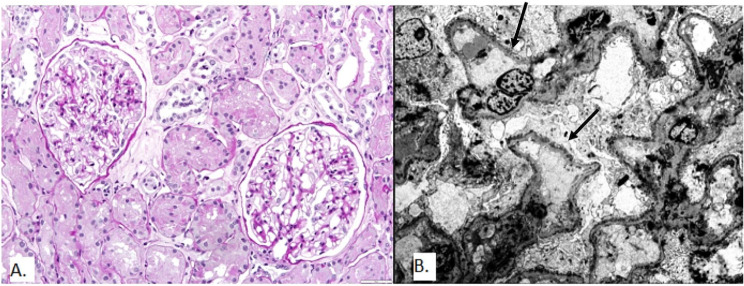
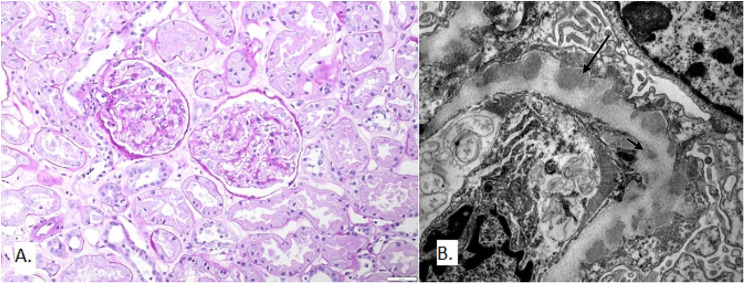
Patients who developed full-blown NS due to MN after an HSCT were enrolled in the University Hospital Centre Zagreb study. The first two patients were treated with an HSCT for acute myeloid leukaemia, and both developed NS after cessation of graft versus host disease (GVHD) prophylaxis. The first patient had reduced kidney function, while the second had completely preserved function. Kidney biopsy showed MN with only subepithelial deposits. A thorough examination revealed that there was no secondary cause of the disease. The patients achieved complete remission after undergoing immunosuppression treatment. The third patient underwent HSCT for acute lymphoblastic leukaemia. He developed both acute and chronic GVHD and also experienced avascular hip necrosis. After sixteen years, the patient developed NS with preserved kidney function. The kidney specimen showed membranous nephropathy (MN) with mesangial and subepithelial deposits. Extensive research was conducted, but no secondary cause for the MN was detected. All three cases tested negative for anti-PLA2R antibodies. Biopsy tissue samples were analysed using laser microdissection and tandem mass spectrometry of glomeruli for the detection of different specific antigens. Patients one and two tested positive for FAT1, whereas patient three tested positive for PCSK6.
MN can develop at various time intervals after HSCT. Specific antigen testing can help establish the relationship between MN and HSCT. In the future, serum testing for anti-FAT1 antibodies in HSCT patients could be significant in diagnosing FAT1-associated MN, similar to how anti-PLA2R antibodies are significant in diagnosing PLA2R-associated MN.
肾病综合征(NS)是造血干细胞移植(HSCT)后罕见的并发症。在接受异基因 HSCT 的膜性肾病(MN)患者中,已经发现了一种新的抗原,称为原钙黏蛋白 FAT1。我们的目的是报告一组基于新型抗原的 MN 患者 HSCT 后病例系列。
在萨格勒布大学中心医院的研究中,纳入了因 HSCT 后 MN 而出现完全性 NS 的患者。前两名患者因急性髓系白血病接受 HSCT,均在停止移植物抗宿主病(GVHD)预防后出现 NS。第一名患者肾功能下降,第二名患者肾功能完全正常。肾活检显示 MN 仅有上皮下沉积物。全面检查发现没有疾病的继发原因。两名患者均接受免疫抑制治疗后完全缓解。第三名患者因急性淋巴细胞白血病接受 HSCT。他同时发生急性和慢性 GVHD,还经历了缺血性髋关节坏死。十六年后,患者出现 NS,肾功能正常。肾脏标本显示膜性肾病(MN),有系膜和上皮下沉积物。进行了广泛的研究,但未发现 MN 的继发原因。所有 3 例抗 PLA2R 抗体均为阴性。使用激光显微切割和肾小球串联质谱分析活检组织样本,以检测不同的特定抗原。患者 1 和 2 检测 FAT1 阳性,而患者 3 检测 PCSK6 阳性。
MN 可在 HSCT 后不同时间间隔发生。特定抗原检测有助于确定 MN 与 HSCT 之间的关系。将来,HSCT 患者血清抗 FAT1 抗体检测可能对诊断 FAT1 相关 MN 具有重要意义,类似于抗 PLA2R 抗体对诊断 PLA2R 相关 MN 的重要性。