Oppong Jennifer, Avicor Silas Wintuma, Baidoo Philip Kweku, Addo-Fordjour Patrick, Larbi John Asiedu, Akowuah Carlos Frimpong, Boateng Akosua, Essien Isaac Prince, Mensah Gloria
Department of Theoretical and Applied Biology Faculty of Biosciences College of Science Kwame Nkrumah University of Science and Technology, Kumasi, Ghana.
Entomology Division Cocoa Research Institute of Ghana, New Tafo-Akim, Ghana.
J Trop Med. 2024 Aug 1;2024:5843481. doi: 10.1155/2024/5843481. eCollection 2024.
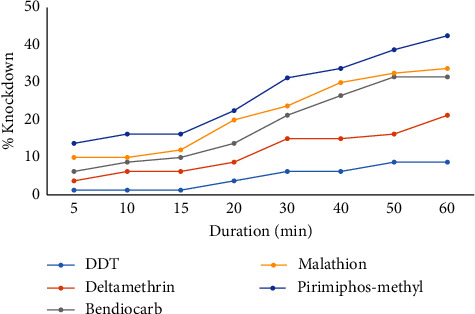
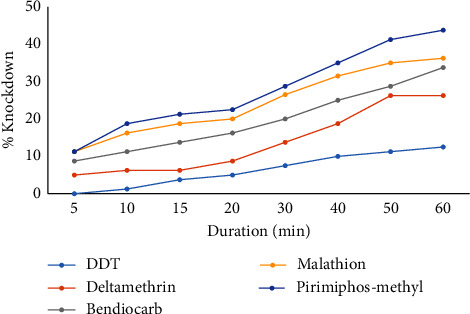
Modified landscapes could create breeding habitats for mosquitoes and affect their community structure and susceptibility with implications for their management. Hence, in this study, household mosquito control methods in two urbanized landscapes; industrial and residential human settlements, in Ghana and insecticide susceptibility of the inhabiting populations were assessed. Household knowledge and usage pattern of mosquito control methods in the modified landscapes were obtained using a questionnaire. Female adult mosquitoes were also subjected to susceptibility tests using mosquito coils (0.08% meperfluthrin, 0.03% dimefluthrin, and 0.3% transfluthrin) and World Health Organization (WHO) insecticide test papers (0.05% deltamethrin, 4% DDT, 0.1% bendiocarb, 0.25% pirimiphos-methyl, and 5% malathion). Although insecticide-treated nets and aerosols were used for mosquito control, mosquito coils were the most common and widely preferred household method. The mosquitoes were resistant to all the insecticides (mosquito coils and WHO test papers) except pirimiphos-methyl. Land use type did not affect insecticide resistance, but the insecticide type did. The findings indicate the effect of household insecticide usage practices on local mosquito populations and their implications for effective vector management and disease control in modified landscapes.
地貌改变可能会为蚊子创造繁殖栖息地,并影响其群落结构和易感性,进而对蚊子的管理产生影响。因此,在本研究中,对加纳两个城市化地区(工业和居住人类住区)的家庭灭蚊方法以及当地蚊子种群的杀虫剂易感性进行了评估。通过问卷调查了解了在这些改变后的地貌中家庭对灭蚊方法的知晓情况和使用模式。还使用蚊香(0.08% 炔丙菊酯、0.03% 四氟甲醚菊酯和 0.3% 氯氟醚菊酯)和世界卫生组织(WHO)杀虫剂测试纸(0.05% 溴氰菊酯、4% 滴滴涕、0.1% 残杀威、0.25% 甲基嘧啶磷和 5% 马拉硫磷)对成年雌蚊进行了易感性测试。尽管杀虫剂处理过的蚊帐和气雾剂也用于灭蚊,但蚊香是最常见且最受广泛青睐的家庭灭蚊方法。除甲基嘧啶磷外,蚊子对所有杀虫剂(蚊香和 WHO 测试纸)均具有抗性。土地利用类型并未影响杀虫剂抗性,但杀虫剂类型有影响。研究结果表明了家庭杀虫剂使用方式对当地蚊子种群的影响及其对改变后的地貌中有效病媒管理和疾病控制的意义。