Achee Nicole L, Perkins T Alex, Moore Sean M, Liu Fang, Sagara Issaka, Van Hulle Suzanne, Ochomo Eric O, Gimnig John E, Tissera Hasitha A, Harvey Steven A, Monroe April, Morrison Amy C, Scott Thomas W, Reiner Robert C, Grieco John P
Department of Biological Sciences, Eck Institute for Global Health, University of Notre Dame, Notre Dame, IN, USA.
Department of Applied and Computational Mathematics and Statistics, University of Notre Dame, Notre Dame, IN, USA.
Curr Res Parasitol Vector Borne Dis. 2022 Dec 9;3:100107. doi: 10.1016/j.crpvbd.2022.100107. eCollection 2023.
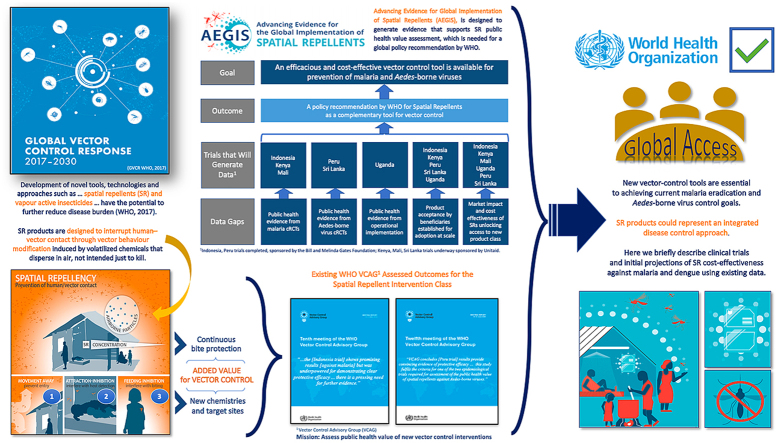
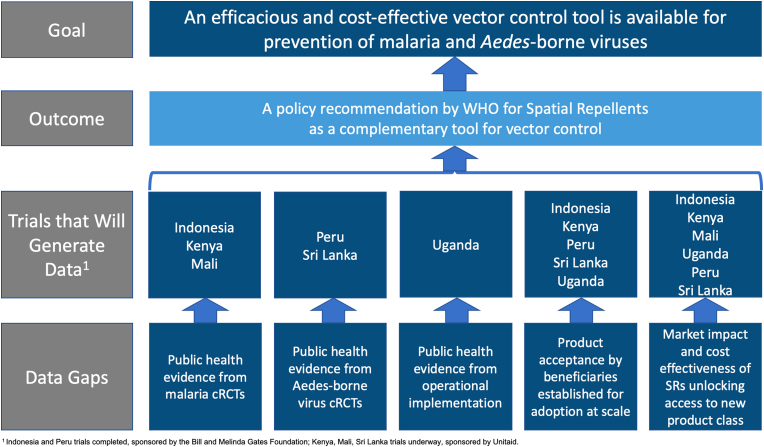
Spatial repellent (SR) products are envisioned to complement existing vector control methods through the continual release of volatile active ingredients (AI) providing: (i) protection against day-time and early-evening biting; (ii) protection in enclosed/semi-enclosed and peri-domestic spaces; (iii) various formulations to fit context-specific applications; and (iv) increased coverage over traditional control methods. SR product AIs also have demonstrated effect against insecticide-resistant vectors linked to malaria and borne virus (ABV) transmission. Over the past two decades, key stakeholders, including World Health Organization (WHO) representatives, have met to discuss the role of SRs in reducing arthropod-borne diseases based on existing evidence. A key focus has been to establish a critical development path for SRs, including scientific, regulatory and social parameters that would constitute an outline for a SR target product profile, i.e. optimum product characteristics. The principal gap is the lack of epidemiological data demonstrating SR public health impact across a range of different ecological and epidemiological settings, to inform a WHO policy recommendation. Here we describe in brief trials that are designed to fulfill evidence needs for WHO assessment and initial projections of SR cost-effectiveness against malaria and dengue.
空间驱避剂(SR)产品旨在通过持续释放挥发性活性成分(AI)来补充现有的病媒控制方法,从而提供:(i)防止白天和傍晚叮咬;(ii)在封闭/半封闭和家庭周边空间提供防护;(iii)各种适合特定环境应用的制剂;以及(iv)比传统控制方法更大的覆盖范围。SR产品的活性成分还已证明对与疟疾和虫媒病毒(ABV)传播相关的抗杀虫剂病媒有效。在过去二十年中,包括世界卫生组织(WHO)代表在内的主要利益相关者举行了会议,根据现有证据讨论了空间驱避剂在减少节肢动物传播疾病方面的作用。一个关键重点是为空间驱避剂确定一条关键的发展路径,包括构成空间驱避剂目标产品概况(即最佳产品特性)大纲的科学、监管和社会参数。主要差距在于缺乏流行病学数据来证明空间驱避剂在一系列不同生态和流行病学环境中的公共卫生影响,从而为世卫组织的政策建议提供依据。在此,我们简要描述旨在满足世卫组织评估证据需求以及空间驱避剂对疟疾和登革热成本效益初步预测的试验。