Zhang Xingfen, Ruan Jiale, He Yujing, Xu Anyi, Fang Yingying, Zhang Qiufeng, Gu Lihu, Liu Xingchen
Department of Liver Disease, Ningbo No. 2 Hospital, Ningbo, Zhejiang, China.
The First Clinical Medical College, Zhejiang Chinese Medical University, Hangzhou, Zhejiang, China.
Front Nutr. 2024 Jul 25;11:1388557. doi: 10.3389/fnut.2024.1388557. eCollection 2024.
Previous studies have suggested a correlation between dietary inflammatory potential and non-alcoholic fatty liver disease (NAFLD). Therefore, the study aimed to investigate the association between dietary inflammatory potential, measured by the dietary inflammation index (DII), and NAFLD.
From establishing the database to June 2023, a systematic search of PubMed, Web of Science, Embase and Cochrane Library were performed to identify relevant observational studies. These studies reported a correlation between DII and NAFLD. The meta-analysis used odds ratio (OR) with 95% confidence intervals (CI) to evaluate the relationship between DII and NAFLD.
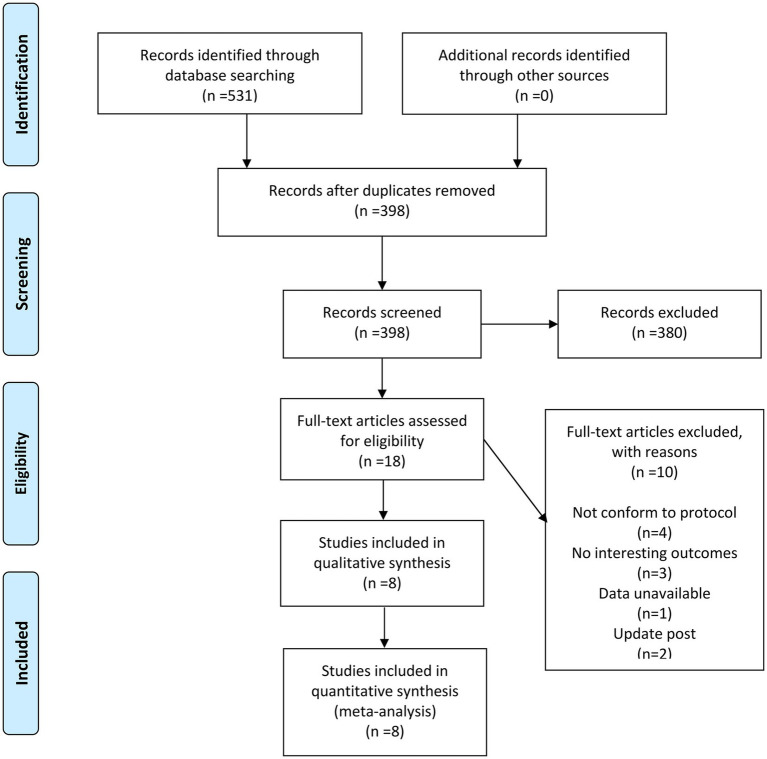
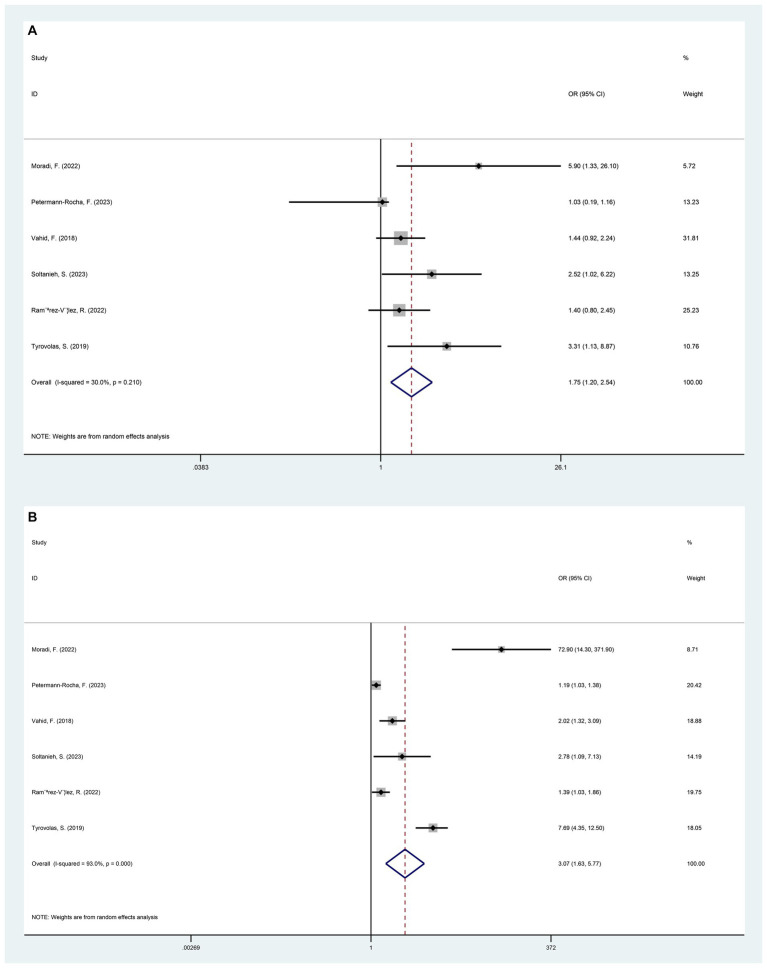
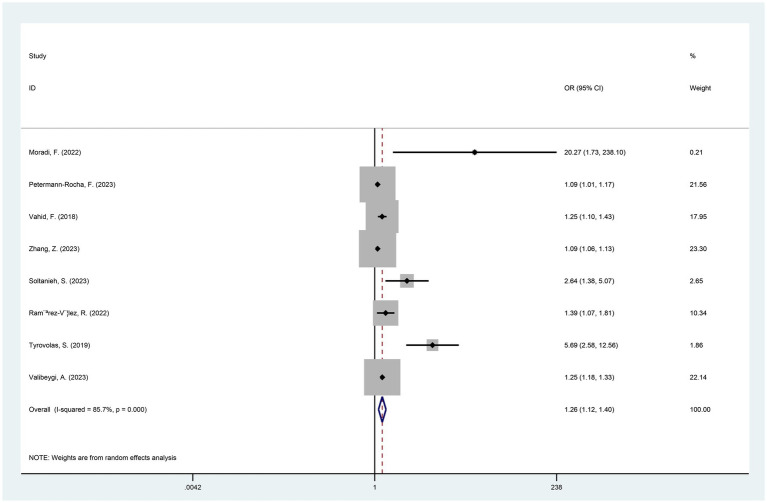
Eight studies were included in this meta-analysis after excluding irrelevant records. A summary of the results from the included studies showed that the risk of NAFLD was higher in those exposed to higher DII (OR = 1.26, 95%CI 1.12 to 1.40, < 0.001), with a high degree of heterogeneity (I = 85.7%, < 0.001). When DII was divided into 3 tertiles from low to high for comparison, the results showed that the risk of NAFLD was higher in Tertile 2 (T2) population compared to the Tertile 1 (T1) population (OR = 1.75, 95%CI 1.20 to 2.54, < 0.005). The risk of NAFLD was significantly higher in Tertile 3 (T3) compared to the T1 population (OR = 3.07, 95%CI 1.63 to 5.77, = 0.001).
The results suggest that high DII is associated with an increased risk of NAFLD, and conversely, low DII is associated with a decreased risk of NAFLD.
The study complies with the Preferred Reporting Items for Systematic Reviews and Meta-Analyses (PRISMA) guidelines and is registered on PROSPERO (CRD42023455013).
先前的研究表明饮食炎症潜能与非酒精性脂肪性肝病(NAFLD)之间存在关联。因此,本研究旨在探讨通过饮食炎症指数(DII)衡量的饮食炎症潜能与NAFLD之间的关联。
从建立数据库到2023年6月,对PubMed、Web of Science、Embase和Cochrane图书馆进行了系统检索,以识别相关的观察性研究。这些研究报告了DII与NAFLD之间的相关性。荟萃分析使用比值比(OR)和95%置信区间(CI)来评估DII与NAFLD之间的关系。
排除无关记录后,本荟萃分析纳入了8项研究。纳入研究的结果总结显示,DII较高者患NAFLD的风险更高(OR = 1.26,95%CI为1.12至1.40,P < 0.001),异质性程度较高(I² = 85.7%,P < 0.001)。当将DII从低到高分为三个三分位数进行比较时,结果显示,与第一三分位数(T1)人群相比,第二三分位数(T2)人群患NAFLD的风险更高(OR = 1.75,95%CI为1.20至2.54,P < 0.005)。与T1人群相比,第三三分位数(T3)人群患NAFLD的风险显著更高(OR = 3.07,95%CI为1.63至5.77,P = 0.001)。
结果表明,高DII与NAFLD风险增加相关,相反,低DII与NAFLD风险降低相关。
本研究符合系统评价和荟萃分析的首选报告项目(PRISMA)指南,并在PROSPERO上注册(CRD42023455013)。