Doustmohammadian Azam, Zamani Farhad, Hébert James R, Moradi-Lakeh Maziar, Esfandyiari Sepideh, Amirkalali Bahareh, Motamed Nima, Maadi Mansooreh, Price Sherry, Gholizadeh Esmaeel, Ajdarkosh Hossein
Gastrointestinal and Liver Diseases Research Center, Iran University of Medical Sciences, Tehran, Iran.
Cancer Prevention & Control Program, University of South Carolina, Columbia, SC, 29208, USA.
J Health Popul Nutr. 2024 Dec 24;43(1):224. doi: 10.1186/s41043-024-00721-1.
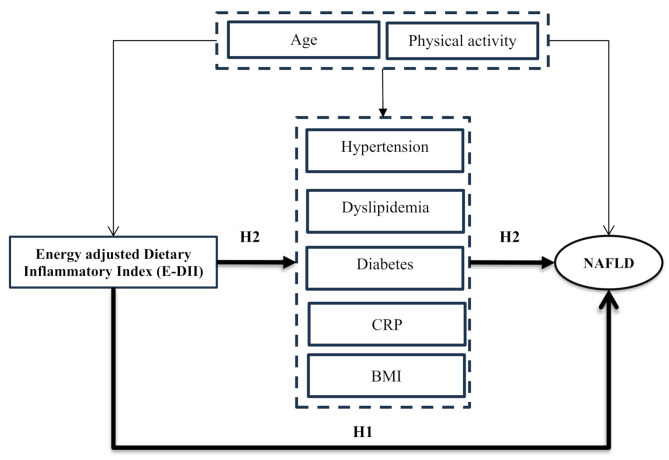
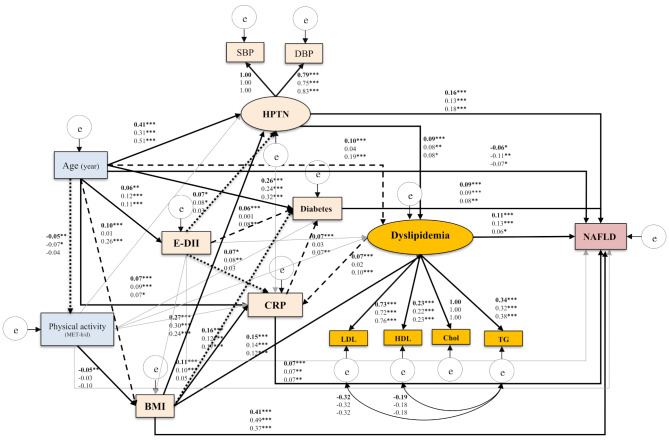
Nonalcoholic fatty liver disease (NAFLD) or metabolic dysfunction-associated steatotic liver disease (MASLD) is a significant global public health dilemma with wide-ranging social and economic implications. Diet and lifestyle modifications remain essential components of NAFLD management. The current study investigated the association between diet-related inflammation and NAFLD among 3110 Iranian adults participating in the Amol Cohort Study (AmolCS), employing the Structural Equation Modeling (SEM) approach.The inflammatory potential of the diet was quantified using an energy-adjusted dietary index (E-DII) score. Findings showed that in the total sample and separately in males, the E-DII score had a significant effect on NAFLD, with mediation through hypertension (β = 0.16, and 0.13, p < 0.001, respectively) and c-reactive protein (CRP) (β = 0.07, and 0.07, p < 0.001, respectively). In the total sample and separately in females, the E-DII score significantly affected NAFLD, with mediation through diabetes (β = 0.06, p < 0.001, and 0.07, p = 0.006, respectively). In full and both gender-specific models, dyslipidemia was a risk factor for NAFLD and partially mediated the effect of hypertension on NAFLD.The current study concluded a mediated association between dietary inflammation and NAFLD through hypertension, CRP, diabetes, and dyslipidemia, suggesting further longitudinal studies, especially in high-risk populations. These findings underscore the complex interplay between diet, inflammation, and NAFLD in Iranian adults.
非酒精性脂肪性肝病(NAFLD)或代谢功能障碍相关脂肪性肝病(MASLD)是一个重大的全球公共卫生难题,具有广泛的社会和经济影响。饮食和生活方式的改变仍然是NAFLD管理的重要组成部分。本研究采用结构方程模型(SEM)方法,调查了参与阿莫勒队列研究(AmolCS)的3110名伊朗成年人中与饮食相关的炎症与NAFLD之间的关联。饮食的炎症潜力通过能量调整饮食指数(E-DII)得分进行量化。研究结果表明,在总样本中以及分别在男性中,E-DII得分对NAFLD有显著影响,通过高血压(β分别为0.16和0.13,p<0.001)和C反应蛋白(CRP)(β分别为0.07和0.07,p<0.001)起中介作用。在总样本中以及分别在女性中,E-DII得分对NAFLD有显著影响,通过糖尿病起中介作用(β分别为0.06,p<0.001,和0.07,p = 0.006)。在完整模型和两个性别特异性模型中,血脂异常是NAFLD的一个危险因素,并且部分介导了高血压对NAFLD的影响。本研究得出结论,饮食炎症与NAFLD之间通过高血压、CRP、糖尿病和血脂异常存在中介关联,建议进行进一步的纵向研究,特别是在高危人群中。这些发现强调了伊朗成年人饮食、炎症和NAFLD之间复杂的相互作用。