Asayesh Mohammad Hassan, Rezapour-Mirsaleh Yasser, Koohestani Fahimeh, Asadi Naghmeh
Department of Educational Psychology & Counseling, Faculty of Psychology and Education, University of Tehran, Tehran, Iran.
Department of Counseling, Faculty of Humanities & Social Sciences, Ardakan University, Ayatallah Khatami Blv, Ardakan, P.O. Box184, Iran.
BMC Nurs. 2024 Aug 9;23(1):545. doi: 10.1186/s12912-024-02222-2.
Empathy with the patient is one of the important factors in nursing care. This study aims to investigate the mediating role of self-compassion in the relationship between attachment styles and empathy in nurses.
This correlational study was conducted using structural equation modeling (SEM) method. The statistical population included nurses working at public hospitals in Yazd City, Iran. A total of 308 nurses were selected by convenience sampling method. The data were collected using self-compassion scale, adult attachment styles scale, Jefferson scale of empathy and analyzed using structural equation analysis in AMOS software.
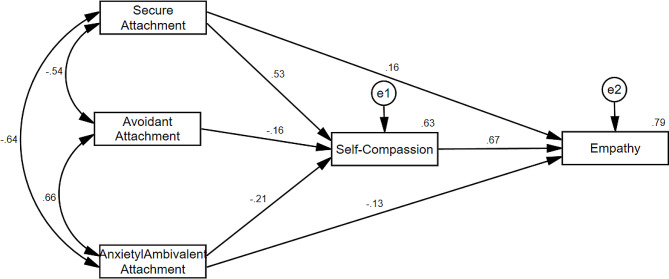
Secure and anxious/ambivalent insecure attachment styles were positively and negatively correlated with empathy, respectively (p < .01). The path coefficient between avoidant and anxious/ambivalent insecure attachment styles and self-compassion was negative. On the contrary, the path coefficient between secure attachment style and self-compassion was positive. There was a positive correlation between self-compassion and empathy. The indirect path coefficient of secure and anxious/ambivalent insecure attachment styles to empathy through self-compassion. was significant (p < .01).
The results showed secure and anxious/ambivalent insecure attachment could directly and indirectly through influencing self-compassion predict empathy in nurses.
对患者的同理心是护理工作中的重要因素之一。本研究旨在探讨自我同情在护士依恋风格与同理心之间关系中的中介作用。
本相关性研究采用结构方程模型(SEM)方法进行。统计总体包括在伊朗亚兹德市公立医院工作的护士。通过便利抽样法共选取308名护士。使用自我同情量表、成人依恋风格量表、杰斐逊同理心量表收集数据,并在AMOS软件中使用结构方程分析进行分析。
安全型和焦虑/矛盾型不安全依恋风格分别与同理心呈正相关和负相关(p <.01)。回避型和焦虑/矛盾型不安全依恋风格与自我同情之间的路径系数为负。相反,安全型依恋风格与自我同情之间的路径系数为正。自我同情与同理心之间存在正相关。安全型和焦虑/矛盾型不安全依恋风格通过自我同情对同理心的间接路径系数显著(p <.01)。
结果表明,安全型和焦虑/矛盾型不安全依恋可通过影响自我同情直接和间接地预测护士的同理心。