
高压扭转后相组成对钛铁合金力学性能的决定性影响。
The Determining Influence of the Phase Composition on the Mechanical Properties of Titanium-Iron Alloys after High-Pressure Torsion.
作者信息
Gornakova Alena S, Straumal Boris B, Tyurin Alexander I, Afonikova Natalia S, Kilmametov Askar R, Druzhinin Alexander V, Nekrasov Aleksey N, Davdian Gregory S, Duong Luong V
机构信息
Osipyan Institute of Solid State Physics of the Russian Academy of Sciences, Ac. Osipyan str. 2, Chernogolovka 142432, Russia.
G.R. Derzhavin Research Institute "Nanotechnologies and Nanomaterials" TSU, Internazionalnaja str. 30, Tambov 392000, Russia.
出版信息
Materials (Basel). 2024 Jul 28;17(15):3740. doi: 10.3390/ma17153740.
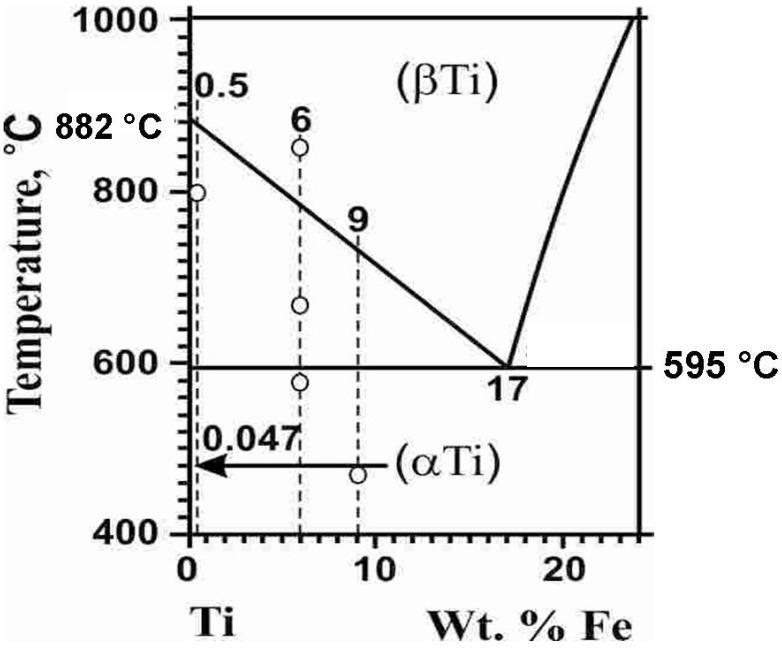
Three titanium alloys with 0.5, 6, and 9 wt.% iron were investigated, and the samples were pre-annealed in three different regions of the Ti-Fe phase diagram, namely β, α+β, and α+FeTi. After annealing, five samples of different phases and structural compositions were studied. They were then subjected to the high-pressure torsion (HPT). The microstructure of the samples before and after HPT treatment was studied using transmission and scanning electron microscopy. The microstructure of the samples obtained during heat treatment before HPT treatment had a fundamental effect on the microstructure after HPT. Grain boundary layers and chains of particles formed during the annealing process made it difficult to mix the material during HPT, which led to the formation of areas with non-uniform mixing of components. Thus, the grain boundary layers of the α-phase formed in the Ti-6wt % Fe alloy after annealing at 670 °C significantly decreased the mixing of the components during HPT. Despite the fact that the microstructure and phase composition of Ti-6wt % Fe alloys pre-annealed in three different regions of the Ti-Fe phase diagram had significant differences, after HPT treatment, the phase compositions of the studied samples were quite similar. Moreover, the measured micro- and nanohardness as well as the Young's modulus of Ti-6wt % Fe alloy had similar values. It was shown that the microhardness of the studied samples increased with the iron content. The values of nanohardness and Young's modulus correlated well with the fractions of β- and ω-phases in the studied alloys.
研究了三种含铁量分别为0.5 wt.%、6 wt.%和9 wt.%的钛合金,并将样品在Ti-Fe相图的三个不同区域,即β、α+β和α+FeTi中进行预退火。退火后,对五个不同相和结构组成的样品进行了研究。然后对它们进行高压扭转(HPT)处理。使用透射电子显微镜和扫描电子显微镜研究了HPT处理前后样品的微观结构。HPT处理前热处理过程中获得的样品微观结构对HPT处理后的微观结构有根本性影响。退火过程中形成的晶界层和颗粒链使得HPT过程中材料难以混合,从而导致形成成分混合不均匀的区域。因此,Ti-6wt%Fe合金在670°C退火后形成的α相晶界层显著降低了HPT过程中各成分的混合。尽管在Ti-Fe相图的三个不同区域预退火的Ti-6wt%Fe合金的微观结构和相组成存在显著差异,但经过HPT处理后,所研究样品的相组成相当相似。此外,Ti-6wt%Fe合金的测量微硬度和纳米硬度以及杨氏模量具有相似的值。结果表明,所研究样品的微硬度随铁含量的增加而增加。纳米硬度和杨氏模量的值与所研究合金中β相和ω相的比例密切相关。





 Zotero 插件