Bristol Royal Hospital for Children, Bristol, BS2 8NJ, UK.
Bristol Renal, University of Bristol, Bristol, UK.
Sci Rep. 2024 Aug 10;14(1):18568. doi: 10.1038/s41598-024-68837-2.
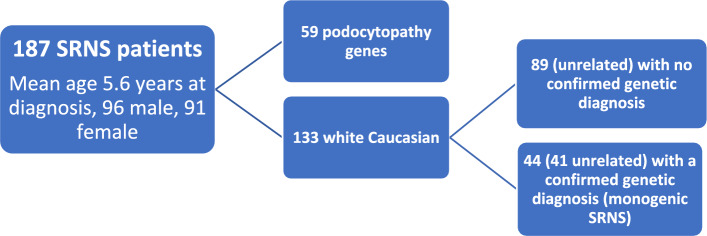
Genetic testing in nephrotic syndrome may identify heterozygous predicted-pathogenic variants (HPPVs) in autosomal recessive (AR) genes that are known to cause disease in the homozygous or compound heterozygous state. In such cases, it can be difficult to define the variant's true significance and questions remain about whether a second pathogenic variant has been missed during analysis or whether the variant is an incidental finding. There are now known to be over 70 genes associated with nephrotic syndrome, the majority inherited as an AR trait. Knowledge of whether such HPPVs occur with equal frequency in patients compared to the general population would assist interpretation of their significance. Exome sequencing was performed on 187 Steroid-Resistant Nephrotic Syndrome (SRNS) paediatric patients recruited to a UK rare disease registry plus originating from clinics at Evelina, London. 59 AR podocytopathy linked genes were analysed in each patient and a list of HPPVs created. We compared the frequency of detected HPPVs with a 'control' population from the gnomAD database containing exome data from approximately 50,000 individuals. A bespoke filtering process was used for both patients and controls to predict 'likely pathogenicity' of variants. In total 130 Caucasian SRNS patients were screened across 59 AR genes and 201 rare heterozygous variants were identified. 17/201 (8.5%) were assigned as 'likely pathogenic' (HPPV) using our bespoke filtering method. Comparing each gene in turn, for SRNS patients with a confirmed genetic diagnosis, in 57 of the 59 genes we found no statistically significant difference in the frequency of these HPPVs between patients and controls (In genes ARHGDIA and TP53RK, we identified a significantly higher number of HPPVs in the control population compared with the patients when filtering was performed with 'high stringency' settings only). In the SRNS patients without a genetics diagnosis confirmed, there was no statistically significant difference identified in any gene between patient and control. In children with SRNS, we propose that identification of HPPV in AR podocytopathy linked genes is not necessarily representative of pathogenicity, given that the frequency is similar to that seen in controls for the majority. Whilst this may not exclude the presence of genetic kidney disease, this type of heterozygous variant is unlikely to be causal and each result must be interpreted in its clinical context.
在肾病综合征中进行基因检测可能会发现常染色体隐性遗传(AR)基因中的杂合预测致病性变异(HPPV),这些基因在纯合或复合杂合状态下已知会导致疾病。在这种情况下,很难确定变异的真正意义,并且仍然存在疑问,即在分析过程中是否遗漏了第二个致病性变异,或者变异是否是偶然发现的。现在已知有超过 70 个基因与肾病综合征有关,其中大多数以 AR 特征遗传。了解这些 HPPV 在患者中的发生频率是否与普通人群相同,将有助于解释其意义。对英国罕见疾病登记处招募的 187 名类固醇耐药性肾病综合征(SRNS)儿科患者进行了外显子组测序,这些患者还来自伦敦伊夫林诊所。对每位患者进行了 59 个 AR 足细胞病相关基因的分析,并创建了一个 HPPV 列表。我们将检测到的 HPPV 的频率与来自约 50,000 个人的外显子组数据的 gnomAD 数据库中的“对照”人群进行了比较。使用专门的过滤过程对患者和对照者进行了“可能的致病性”预测。总共对 130 名白人 SRNS 患者进行了 59 个 AR 基因的筛查,发现了 201 个罕见的杂合变异。使用我们的定制过滤方法,将 201 个中的 17 个(8.5%)指定为“可能致病性”(HPPV)。逐个比较每个基因,对于有明确遗传诊断的 SRNS 患者,在我们发现的 59 个基因中,有 57 个基因中患者和对照者之间这些 HPPV 的频率没有统计学差异(在 ARHGDIA 和 TP53RK 基因中,当仅使用“高严格性”设置进行过滤时,我们发现对照者中的 HPPV 数量明显高于患者)。在没有遗传诊断的 SRNS 患者中,在任何基因中都没有发现患者与对照者之间有统计学意义的差异。在患有 SRNS 的儿童中,我们提出,在 AR 足细胞病相关基因中发现 HPPV 不一定代表致病性,因为大多数情况下,其频率与对照者相似。尽管这不能排除遗传肾脏疾病的存在,但这种杂合变体不太可能是因果关系,每个结果都必须在其临床背景下进行解释。