Aggarwal Vikas, Hyder S Nabeel, Kamdar Neil, Zghouzi Mohamed, Visovatti Scott H, Yin Zhe, Barnes Geoffrey, Froehlich James, Moles Victor M, Cascino Thomas, Agarwal Prachi, Haft Jonathan, Rosenfield Kenneth, Qiang Amy, McLaughlin Vallerie V, Nallamothu Brahmajee K
Division of Cardiology (Frankel Cardiovascular Center), Department of Internal Medicine, University of Michigan Medical School, Ann Arbor, Michigan.
Section of Cardiology, Veteran Affairs Ann Arbor Health System, Ann Arbor, Michigan.
J Soc Cardiovasc Angiogr Interv. 2023 Jul 5;2(6Part A):101063. doi: 10.1016/j.jscai.2023.101063. eCollection 2023 Nov-Dec.
Persistent symptoms of chest pain, dyspnea, fatigue, lightheadedness, and/or syncope more than 3 months after an acute pulmonary embolism (PE) are collectively classified as postpulmonary embolism syndrome (PPES). Although PPES is increasingly recognized as an important long-term sequel of acute PE, its contemporary incidence is unclear. Furthermore, the utilization of diagnostic testing for further phenotypic characterization of these patients is unknown. This study aimed to define the incidence of PPES and evaluate the utilization of diagnostic tests among a national cohort of patients with PE.
Retrospective cohort study was performed using the national administrative database, Clinformatics DataMart Database (Optum Insight), and included adult patients (18 years or older) with no history of acute PE or pulmonary hypertension, diagnosed with acute PE between October 1, 2016, and December 31, 2018. With acute PE event as the exposure, the incidence of symptoms consistent with PPES and diagnostic test utilization among patients with PPES were evaluated.
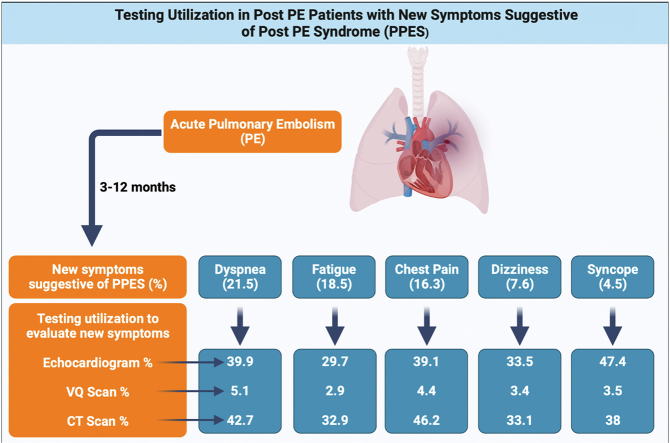
Of 21,297 incident patients with acute PE, 11,969 (56.2%) showed ≥1 symptom of PPES, which was new since their pre-PE baseline. New dyspnea was the most common and noted in 3268/15,203 (21.5%) patients, followed by new malaise or fatigue in 2894/15,643 (18.5%) patients. Among the 11,969 patients with PPES, 5128 (42.8%) received ≥1 diagnostic test, with 3242 (27%) receiving a computed tomography pulmonary angiogram, 2997 (25%) receiving an echocardiogram, and 325 (2.7%) received a ventilation-perfusion scan within 3-12 months after PE. Significantly lower use of diagnostic testing was noted in patients older than 65 years (adjusted odds ratio, 0.89; 95% CI, 0.81-0.98).
Symptoms consistent with PPES are common after acute PE, occurring in more than half of the patients. Diagnostic imaging for further phenotypic characterization is used in less than half of such patients with PPES.
急性肺栓塞(PE)后3个月以上持续存在胸痛、呼吸困难、疲劳、头晕和/或晕厥症状,统称为肺栓塞后综合征(PPES)。尽管PPES越来越被认为是急性PE的一个重要长期后遗症,但其当代发病率尚不清楚。此外,对于这些患者进行进一步表型特征分析的诊断测试的应用情况也未知。本研究旨在确定PPES的发病率,并评估全国范围内PE患者队列中诊断测试的应用情况。
使用国家行政数据库Clinformatics DataMart Database(Optum Insight)进行回顾性队列研究,纳入2016年10月1日至2018年12月31日期间诊断为急性PE且无急性PE或肺动脉高压病史的成年患者(18岁及以上)。以急性PE事件为暴露因素,评估PPES症状一致的患者的发病率以及PPES患者中诊断测试的应用情况。
在21297例急性PE发病患者中,11969例(56.2%)出现≥1种PPES症状,这些症状自PE前基线以来为新发。新发呼吸困难最为常见,在15203例患者中的3268例(21.5%)中出现,其次是新发不适或疲劳,在15643例患者中的2894例(18.5%)中出现。在11969例PPES患者中,5128例(42.8%)接受了≥1项诊断测试,其中3242例(27%)接受了计算机断层扫描肺动脉造影,2997例(25%)接受了超声心动图检查,325例(2.7%)在PE后3至12个月内接受了通气-灌注扫描。65岁以上患者的诊断测试使用显著较低(校正比值比,0.89;95%可信区间,0.81-0.98)。
急性PE后出现与PPES一致的症状很常见,超过半数患者出现。不到半数的此类PPES患者使用诊断成像进行进一步的表型特征分析。