Costa Valton, Gianlorenço Anna Carolyna, Andrade Maria Fernanda, Camargo Lucas, Menacho Maryela, Arias Avila Mariana, Pacheco-Barrios Kevin, Choi Hyuk, Song Jae-Jun, Fregni Felipe
Neurosciences Laboratory, Physical Therapy Department, Federal University of Sao Carlos, Sao Carlos, SP, Brazil.
Spaulding Neuromodulation Center and Center for Clinical Research Learning, Spaulding Rehabilitation Hospital and Massachusetts General Hospital, Harvard Medical School, Boston, MA, USA.
Pain Rep. 2024 Aug 7;9(5):e1171. doi: 10.1097/PR9.0000000000001171. eCollection 2024 Oct.
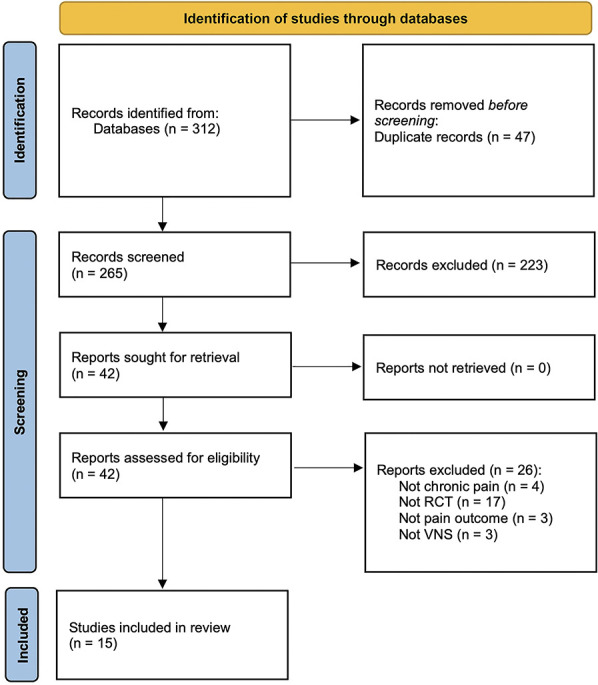
Chronic pain is one of the major causes of disability with a tremendous impact on an individual's quality of life and on public health. Transcutaneous vagus nerve stimulation (tVNS) is a safe therapeutic for this condition. We aimed to evaluate its effects in adults with chronic pain. A comprehensive search was performed, including randomized controlled trials published until October 2023, which assessed the effects of noninvasive tVNS. Cohen's effect size and 95% confidence intervals (CIs) were calculated, and random-effects meta-analyses were performed. Fifteen studies were included. The results revealed a mean effect size of 0.41 (95% CI 0.17-0.66) in favor of tVNS as compared with control, although a significant heterogeneity was observed (χ = 21.7, = 10, = 0.02, = 53.9%). However, when compared with nonactive controls, tVNS shows a larger effect size (0.79, 95% CI 0.25-1.33), although the number of studies was small (n = 3). When analyzed separately, auricular tVNS and cervical tVNS against control, it shows a significant small to moderate effect size, similar to that of the main analysis, respectively, 0.42 (95% CI 0.08-0.76, 8 studies) and 0.36 (95% CI 0.01-0.70, 3 studies). No differences were observed in the number of migraine days for the trials on migraine. This meta-analysis indicates that tVNS shows promise as an effective intervention for managing pain intensity in chronic pain conditions. We discuss the design of future trials to confirm these preliminary results, including sample size and parameters of stimulation.
慢性疼痛是导致残疾的主要原因之一,对个人生活质量和公众健康产生巨大影响。经皮迷走神经刺激(tVNS)是治疗这种疾病的一种安全疗法。我们旨在评估其对慢性疼痛成年人的疗效。进行了全面检索,包括截至2023年10月发表的评估非侵入性tVNS疗效的随机对照试验。计算了科恩效应量和95%置信区间(CI),并进行了随机效应荟萃分析。纳入了15项研究。结果显示,与对照组相比,tVNS的平均效应量为0.41(95%CI 0.17 - 0.66),尽管观察到显著的异质性(χ² = 21.7,df = 10,P = 0.02,I² = 53.9%)。然而,与非活性对照组相比,tVNS显示出更大的效应量(0.79,95%CI 0.25 - 1.33),尽管研究数量较少(n = 3)。分别分析耳穴tVNS和颈部tVNS与对照组的情况时,其效应量分别为0.42(95%CI 0.08 - 0.76,8项研究)和0.36(95%CI 0.01 - 0.70,3项研究),显示出显著的小到中等效应量,与主要分析结果相似。偏头痛试验中偏头痛天数未观察到差异。这项荟萃分析表明,tVNS有望成为管理慢性疼痛状况下疼痛强度的有效干预措施。我们讨论了未来试验的设计,以证实这些初步结果,包括样本量和刺激参数。