Baria Katherine, De Toni Enrico N, Yu Binbing, Jiang Zhuoxin, Kabadi Shaum M, Malvezzi Matteo
Global Medical Affairs, AstraZeneca Pharmaceuticals, Gaithersburg, Maryland.
Department of Internal Medicine II, Ludwig Maximilian University of Munich, München, Germany.
Gastro Hep Adv. 2022 Apr 15;1(4):618-626. doi: 10.1016/j.gastha.2022.04.007. eCollection 2022.
Biliary tract cancer (BTC) consists of a group of hepatic and perihepatic tumors that are in close proximity but are anatomically different, including gallbladder cancer (GBC), cholangiocarcinoma (extrahepatic and intrahepatic [ICC]), and ampulla of Vater cancer (AVC). Most epidemiologic research has focused on 1 or more anatomic subtypes, or does not differentiate BTC from hepatocellular carcinoma or other primary liver cancers. Here, we provide a descriptive update on global incidence and mortality rates for BTC, overall and by anatomic subtypes.
Age-standardized rates (per 100,000 person-years) were derived from the International Agency for Research on Cancer, Cancer Incidence in Five Continents, Volume XI (2008-2012; 22 countries), and the World Health Organization Mortality Database (2006-2016; 38 countries).
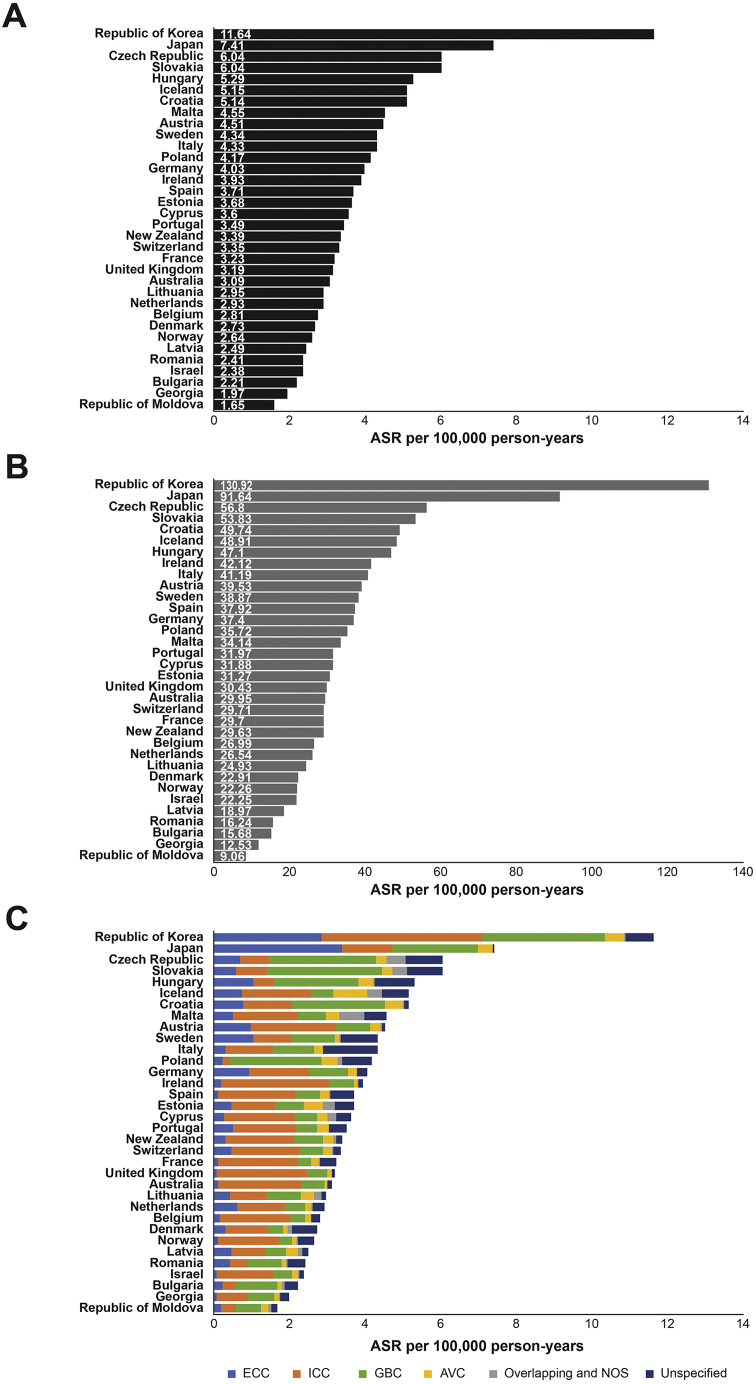
BTC incidence varied by country, with the highest in Chile (14.35) and the lowest in Vietnam (1.25). Mortality rates for BTC were highest for the Republic of Korea (11.64) and lowest for the Republic of Moldova (1.65). BTC mortality rates increased over time in 24 of 34 countries. Patients aged ≥75 years had 5-10 times higher mortality rates than the overall BTC rate in all countries. In most countries, incidence rates were highest for GBC, and mortality rates highest for ICC, while both were lowest for AVC. Females had and died from GBC more frequently than males. For ICC, extrahepatic cholangiocarcinoma, and AVC, males trended toward higher incidence and mortality rates.
The increasing incidence and mortality trends reported here indicate a need for improved prevention and treatment for all BTC subtypes.
胆道癌(BTC)由一组肝内和肝周肿瘤组成,这些肿瘤位置相近但解剖结构不同,包括胆囊癌(GBC)、胆管癌(肝外和肝内胆管癌[ICC])以及 Vater 壶腹癌(AVC)。大多数流行病学研究聚焦于一种或多种解剖学亚型,或者未将 BTC 与肝细胞癌或其他原发性肝癌区分开来。在此,我们提供了 BTC 总体及按解剖学亚型划分的全球发病率和死亡率的描述性最新数据。
年龄标准化发病率(每 10 万人年)源自国际癌症研究机构的《五大洲癌症发病率》第十一卷(2008 - 2012 年;22 个国家)以及世界卫生组织死亡率数据库(2006 - 2016 年;38 个国家)。
BTC 的发病率因国家而异,智利最高(14.35),越南最低(1.25)。BTC 的死亡率韩国最高(11.64),摩尔多瓦共和国最低(1.65)。在 34 个国家中的 24 个国家,BTC 的死亡率随时间增加。在所有国家,年龄≥75 岁的患者死亡率比 BTC 总体死亡率高 5 - 10 倍。在大多数国家,GBC 的发病率最高,ICC 的死亡率最高,而 AVC 的发病率和死亡率均最低。女性患 GBC 并死于该病的频率高于男性。对于 ICC、肝外胆管癌和 AVC,男性的发病率和死亡率有上升趋势。
此处报告的发病率和死亡率上升趋势表明,需要改进所有 BTC 亚型的预防和治疗措施。