• 文献检索
  • 文档翻译
  • 深度研究
  • 学术资讯
  • Suppr Zotero 插件Zotero 插件
  • 邀请有礼
  • 套餐&价格
  • 历史记录
应用&插件
Suppr Zotero 插件Zotero 插件浏览器插件Mac 客户端Windows 客户端微信小程序
定价
高级版会员购买积分包购买API积分包
服务
文献检索文档翻译深度研究API 文档MCP 服务
关于我们
关于 Suppr公司介绍联系我们用户协议隐私条款
关注我们

Suppr 超能文献

核心技术专利:CN118964589B侵权必究
粤ICP备2023148730 号-1Suppr @ 2026

文献检索

告别复杂PubMed语法,用中文像聊天一样搜索,搜遍4000万医学文献。AI智能推荐,让科研检索更轻松。

立即免费搜索

文件翻译

保留排版,准确专业,支持PDF/Word/PPT等文件格式,支持 12+语言互译。

免费翻译文档

深度研究

AI帮你快速写综述,25分钟生成高质量综述,智能提取关键信息,辅助科研写作。

立即免费体验

增强患者对实验室检验结果的理解:呈现格式及其对感知、决策、行动和记忆影响的系统评价。

Enhancing Patient Understanding of Laboratory Test Results: Systematic Review of Presentation Formats and Their Impact on Perception, Decision, Action, and Memory.

机构信息

Department of Family Medicine, Care and Public Health Research Institute, Maastricht University, Maastricht, Netherlands.

Department of Clinical Chemistry, Reinier Medical Diagnostic Center, Delft, Netherlands.

出版信息

J Med Internet Res. 2024 Aug 12;26:e53993. doi: 10.2196/53993.

DOI:10.2196/53993
PMID:39133906
原文链接:https://pmc.ncbi.nlm.nih.gov/articles/PMC11347896/
Abstract

BACKGROUND

Direct access of patients to their web-based patient portal, including laboratory test results, has become increasingly common. Numeric laboratory results can be challenging to interpret for patients, which may lead to anxiety, confusion, and unnecessary doctor consultations. Laboratory results can be presented in different formats, but there is limited evidence regarding how these presentation formats impact patients' processing of the information.

OBJECTIVE

This study aims to synthesize the evidence on effective formats for presenting numeric laboratory test results with a focus on outcomes related to patients' information processing, including affective perception, perceived magnitude, cognitive perception, perception of communication, decision, action, and memory.

METHODS

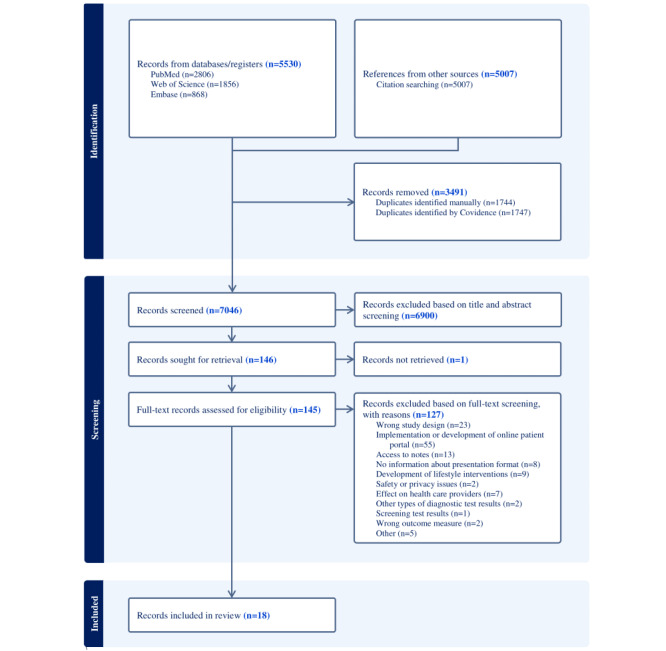
The search was conducted in 3 databases (PubMed, Web of Science, and Embase) from inception until May 31, 2023. We included quantitative, qualitative, and mixed methods articles describing or comparing formats for presenting diagnostic laboratory test results to patients. Two reviewers independently extracted and synthesized the characteristics of the articles and presentation formats used. The quality of the included articles was assessed by 2 independent reviewers using the Mixed Methods Appraisal Tool.

RESULTS

A total of 18 studies were included, which were heterogeneous in terms of study design and primary outcomes used. The quality of the articles ranged from poor to excellent. Most studies (n=16, 89%) used mock test results. The most frequently used presentation formats were numerical values with reference ranges (n=12), horizontal line bars with colored blocks (n=12), or a combination of horizontal line bars with numerical values (n=8). All studies examined perception as an outcome, while action and memory were studied in 1 and 3 articles, respectively. In general, participants' satisfaction and usability were the highest when test results were presented using horizontal line bars with colored blocks. Adding reference ranges or personalized information (eg, goal ranges) further increased participants' perception. Additionally, horizontal line bars significantly decreased participants' tendency to search for information or to contact their physician, compared with numerical values with reference ranges.

CONCLUSIONS

In this review, we synthesized available evidence on effective presentation formats for laboratory test results. The use of horizontal line bars with reference ranges or personalized goal ranges increased participants' cognitive perception and perception of communication while decreasing participants' tendency to contact their physicians. Action and memory were less frequently studied, so no conclusion could be drawn about a single preferred format regarding these outcomes. Therefore, the use of horizontal line bars with reference ranges or personalized goal ranges is recommended to enhance patients' information processing of laboratory test results. Further research should focus on real-life settings and diverse presentation formats in combination with outcomes related to patients' information processing.

摘要

背景

患者直接访问他们的基于网络的患者门户,包括实验室测试结果,已经变得越来越普遍。对于患者来说,数值实验室结果可能难以解释,这可能导致焦虑、困惑和不必要的医生咨询。实验室结果可以以不同的格式呈现,但关于这些呈现格式如何影响患者对信息的处理,证据有限。

目的

本研究旨在综合有效呈现数值实验室测试结果的格式证据,重点关注与患者信息处理相关的结果,包括情感感知、感知大小、认知感知、沟通感知、决策、行动和记忆。

方法

该搜索在 3 个数据库(PubMed、Web of Science 和 Embase)中进行,从成立到 2023 年 5 月 31 日。我们纳入了描述或比较向患者呈现诊断实验室测试结果的格式的定量、定性和混合方法文章。两位审查员独立提取和综合了文章和使用的呈现格式的特征。使用混合方法评估工具对纳入文章的质量进行了两位独立审查员的评估。

结果

共有 18 项研究纳入,研究设计和主要结果使用方面存在异质性。文章的质量从差到优不等。大多数研究(n=16,89%)使用模拟测试结果。最常用的呈现格式是带有参考范围的数值(n=12)、带有彩色块的水平条形图(n=12)或水平条形图与数值的组合(n=8)。所有研究都将感知作为一个结果进行了检验,而行动和记忆分别在 1 项和 3 项研究中进行了检验。一般来说,当使用带有彩色块的水平条形图呈现测试结果时,参与者的满意度和可用性最高。添加参考范围或个性化信息(例如,目标范围)进一步增加了参与者的感知。此外,与带有参考范围的数值相比,水平条形图显著降低了参与者寻找信息或联系医生的倾向。

结论

在本综述中,我们综合了关于实验室测试结果有效呈现格式的现有证据。使用带有参考范围或个性化目标范围的水平条形图增加了参与者的认知感知和沟通感知,同时降低了参与者联系医生的倾向。关于这些结果,行动和记忆的研究较少,因此无法得出单一首选格式的结论。因此,建议使用带有参考范围或个性化目标范围的水平条形图来增强患者对实验室测试结果的信息处理。未来的研究应侧重于现实生活环境和多种呈现格式与与患者信息处理相关的结果相结合。
https://cdn.ncbi.nlm.nih.gov/pmc/blobs/43e6/11347896/5bce70027eca/jmir_v26i1e53993_fig2.jpg
https://cdn.ncbi.nlm.nih.gov/pmc/blobs/43e6/11347896/f25d30985dfd/jmir_v26i1e53993_fig1.jpg
https://cdn.ncbi.nlm.nih.gov/pmc/blobs/43e6/11347896/5bce70027eca/jmir_v26i1e53993_fig2.jpg
https://cdn.ncbi.nlm.nih.gov/pmc/blobs/43e6/11347896/f25d30985dfd/jmir_v26i1e53993_fig1.jpg
https://cdn.ncbi.nlm.nih.gov/pmc/blobs/43e6/11347896/5bce70027eca/jmir_v26i1e53993_fig2.jpg

相似文献

1
Enhancing Patient Understanding of Laboratory Test Results: Systematic Review of Presentation Formats and Their Impact on Perception, Decision, Action, and Memory.增强患者对实验室检验结果的理解:呈现格式及其对感知、决策、行动和记忆影响的系统评价。
J Med Internet Res. 2024 Aug 12;26:e53993. doi: 10.2196/53993.
2
Prescription of Controlled Substances: Benefits and Risks管制药品的处方:益处与风险
3
Interventions to improve safe and effective medicines use by consumers: an overview of systematic reviews.改善消费者安全有效用药的干预措施:系统评价概述
Cochrane Database Syst Rev. 2014 Apr 29;2014(4):CD007768. doi: 10.1002/14651858.CD007768.pub3.
4
Interventions for interpersonal communication about end of life care between health practitioners and affected people.干预健康从业者与受影响者之间关于临终关怀的人际沟通。
Cochrane Database Syst Rev. 2022 Jul 8;7(7):CD013116. doi: 10.1002/14651858.CD013116.pub2.
5
Falls prevention interventions for community-dwelling older adults: systematic review and meta-analysis of benefits, harms, and patient values and preferences.社区居住的老年人跌倒预防干预措施:系统评价和荟萃分析的益处、危害以及患者的价值观和偏好。
Syst Rev. 2024 Nov 26;13(1):289. doi: 10.1186/s13643-024-02681-3.
6
Signs and symptoms to determine if a patient presenting in primary care or hospital outpatient settings has COVID-19.在基层医疗机构或医院门诊环境中,如果患者出现以下症状和体征,可判断其是否患有 COVID-19。
Cochrane Database Syst Rev. 2022 May 20;5(5):CD013665. doi: 10.1002/14651858.CD013665.pub3.
7
Survivor, family and professional experiences of psychosocial interventions for sexual abuse and violence: a qualitative evidence synthesis.性虐待和暴力的心理社会干预的幸存者、家庭和专业人员的经验:定性证据综合。
Cochrane Database Syst Rev. 2022 Oct 4;10(10):CD013648. doi: 10.1002/14651858.CD013648.pub2.
8
Eliciting adverse effects data from participants in clinical trials.从临床试验参与者中获取不良反应数据。
Cochrane Database Syst Rev. 2018 Jan 16;1(1):MR000039. doi: 10.1002/14651858.MR000039.pub2.
9
A rapid and systematic review of the clinical effectiveness and cost-effectiveness of topotecan for ovarian cancer.拓扑替康治疗卵巢癌的临床有效性和成本效益的快速系统评价。
Health Technol Assess. 2001;5(28):1-110. doi: 10.3310/hta5280.
10
Shared decision-making for people with asthma.哮喘患者的共同决策
Cochrane Database Syst Rev. 2017 Oct 3;10(10):CD012330. doi: 10.1002/14651858.CD012330.pub2.

引用本文的文献

1
Perceptions, Experiences, and Beliefs About Patient Portals Among Women With Limited English Proficiency: Multicultural Qualitative Interview Study.英语水平有限的女性对患者门户网站的认知、体验和信念:多元文化定性访谈研究
J Med Internet Res. 2025 Feb 26;27:e60699. doi: 10.2196/60699.
2
Molecular monitoring in CML-a modern example of an old proverb.慢性粒细胞白血病的分子监测——一句古老谚语的现代例证。
Blood Cancer J. 2024 Nov 28;14(1):211. doi: 10.1038/s41408-024-01192-7.
3
The impact of different radiology report formats on patient information processing: a systematic review.

本文引用的文献

1
Potentials and pitfalls of ChatGPT and natural-language artificial intelligence models for the understanding of laboratory medicine test results. An assessment by the European Federation of Clinical Chemistry and Laboratory Medicine (EFLM) Working Group on Artificial Intelligence (WG-AI).ChatGPT 和自然语言人工智能模型在理解检验医学结果方面的潜力和陷阱。欧洲临床化学和检验医学联合会(EFLM)人工智能工作组(WG-AI)的评估。
Clin Chem Lab Med. 2023 Apr 24;61(7):1158-1166. doi: 10.1515/cclm-2023-0355. Print 2023 Jun 27.
2
Taxonomies for synthesizing the evidence on communicating numbers in health: Goals, format, and structure.用于综合健康领域中传达数字证据的分类法:目标、格式和结构。
Risk Anal. 2022 Dec;42(12):2656-2670. doi: 10.1111/risa.13875. Epub 2022 Jan 10.
3
不同放射学报告格式对患者信息处理的影响:一项系统综述
Eur Radiol. 2025 May;35(5):2644-2657. doi: 10.1007/s00330-024-11165-w. Epub 2024 Nov 15.
User-Centered System Design for Communicating Clinical Laboratory Test Results: Design and Evaluation Study.以用户为中心的临床检验结果沟通系统设计:设计与评估研究
JMIR Hum Factors. 2021 Nov 25;8(4):e26017. doi: 10.2196/26017.
4
The PRISMA 2020 statement: an updated guideline for reporting systematic reviews.PRISMA 2020 声明:系统评价报告的更新指南。
BMJ. 2021 Mar 29;372:n71. doi: 10.1136/bmj.n71.
5
Patient Challenges and Needs in Comprehending Laboratory Test Results: Mixed Methods Study.患者理解实验室检查结果的挑战和需求:混合方法研究。
J Med Internet Res. 2020 Dec 7;22(12):e18725. doi: 10.2196/18725.
6
Numbers, graphs and words - do we really understand the lab test results accessible via the patient portals?数字、图表和文字——我们真的理解通过患者门户获取的实验室检测结果吗?
Isr J Health Policy Res. 2020 Oct 28;9(1):58. doi: 10.1186/s13584-020-00415-z.
7
Preference for and understanding of graphs presenting health risk information. The role of age, health literacy, numeracy and graph literacy.偏好和理解呈现健康风险信息的图表。年龄、健康素养、计算能力和图表素养的作用。
Patient Educ Couns. 2021 Jan;104(1):109-117. doi: 10.1016/j.pec.2020.06.031. Epub 2020 Jul 2.
8
Features of a Patient Portal for Blood Test Results and Patient Health Engagement: Web-Based Pre-Post Experiment.患者检验结果和患者健康参与的患者门户的特点:基于网络的预-后实验。
J Med Internet Res. 2020 Jul 20;22(7):e15798. doi: 10.2196/15798.
9
Patients' Attitudes Toward an Online Patient Portal for Communicating Laboratory Test Results: Real-World Study Using the eHealth Impact Questionnaire.患者对用于传达实验室检查结果的在线患者门户的态度:使用电子健康影响问卷的真实世界研究
JMIR Form Res. 2020 Mar 4;4(3):e17060. doi: 10.2196/17060.
10
A Systematic Review of Patient-Facing Visualizations of Personal Health Data.个人健康数据患者可视化的系统评价
Appl Clin Inform. 2019 Aug;10(4):751-770. doi: 10.1055/s-0039-1697592. Epub 2019 Oct 9.